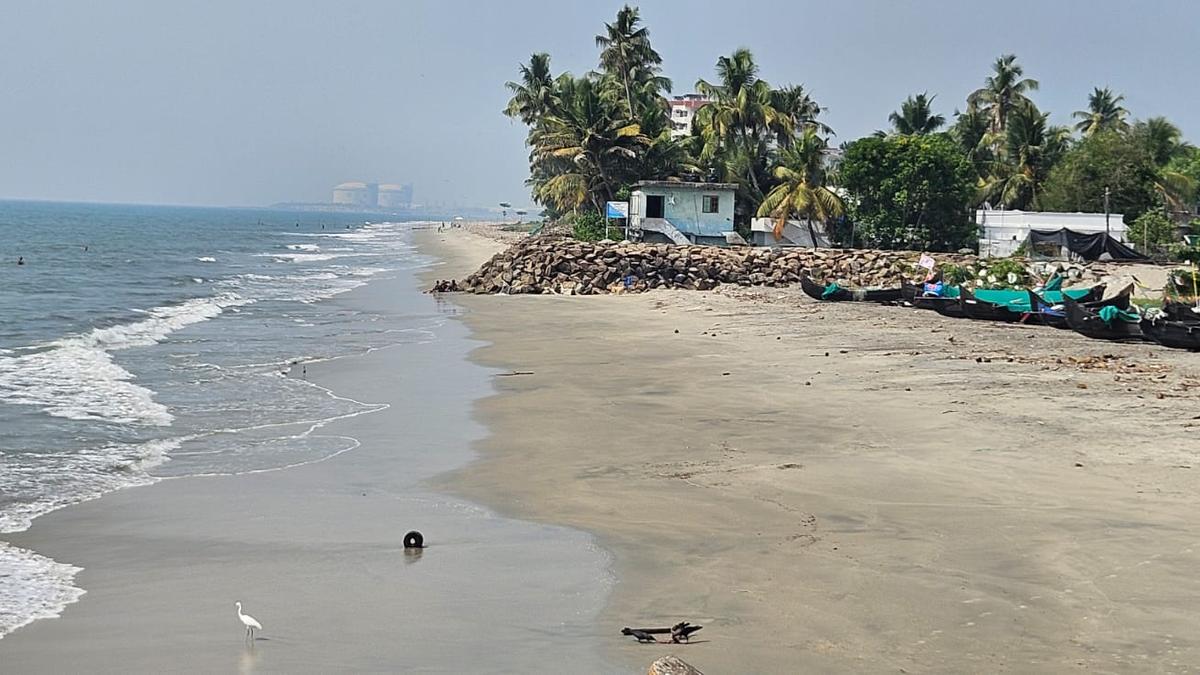
Survey done to assess areas vulnerable to sea incursion on Kannamaly-INS Dronacharya stretch
The Hindu
Volunteers survey vulnerable areas on the Chellanam coast to compile a report for coastal protection measures.
Amid the fear that sea incursion could take a heavy toll on houses on the Chellanam coast during the monsoon, volunteers walked the 9-km distance from Puthen Thodu in Kannamaly to INS Dronacharya, where coastal protection measures are necessary, as part of a survey organised by Chellanam Kochi Janakeeya Vedi to identify vulnerable areas on the coast.
The data gathered thus would be compiled into a report to be taken up before the fora for coastal protection measures beyond the 7.32-km-long stretch in Chellanam where a seawall, tetrapods, and half-a-dozen groynes were readied over the years, it is learnt. The survey team was accompanied by over two dozen volunteers from each unit of the Janakeeya Vedi, an NGO that had been highlighting the plight of fishers and others who resided on the coast, owing to sea incursion.
At many places, it was seen that granite boulders that were placed together to reduce the intensity of the waves had round edges caused by constant movement after high waves lashed the shore. This also eroded the seawall at many places indicating an impending sea incursion. All these areas that needed protection measures were marked as part of the survey that began early in the morning and went on till evening. The survey report would be compiled and finalised the coming week, said V.T. Sebastian, general convenor of the Vedi.
Attributing rising instances of sea incursion to dredging of the shipping channel, the NGO has over the years been citing how it can be prevented by depositing the dredged sludge, now deposited over 20 km away, into the outer sea along the 11-km-long stretch on the Kannamaly-INS Dronacharya stretch where the coast is most vulnerable to sea incursion.
“In addition, groynes must be built at frequent intervals to curb sea erosion and to regain the coast. This apart, tetrapods that are prohibitively costly and also leave a huge carbon footprint in the form of aggregate and manufactured sand that is sourced from the Western Ghats can be totally done away with if geo tubes laid on the coast are filled with sand that is ‘pipe-dredged’ from the sea bed. This process will cost approximately ₹30 crore, while the conventional method of coastal protection using tetrapods could cost around ₹500 crore,” Mr. Sebastian said.
A whopping ₹344 crore had been spent on tetrapod protection of the Chellanam coast. Another advantage of geo tubes were that the sea would deposit sand once washed away from the shore, if they are laid with about 200-metre gaps in between. This has added advantages as well — it would help to mitigate sea erosion and regain the coast, resulting in the formation of an around 20-km-long beach that would bring in tourists who prefer to shun crowded, polluted beaches. It would also increase fish catch on the coastal waters, he added.


Congress criticises Modi government, citing reports about Pakistan's diplomatic role amid U.S.-Iran tensions, labelling it a setback for India.

Folk music with the Barmer Boys that crosses all boundaries

Tamil comic blockbuster Thaai Kizhavi releases on JioHotstar this week, as actress Radikaa Sarathkumar rewrites rules on pay, age, and women in Tamil films

"The jury has difficulty coming to a consensus regarding one defendant, do you have any advice on how to move forward?" the jurors told Judge Carolyn Kuhl

Maharashtra relocates 25 leopards to Gujarat's Vantara facility amid rising leopard and tiger populations, says Forest Minister Naik.

Assembly polls 2026: Follow updates from The Hindu on the upcoming elections in five States on March 24, 2026

Delhi's per capita income is projected to grow 7.09% by 2025-26, highlighting the city's economic progress and infrastructure challenges.

Review meeting held in Dharmapuri with election observers and nodal officers to discuss upcoming Assembly elections.

Execution of development projects, infrastructure augmentation to occupy centre stage in electioneering

Telangana Cabinet approves Hate Speech and Parents Support Bills, ensuring accountability for neglecting elderly and curbing hate-driven offences.

EU and Australia finalize a free trade agreement and establish a new defense partnership to enhance economic and military cooperation.

U.S.-Israeli war on Iran LIVE: Iran faces deadline of US President Donald Trump warning to open Strait of Hormuz. Follow The Hindu for more LIVE updates on March 23 2026 on Iran-Israel war.

KPCC chief Sunny Joseph emphasizes UDF's focus on Sabarimala and corruption while expressing confidence in winning Kerala's upcoming Assembly elections.