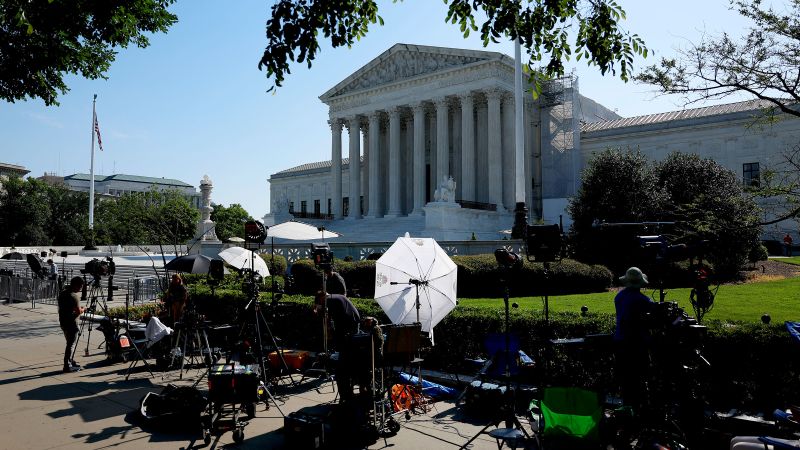
Supreme Court won’t take up Georgia dispute over ‘at-large’ elections and minority vote dilution
CNN
The Supreme Court won’t take up a case challenging Georgia’s system for electing its public utility board, in a defeat for Black voters who argued that the so-called “at-large” electoral system diluted their votes.
The Supreme Court won’t take up a case challenging Georgia’s system for electing its public utility board in a defeat for Black voters who argued the so-called “at-large” electoral system diluted their votes. The justices’ refusal to get involved will potentially make it much harder for challenges to such at-large systems of voting – that challengers call a “relic of Jim Crow” – to move forward in three states in the South. The five members of Georgia’s Public Service Commission are each elected in staggered, statewide votes – a system that a federal judge said violated the Voting Rights Act. That ruling was then reversed by the 11th US Circuit Court of Appeals, prompting the Black voters’ appeal to the Supreme Court. In declining to take up the case Monday, the Supreme Court did not say anything on the merits of the arguments. However, the move leaves standing an 11th Circuit precedent that could affect other Voting Rights Act lawsuits brought in Florida, Georgia and Alabama, the three states the circuit covers. The 11th Circuit concluded that the Black voters’ challenge failed because they did not put forward a remedy to cure the alleged vote dilution that would maintain the at-large system the state had chosen for the commission. In their request, the voters noted that, if allowed to stand, the 11th Circuit precedent would make it more difficult, if not impossible, for other Voting Rights Act challenges to be brought against at-large election schemes, including challenges to local entities – like school boards – that use that method of election.


Cuba is working to restore the electricity supply after another island-wide blackout left more than 10 million people without power.

President Donald Trump said Sunday border czar Tom Homan will be in charge of deploying Immigration and Customs Enforcement agents to airports on Monday, with Homan telling CNN the agents will help with security at entrances and exits to ease the Transportation Security Administration’s workload.

Donald Trump wants us to believe that a deal with Cuba is close at hand. After this past week, I am not so sure.

President Donald Trump has said ICE agents will head to US airports tomorrow amid a partial government shutdown. Follow for live updates

President Donald Trump said Sunday border czar Tom Homan will be in charge of deploying Immigration and Customs Enforcement agents to airports on Monday, with Homan telling CNN the agents will assist with security at entrances and exits to ease TSA workload amid a partial government shutdown.

Janet Mills and her allies are counting on a gender gap to narrow Platner’s wide lead ahead of the June 9 primary to decide who will face incumbent Republican Sen. Susan Collins. They are betting that the unfiltered style that has brought Platner widespread attention as someone who could help Democrats reach young men will backfire with women.

Why do people “pledge allegiance” to a “state” that is no longer a state? And what spurs someone to not just attack innocent people, but to then make a statement of loyalty while doing so?

A Supreme Court case examining state deadlines for election ballots sent in the mail is just the tip of the spear in President Donald Trump’s war on mail-in voting.

As a shrinking number of Transportation Security Administration agents work to keep hourslong security lines moving despite not being paid, President Donald Trump stepped into the fray Saturday, announcing he will send Immigration and Customs Enforcement officers to airports by Monday if Congress doesn’t agree to a plan to end the partial government shutdown.

Donald Trump wants us to believe that a deal with Cuba is close at hand. After this past week, I am not so sure.

The search for missing 84-year-old Nancy Guthrie, mother of “Today” show host Savannah Guthrie, has stretched into another anguished week, with mounting pressure on investigators and a family grappling with uncertainty.

Cuba’s Ministry of Energy announced Saturday evening that entire island has suffered another electrical blackout, leaving more than 10 million people without power.

Iran’s attempt to strike a US-UK base over 2,000 miles (over 3,000 kilometers) off its coast has renewed questions about Tehran’s military capabilities and how far its missiles can reach.