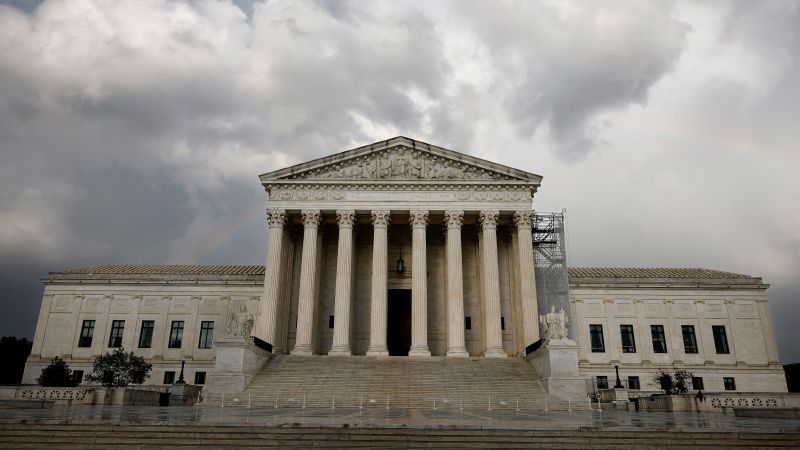
Supreme Court’s ‘shadow docket’ surges with decisions looming on student loans, elections, abortion and climate
CNN
Less than a month ago, Justice Elena Kagan had suggested the Supreme Court consider dialing back its review of significant cases on its controversial emergency docket.
Less than a month ago, Justice Elena Kagan suggested the Supreme Court consider dialing back its review of significant cases on its controversial emergency docket. “Our summers used to be actually summers,” Kagan told a group of judges in California, lamenting the “relentless” filing of emergency appeals. “We’ve gotten into a pattern where we’re doing too many of them.” Since then, the Supreme Court’s emergency caseload has exploded. In coming days, the high court is expected to tackle short-fuse challenges to President Joe Biden’s latest effort to reduce student debt and to cut planet-warming pollution by limiting power plant emissions. And the court must decide whether Arizona, a presidential battleground, may require thousands of people to prove their US citizenship before voting this year. Also pending is a fight over Biden’s requirement that family planning clinics that receive federal public health funding provide referrals for abortions for patients who request it. The court’s emergency docket – the “shadow docket,” to critics – is where the justices deal with questions that need resolution faster than the months it can take to submit briefs, hear oral arguments and draft formal opinions on its regular docket.The cases usually deal with the narrow question of what will happen as that underlying legal process plays out. But the orders can have significant and immediate real-world consequences. “There’s just no disputing that this has been a busier summer for emergency applications, both by volume and by significance, than any summer we’ve seen in a long time – if ever,” said Steve Vladeck, a CNN Supreme Court analyst and professor at the Georgetown University Law Center, who says the court is essentially inviting these cases by issuing emergency rulings with more impact.


President Donald Trump has said ICE agents will head to US airports tomorrow amid a partial government shutdown. Follow for live updates

Cuba is working to restore the electricity supply after another island-wide blackout left more than 10 million people without power.

President Donald Trump said Sunday border czar Tom Homan will be in charge of deploying Immigration and Customs Enforcement agents to airports on Monday, with Homan telling CNN the agents will help with security at entrances and exits to ease the Transportation Security Administration’s workload.

Donald Trump wants us to believe that a deal with Cuba is close at hand. After this past week, I am not so sure.

President Donald Trump has said ICE agents will head to US airports tomorrow amid a partial government shutdown. Follow for live updates

President Donald Trump said Sunday border czar Tom Homan will be in charge of deploying Immigration and Customs Enforcement agents to airports on Monday, with Homan telling CNN the agents will assist with security at entrances and exits to ease TSA workload amid a partial government shutdown.

Janet Mills and her allies are counting on a gender gap to narrow Platner’s wide lead ahead of the June 9 primary to decide who will face incumbent Republican Sen. Susan Collins. They are betting that the unfiltered style that has brought Platner widespread attention as someone who could help Democrats reach young men will backfire with women.

Why do people “pledge allegiance” to a “state” that is no longer a state? And what spurs someone to not just attack innocent people, but to then make a statement of loyalty while doing so?

A Supreme Court case examining state deadlines for election ballots sent in the mail is just the tip of the spear in President Donald Trump’s war on mail-in voting.

As a shrinking number of Transportation Security Administration agents work to keep hourslong security lines moving despite not being paid, President Donald Trump stepped into the fray Saturday, announcing he will send Immigration and Customs Enforcement officers to airports by Monday if Congress doesn’t agree to a plan to end the partial government shutdown.

Donald Trump wants us to believe that a deal with Cuba is close at hand. After this past week, I am not so sure.

The search for missing 84-year-old Nancy Guthrie, mother of “Today” show host Savannah Guthrie, has stretched into another anguished week, with mounting pressure on investigators and a family grappling with uncertainty.

Cuba’s Ministry of Energy announced Saturday evening that entire island has suffered another electrical blackout, leaving more than 10 million people without power.