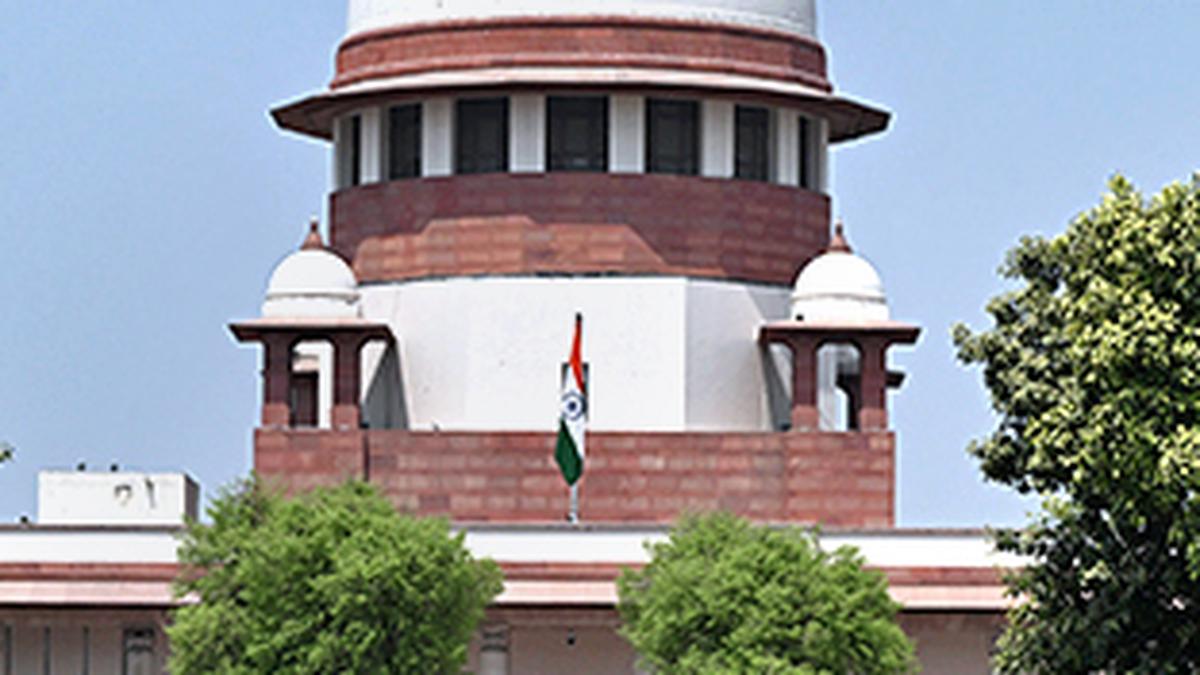
Supreme Court’s pendency crosses 82,000 despite full force of 34 judges most of the time in past two years
The Hindu
Supreme Court under Chief Justice Chandrachud minimizes vacancies, but faces record high backlog of over 82,000 cases.
Ever since the appointment of Chief Justice of India D.Y. Chandrachud as the top judge on November 9, 2022, the Supreme Court has managed to keep its judicial vacancies to the minimum.
Except for a brief delay between December 13, 2022 and January 31, 2023, appointment of judges to the top court has proceeded relatively smoothly. For the most part of 2023 and the current year, the court has functioned with its full sanctioned strength of 34 judges.
Also read: What are the Constitution Bench verdicts expected in the second half of 2024? | Explained
Yet, the National Judicial Data Grid figures on August 31 show a record high of 82,887 pending cases. Chief Justice Chandrachud had inherited a backlog of 69,647 cases in November 2022 when he took over as the top judge. The pendency by the end of 2023 was a little over 80,000 cases.
The unceasing increase in backlog over the past two years raises the question whether a solution to pendency lies beyond maintaining the full sanctioned judicial strength of 34 judges.
Several resolutions of the Supreme Court Collegium led by Chief Justice Chandrachud in the past two years have explicitly voiced concern about the “huge workload”.
For example, a November 2023 resolution points out that the “Supreme Court has a huge backlog of cases”.


NCSC reviews the reservation policy at Kalpakkam's atomic energy units, ensuring effective implementation and addressing concerns with officials.

Shivamogga Deputy Commissioner Prabhulinga Kavalikatti stated that the philosophy of the 12th-century Vachanas has served as a daily guiding principle in his role as an officer.

CM Siddaramaiah says he presented the State Budget at an "auspicious" time, owing to pressure from family and officials.

India's first open-source psychiatric disorders database, CALM-Brain, launched in Bengaluru, aims to enhance understanding and treatment of mental health issues.

Political parties in Tamil Nadu ramp up their election strategies in high-tech war rooms, focusing on youth engagement and real-time responses.

‘Follower’ dives into the heated border dispute between Karnataka and Maharashtra in Belagavi while tackling the messy world of social media and its impact on friendships

India's NavIC satellite system faces setbacks, limiting its security capabilities amid concerns of reliance on foreign navigation systems

Harish Rana's last rites held, family donates his organs

Telangana's Rythu Bandhu budget allocation for FY 2026-27 is expected to decline, affecting agricultural support for farmers.

In Surendranagar, Gujarat, where only a handful of families continue to practise tangaliya weaving, we visit artisanal communities working with brands like Jaypore to revive the intricate craft for contemporary wardrobes

Madras High Court allows police to arrest YouTuber 'Savukku' Shankar if needed, dismissing claims of solitary confinement.

Lula leads Brazil's largest-ever business delegation to India, aiming for trade deals and global governance reforms amidst geopolitical challenges.

AIADMK reveals its first candidate list for Tamil Nadu Assembly election, featuring familiar names and few surprises.