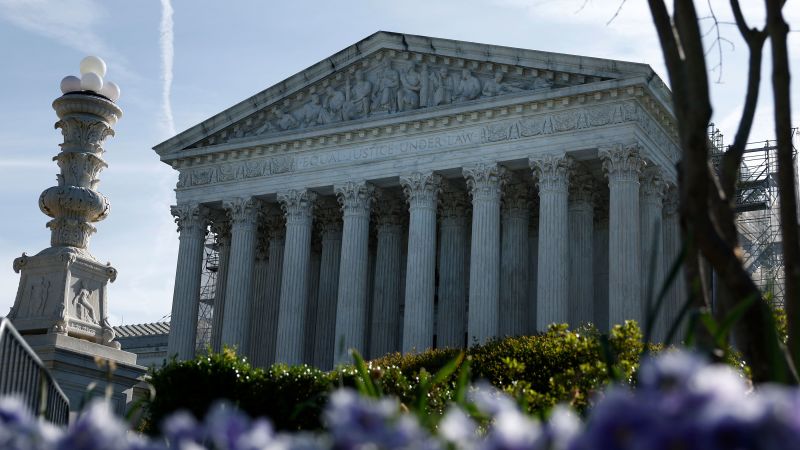
Supreme Court halts Biden’s ‘good neighbor’ plan to curb smog
CNN
The Supreme Court on Thursday upended a Biden administration effort to reduce smog and air pollution wafting across state lines in the latest decision from the high court that undermined the federal government’s power to protect the environment.
The Supreme Court on Thursday upended a Biden administration effort to reduce smog and air pollution wafting across state lines in the latest decision from the high court that undermined the federal government’s power to protect the environment. The decision is a win for the Republican-led states and industry groups that challenged the Environmental Protection Agency’s “good neighbor” plan, which imposed strict emission limits on power plants and industrial sources in upwind states to reduce pollution for their counterparts downwind. While the Supreme Court’s decision on Thursday to grant a stay technically doesn’t completely scuttle the plan, it places implementation of the Biden program on hold through what will be a complicated legal fight that will almost uncertainly continue past the November election and into next year – and possibly another presidential administration. Justice Neil Gorsuch wrote the opinion for a 5-4 majority. Justice Amy Coney Barrett wrote a dissent, joined by the three liberal justices, that said the court was intervening too quickly without seeing the full development of the case’s record in lower court proceedings. “Our emergency docket requires us to evaluate quickly the merits of applications without the benefit of full briefing and reasoned lower court opinions,” Barrett wrote. “Given those limitations, we should proceed all the more cautiously in cases like this one with voluminous, technical records and thorny legal questions.” Barrett’s dissent from the rest of the conservative wing is notable. During oral arguments for the case, she and the three liberal justices had questioned whether the Supreme Court should grant the request to halt the plan given that lower courts have barely reviewed the underlying legal dispute involved.


For over a month, Transportation Security Administration employees have been showing up to work at US airports without getting paid.

CNN’s 5 Things AM brings you the news you need to know every morning.

Both President Donald Trump and first lady Melania Trump have encouraged Susie Wiles to take the time she needs away from the White House to deal with her treatment, but Wiles argued she does not plan to do so, people familiar said.

A transparency law passed by Congress has forced the release of more Epstein files than ever before, but some lawmakers and victims are exploring ways to push the Justice Department to disclose even more information from the voluminous trove that’s being withheld.

Former US National Counterterrorism Center Director Joe Kent sat Wednesday for an extensive interview with former Fox News host and right-wing podcaster Tucker Carlson, his first public comments since he resigned from his post, citing concerns about the war with Iran.

When Attorney General Pam Bondi and Deputy Attorney General Todd Blanche arrived on Capitol Hill Wednesday afternoon, they hoped to boost members’ confidence on their handling of the Jeffrey Epstein investigation. Within half an hour, Democratic lawmakers had walked out.

Cuba is going dark under US pressure. How the crisis unfolded and why its troubles are far from over
Almost three months after the US effectively imposed an oil blockade on Cuba that worsened its energy crunch, nearly every aspect of Cuban society has been feeling the strain.

The Department of Homeland Security has been ensnared by a partial government shutdown as Congress did not act to fund the agency by the end of Friday. But nearly all DHS workers will remain on the job — even if many won’t get paid until the lapse ends — and the public probably won’t notice much of a change.

The USS Gerald R. Ford aircraft carrier is moving away from operations tied to the Iran war and sailing to the US Navy’s base in Crete for repairs after a fire broke out in the ship’s laundry area last week, a US official said.

An American college student visiting friends for spring break has gone missing in Spain, his family said, adding police have his phone.

A typically friendly setting for one of their own turned tense on Capitol Hill Wednesday with senators grilling Markwayne Mullin for roughly three hours as he vies to become President Donald Trump’s next Department of Homeland Security chief.

Top Trump administration officials testified publicly Wednesday for the first time since the launch of the Iran war three weeks ago.

The White House is temporarily lifting key limits on the shipping of oil, gas and other commodities throughout the US, in its latest effort to counter rising energy prices sparked by its war with Iran.