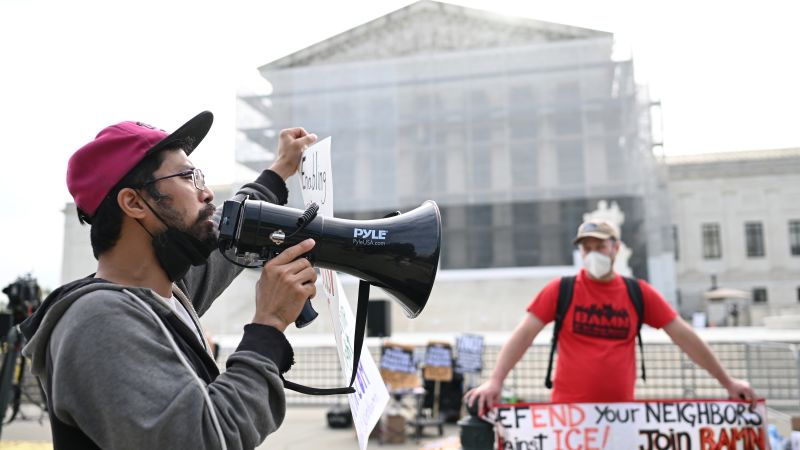
Supreme Court enters final stretch of term poised to decide cases on birthright citizenship, transgender care and religion
CNN
The Supreme Court is turning to the final weeks of a busy term that started off with blockbuster appeals over transgender rights and TikTok but that has increasingly become wrapped up in the policies and politics of President Donald Trump.
The Supreme Court is turning to the final weeks of a busy term that started off with blockbuster appeals over transgender rights and TikTok but that has increasingly become wrapped up in the policies and politics of President Donald Trump. With more than half of its argued cases from the term that began in October still pending, the justices are now working toward issuing a flurry of opinions through the end of June that could have profound implications for the federal government, religious interest groups and millions of American people. The 6-3 conservative court’s end-of-term push has been complicated and overshadowed this year by more than a dozen emergency appeals tied to Trump’s second term, including cases dealing with mass firings, immigration and the president’s efforts to end birthright citizenship. Those cases will continue even after the court rises for its summer break. Here are some of the most important outstanding appeals: The first argued appeal involving Trump’s second term has quickly emerged as one of the most significant cases the justices may decide in coming weeks. The Justice Department claims that three lower courts vastly overstepped their authority by imposing nationwide injunctions that blocked the president from enforcing his order limiting birthright citizenship. Whatever the justices say about the power of courts to halt a president’s executive order on a nationwide basis could have an impact beyond birthright citizenship. Trump has, for months, vociferously complained about courts pausing dozens of his policies with nationwide injunctions.


The Supreme Court on Tuesday will consider the legality of a policy championed by President Donald Trump during his first term that prevented scores of migrants arriving at the southern border from starting the process of applying for asylum.

A young, well-liked facilities manager at the Kennedy Center has gone from being described as “in charge of HVAC and toilets” to head of the renowned arts institution.

Democrats in Florida are hoping to capitalize on the party’s recent special election overperformances and come out on top Tuesday in a special state House election for a Palm Beach district that includes President Donald Trump’s Mar-a-Lago residence.

The Supreme Court on Monday appeared ready to limit mail-in ballots, a move that would reinforce the justices’ pattern of shrinking voter protections and that has, at bottom, favored Republican interests and the Trump administration.

An Air Canada plane traveling from Montreal collided with an emergency vehicle on the runway at New York City’s LaGuardia Airport in the late hours of Sunday night, killing two pilots and injuring dozens of people.

Top Senate Republicans on Capitol Hill believe their party is unified behind a plan to reopen the Department of Homeland Security. Now, they need to sell the plan to Democrats.

Markwayne Mullin will serve as Donald Trump’s next Department of Homeland Security secretary, elevating the US senator to helm the agency at the center of the president’s controversial immigration enforcement effort and an ongoing shutdown.

President Donald Trump’s sudden turnabout and, according to him, rapidly advancing peace talks made for an abrupt shift in the administration’s approach to the Iran war.

The Supreme Court’s conservative majority appeared dubious of state laws that allow the counting of mail ballots that arrive at election offices after Election Day as justices heard oral arguments in a challenge to Mississippi’s five-day grace period for mail ballots.

The chief district judge in New Jersey appointed Robert Frazer, a career prosecutor, to serve as US attorney for the state, ending for now a dispute over the legality of the office’s leadership that threatened to derail criminal investigations.

Tens of thousands of taxpayer dollars were spent on expenses for hair and makeup artists and a horse for the advertisement showcasing outgoing Department of Homeland Security Secretary Kristi Noem in front of Mount Rushmore, according to invoices seen by CNN.

President Donald Trump was presented Sunday with a potential off-ramp to the more than month-long Department of Homeland Security shutdown: fund every part of the department except enforcement operations by Immigration and Customs Enforcement, two sources familiar with the conversations told CNN.

Immigration and Customs Enforcement agents are heading to 13 airports today to help with crowd management as travelers at some airports wait in hours-long security lines amid the DHS shutdown. Follow here for the latest.