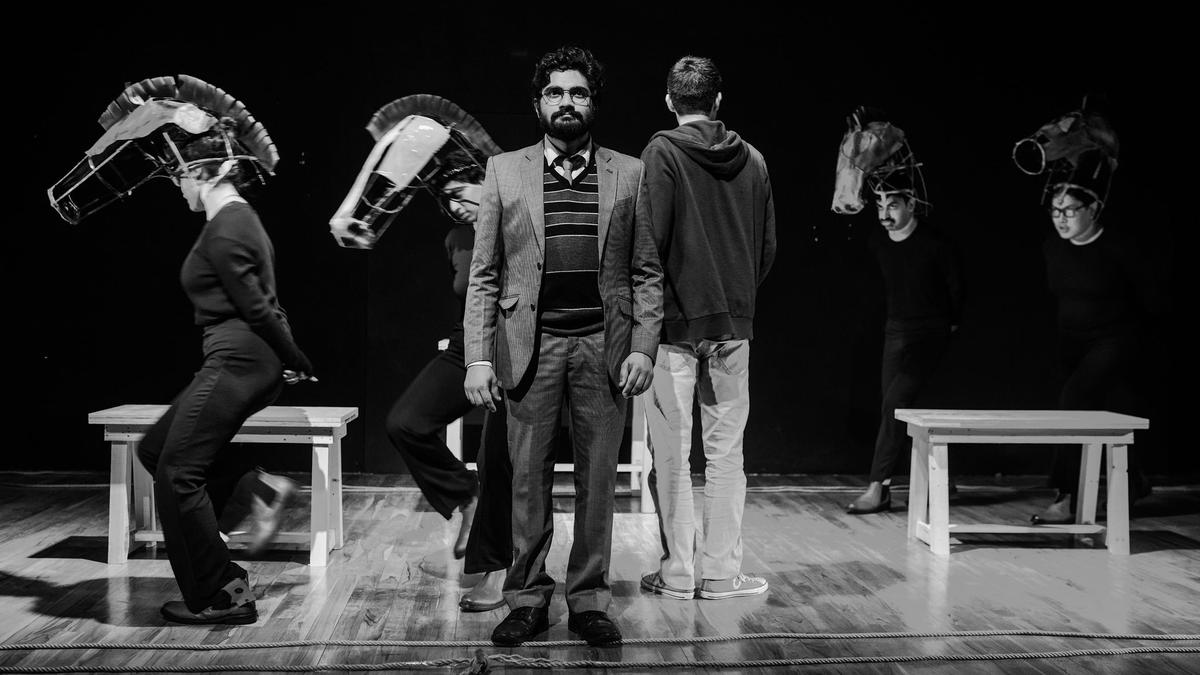
Sukrit Mahajan reimagines Peter Shaffer’s Equus in Bengaluru theatre
The Hindu
With shadow theatre and Jungian psychology, Equus restages Peter Shaffer’s classic for Bengaluru audiences, exploring the human psyche
Why should art delve into the murky, uncomfortable corners of the human psyche? According to Sukrit Mahajan, the director of Equus (reimagined by Playhouse Production), theatre is not just about entertainment — it’s about holding a mirror to the deepest parts of ourselves, even those we’d rather keep hidden.
Few plays embody this philosophy as profoundly as Peter Shaffer’s Equus, a searing psychological drama that lays bare the entangled forces of obsession, shame, and desire. First staged in 1973, Equus tells the story of Alan Strang, a teenager whose inexplicable act of violence — blinding six horses — sets the stage for an exploration of faith, repression, and the fragility of the human mind. Now, Sukrit brings this Tony-winning classic to Indian audiences, using shadow theatre and a profoundly personal lens to illuminate the shadows within.
“The first play I ever acted in was Equus,” Sukrit recalls, reflecting on his college days. “It changed the trajectory of my life and career. Revisiting it as my debut production with Playhouse Productions felt like coming full circle.”
This deeply personal connection, paired with Sukrit’s training at Drama School Mumbai, infuses his adaptation with fresh interpretations. Drawing inspiration from Carl Jung’s theory of the ‘shadow self,’ Sukrit examines the repressed parts of the psyche — those hidden, shameful truths we suppress even from ourselves. “Every character in Equus has a shadow self,” Sukrit explains, “It’s not just Alan or his psychiatrist Dr Martin Dysart. That’s what makes the play universal and deeply human.”
To bring this to life, Sukrit employs shadow theatre, a visual metaphor for the characters’ concealed desires and fears. Long curtains transform into screens where actors’ shadows loom larger than life, blurring the line between what is hidden and what is revealed. “Whenever a character’s shadow self is explored, it’s staged in the shadows, emphasising its intangible yet omnipresent nature,” says Sukrit.
This innovative staging (also the USP of this restaging of Equus is paired with a haunting soundscape of church organs, evoking the play’s themes of faith and fervour. “The music was a deliberate choice,” Sukrit notes, “Given the play’s ties to religion and Christianity, the church organ felt like the perfect auditory metaphor.”
While Equus is a towering work in global theatre — having featured stars like Anthony Hopkins and Daniel Radcliffe in past productions — Sukrit was unburdened by its legacy. “I never felt pressured to match prior productions,” he says. “For me, the goal was to create something thought-provoking, engaging, and true to the script.”


Environmental activist Bolisetty Satyanarayana urges urgent action to protect Kolleru Lake from ecological degradation and illegal aquaculture.

A 27-year-old man was murdered in east Bengaluru, with police suspecting a financial dispute as the motive.

A survey reveals a drastic decline in Thiruvananthapuram's house sparrow population, prompting calls for urgent conservation efforts.

AIADMK announces candidates A. Anbalagan and A. Gandhi for Puducherry Assembly elections in Oupalam and Orleanpeth constituencies.

Shorts News: Landslide hits Mandi after rain, nine houses evacuated

Three men arrested in Delhi for hoarding 74 LPG cylinders, facing charges under the Essential Commodities Act.

Bengaluru police summon Muthappa Rai's son, Ricky Rai, after a Lamborghini was caught performing dangerous stunts, raising public safety concerns.

LPG cargo ship from the US arrives at New Mangalore Port as charges waived amid West Asia conflict concerns.

Modi convenes ministerial meeting to address energy supply challenges amid West Asia conflict and ensure stable logistics nationwide.

CPI(M) negotiates with DMK over seat allocation for Tamil Nadu Assembly elections, aiming for six seats amid alliance talks.

Join our webinar to explore the necessity and impact of foreign universities establishing campuses in India.

PM Modi praises Bihar's rich culture and history in a heartfelt letter to CM Nitish Kumar on Bihar Diwas.

Former Minister Semmalai urges parties to limit freebies and prioritize development for Tamil Nadu's future prosperity.