Study of the Saurashtra Basin dates the minerals found in sediments revealing geological history of Indian subcontinent
The Hindu
IIT Bombay researchers study Saurashtra Basin sediments, revealing ancient supercontinent configurations and continental movement insights.
A compelling historical study of the Saurashtra Basin’s sediments by a team of researchers from the Indian Institute of Technology Bombay (IIT Bombay) and National Centre for Earth Science Studies, Thiruvananthapuram is piecing together the region’s paleogeography, that reveals ancient supercontinent configurations, providing insights into how continents were formed and have moved over time.
Located in the Western India, spanning western Gujarat and the north of Mumbai coastline, Saurashtra Basin expanses in 2,40,000 square km area spanning sea and land. Much of the landscape here remains buried in volcanic rocks called Deccan Traps, created by volcanic eruptions at the Western Ghats during the Cretaceous period, 66 million years ago. However, the sediment beneath the volcanic ash and rocks hides the extraordinary journey of the Indian subcontinent over the millennia.
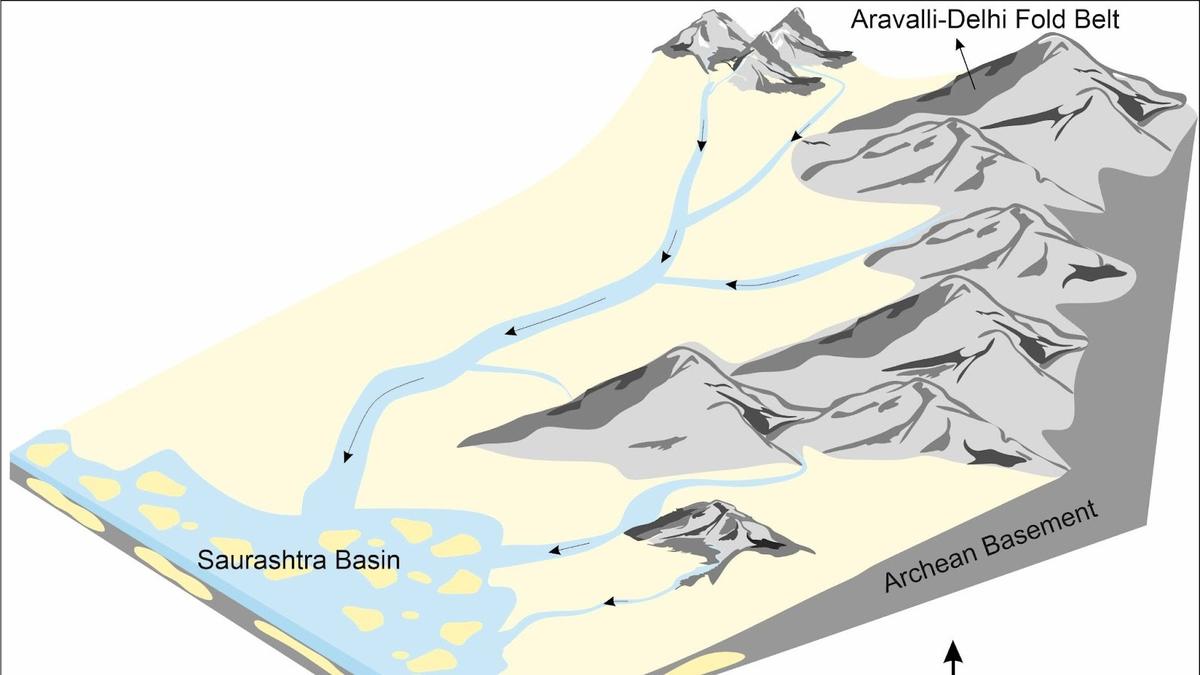
Explaining the formation of the region, Dr. Pawan Kumar Rajak from the Department of Earth Sciences, IIT Bombay and the lead author of the study said that the Saurashtra Basin was formed by the separation of India from Madagascar about 100 million years ago. “Before the separation, India, Madagascar, and the Seychelles were joined together. After the separation, the western margin of India became lowlands, while the north and north-eastern parts of the study area acted as highlands,” Mr. Rajak said.
Rivers flowing from the highlands of the north and eastern regions of the subcontinent brought along with them the sediments from these regions, depositing them in the low-lying Saurashtra Basin. “The eruption of Deccan volcanism, which happened later, covered a vast area of the Saurashtra Basin, making it difficult to study the sediments. Today, only the mountains, hills, river sections and road-cuts expose the sediments of that time,” Mr. Rajak said.
The study focuses on the ‘Mesozoic’ era sandstones in the Saurashtra Basin. The Mesozoic era, known as the age of the dinosaurs, spans from about 252 to 66 million years ago. By examining the mineral content and employing cutting-edge dating techniques on these sandstones, the study pieces together the source and routes of the materials leading to their current location in the basin. The team used two techniques: electron probe microanalysis (EPMA) and laser ablation-inductively coupled plasma-mass spectrometry (LA-ICP-MS).
Explaining the usages of these techniques, Mr. Rajak said, “The high precision and low detection limits of LA-ICP-MS allow us to know the minerals’ composition and ages on a small scale. The EPMA can determine the composition of minerals as well as the Uranium-Thorium (U-Th) age of a mineral, such as monazite, and helps identify the possible sources.”
The team focused on zircon and monazite; minerals known for preserving geological data remarkably well. “Both are rare earth elements-bearing minerals and contain a significant amount of U and Th in their crystal lattice. Decaying U or Th into lead (Pb) is used as a geological clock. So, studying these minerals helps us gain information about important geological events in the past,” Mr. Rajak explained.


Supreme Court criticises Haryana Police for mishandling a four-year-old rape case, mandates swift action and oversight with a Special Investigation Team.

On World Theatre Day 2026, artists in Hyderabad call for affordable venues as rising costs and infrastructure gaps challenge the city’s theatre ecosystem.

Madhapur police seize 31 illegally transported commercial gas cylinders, ensuring public safety and compliance with regulatory norms.

Punjab AAP MLA Harmeet Singh Pathanmajra arrested in Gwalior after evading police in a rape case for over six months.

Bose Krishnamachari resigned from the Kochi Biennale Foundation amid sexual harassment allegations, confirmed by the foundation's chairperson.

Apple Maps, an app that comes bundled on hundreds of millions of iPhones and other devices each year, will display paid advertising on top of existing organic search results

From the universe’s many wondorous objects to a fascinating pattern of numbers, and whether AI can possess superhuman strength, Science At The Sabha will have fascinating talks for participants of all ages

A Sikh organisation has lodged a complaint against the makers of the film alleging that the movie’s promotional material has hurt the religious sentiments of the Sikh community

Speculation over Congress' Chief Ministerial candidate in Kerala persists despite party leaders' attempts to quell the discussions ahead of elections.

A fake dentist operating illegal clinic in Hyderabad's Old Neredmet has been arrested for endangering public health.

Explore the concept of Force Majeure and its implications amid ongoing geopolitical conflicts affecting global gas exports.

Malavika Sarukkai’s latest production Beeja explores humanity, Nature and healing through the language of dance.

Hindustani expert N Rajam and Mandolin Rajesh are among the National Awardees of the Sree Ramaseva Mandali’s Chamarajpet Ramanavami this year