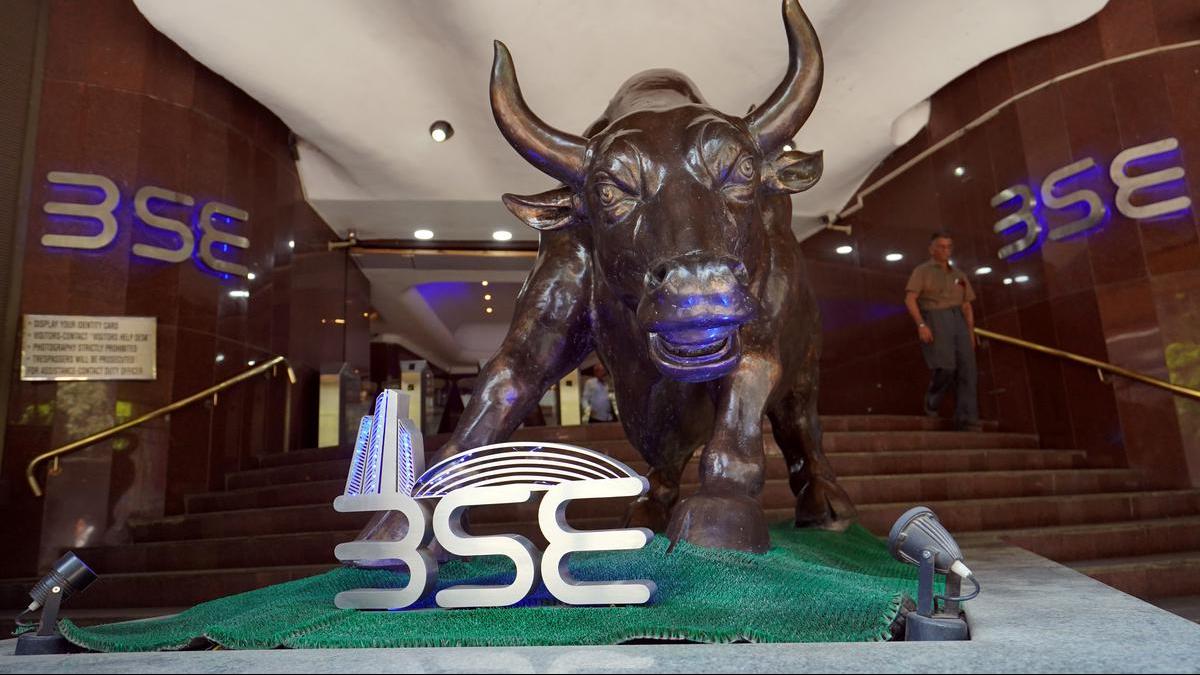
Stock markets fall in early trade on weak global trends
The Hindu
Equity benchmark indices began the trade on a weak note on May 24 following a bearish trend in the global markets as investors preferred to remain on the sidelines ahead of the release of the U.S. Federal Open Market Committee (FOMC) meeting minutes.
Equity benchmark indices began the trade on a weak note on May 24 following a bearish trend in the global markets as investors preferred to remain on the sidelines ahead of the release of the U.S. Federal Open Market Committee (FOMC) meeting minutes.
Halting a three-day rally, the 30-share BSE Sensex fell 251.26 points to 61,730.53. The NSE Nifty declined 78.3 points to 18,269.70.
Among the Sensex firms, ICICI Bank, HDFC Bank, HDFC, Mahindra & Mahindra, Bajaj Finserv, UltraTech Cement, Asian Paints and Tata Motors were the major laggards. Power Grid, Kotak Mahindra Bank, Maruti Suzuki India, Tech Mahindra, ITC and NTPC were among the winners.
In Asian markets, Seoul, Tokyo, Shanghai and Hong Kong were trading lower. The U.S. market ended in the negative territory on May 23. Market participants are waiting for the release of the FOMC meeting minutes, scheduled for Wednesday.
Meanwhile, global oil benchmark Brent crude climbed 0.91% to $77.54 a barrel. Foreign Institutional Investors (FIIs) were buyers on Tuesday as they bought equities worth ₹182.51 crore, according to exchange data.
The BSE benchmark settled at 61,981.79, a marginal gain of 18.11 points or 0.03% on Tuesday. The Nifty went up by 33.60 points or 0.18% to end at 18,348.
"The U.S. debt ceiling impasse continues to affect markets. Since failure to reach a resolution will have catastrophic consequences for the global economy and markets, a resolution of the crisis at the eleventh hour is the most likely scenario. But markets will be on tenterhooks till then," said V. K. Vijayakumar, Chief Investment Strategist at Geojit Financial Services.


L&T confirms 95% of its West Asia project sites are safe, while addressing logistics challenges amid ongoing regional conflicts.

Mines Ministry to auction 19 critical mineral blocks on March 23, expanding strategic resources for clean energy and technology sectors.

Mines Ministry to auction 19 critical mineral blocks on March 23, expanding strategic resources for clean energy and technology sectors.

Five top firms lose ₹1 lakh crore in market value, with HDFC Bank experiencing the largest decline of ₹56,124.48 crore.

HDFC Bank terminates three senior officials over client onboarding issues at its DIFC branch amid ethical concerns following chairman's resignation.

Air India CEO warns of potential flight cuts and reduced travel demand due to rising fuel costs amid ongoing Gulf conflict.

Options are widely used by retail traders to speculate on the value of the stock for immediate gains and such behaviour in large scale can distort the market

India achieves 1 billion tonne coal production for the second consecutive year, ensuring stable energy supply and economic growth.

Generic drugmakers in India launch affordable Semaglutide versions, targeting a $1 billion diabetes and weight loss market.

Indian and Asian refiners eye Iranian oil purchases as U.S. waives sanctions amid energy crisis linked to the Iran-Israel war.

Iran war impacts pesticide prices, warning of a 20-25% rise and increased risk of counterfeit products during the kharif season.

India's forex reserves fell by $7 billion to $709.76 billion, according to RBI data for the week ending March 13.

Natco Pharma will launch its Semaglutide injection (multi dose vials) in the domestic market on Saturday.