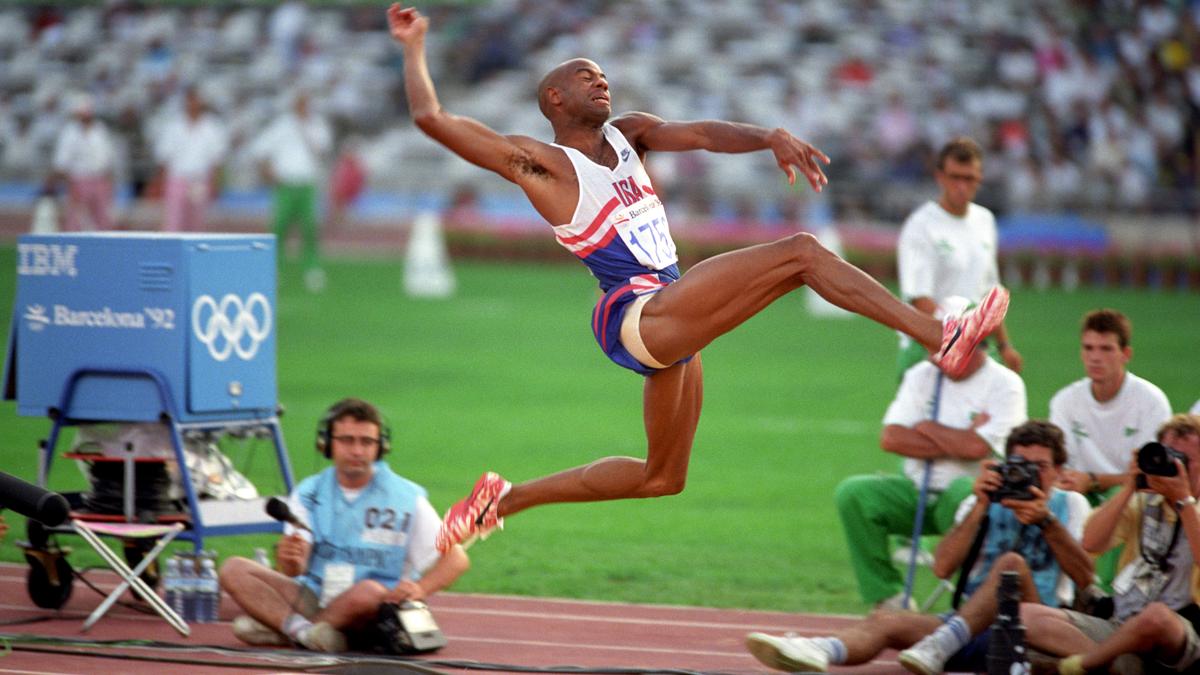
Still a giant leap for man: the stagnation of the long jump Premium
The Hindu
Carl Lewis' claim that long jump is the hardest track and field event sparks controversy and debate on social media.
In April 2022, the legendary Carl Lewis put out a blunt statement on social media platform X (then Twitter) that long jump was the hardest event in track and field. “There have been 5 male world record holders [sic: breakers] in the long jump since 1936,” Lewis said. “The present outdoor record is 31 years old... Seems pretty tough to me. What other event is that difficult to master?”
In quick time, Lewis was roundly criticised and even called an attention seeker, pretty much in line with X’s image of being a toxic crucible of abuse and simplistic narratives. It didn’t matter that Lewis was a nine-time Olympic gold medallist, with four of those in the long jump in a streak that started at Los Angeles 1984 and ended at Atlanta 1996.
Lewis’ rationale was that Mike Powell’s world record of 8.95m at the Tokyo World Championships in 1991 was — and is still — standing. The same with Bob Beamon’s Olympic record of 8.90m set at Mexico City 1968. Starting 1970, the men’s high jump, triple jump and pole vault — the other three jump events — have seen 12, 5 and 14 athletes better the best mark. Long jump has seen a grand total of one. Of the six record-holders from 1935, Powell, Beamon and Jesse Owens have each held it for 23 years or more.
In fairness, the longevity of a world record shouldn’t always determine the difficulty level of an event. If that is the case, the women’s track races should be the hardest of all, for the 100m, 200m, 400m and 800m records have remained intact since the 1980s. But Lewis’ thinking had more than a kernel of truth — that long jump was among the toughest to master, if not the toughest, and the lack of progression in world record distances was one of its prime fallouts.
“Long jump is a combination of speed, elastic strength and technique,” James Hillier, the athletics director at Reliance Foundation, told The Hindu. “If you look at the runway data from the Olympic Games, the winner has had the fastest times. The issue is how you transfer horizontal speed, which might be 10 m/s or higher for top long jumpers, into a vertical lift off the board.
“You have to hit that sweet spot. You have to be able to run fast enough because the speed is what carries you forward. But you should also be running within yourself so that you can coordinate and time a take-off. If you are driving a car at 30 miles an hour, and someone tugs the steering wheel, the car will just go off a little bit but you can correct it. If you are going at 100 miles an hour, a slight tug can result in a very bad accident. It is the same in long jumping.”
Between the 40m runway and the jump lies the 20cm take-off board where pin-point accuracy is non-negotiable. Jump from a few centimetres behind and you will end up losing that much distance. Leap from too close, the margin of error for a foul shrinks.


Chennai Super Kings celebrate IPL 2026 with a star-studded fan event, honoring past legends and welcoming new talents.

Discover Chennai Super Kings' IPL 2026 roster, schedule, and support staff details as they aim for a comeback.

Barcelona secures a narrow 1-0 win over Rayo Vallecano, maintaining their LaLiga lead thanks to Araujo's header and Garcia's heroics.

Abhijith Praveen's outstanding performance leads Masters CC to victory in the Celestial Trophy all-Kerala cricket tournament.

Wimbledon will implement video review technology on six courts, allowing players to challenge chair umpire decisions during matches.

Batting-heavy Sunrisers Hyderabad hopes to bowl rivals over

Jhingan’s late leveller denies Chennaiyin a winning start at home

Jhingan’s late leveller denies Chennaiyin a winning start at home

South Africa levels T20I series against New Zealand with a 19-run victory, highlighting spinners' dominance ahead of the final match.

LeBron James sets a new NBA record for most games played, surpassing Robert Parish with his 1,612th appearance.

Rajasthan Royals has the task of filling Sanju Samson’s big shoes

Yashaswini’s birthday gift for long-time coach

Manav, Yashaswini win maiden National titles