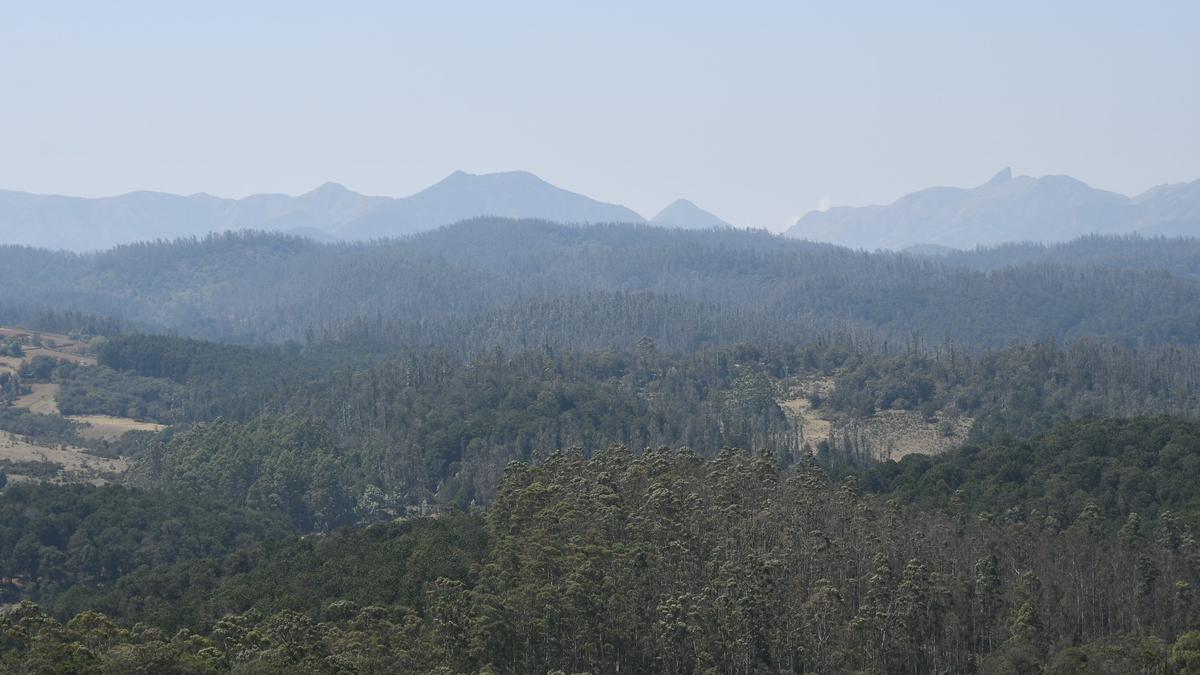
State Planning Commission details focus areas for improving the forest cover in Tamil Nadu
The Hindu
Tamil Nadu's forest cover analysis reveals alarming loss, prompting policy focus on restoration and conservation efforts statewide.
The picturesque Nilgiris, known as the Queen of Hills, was once rich in forest density. Alarmingly, the Nilgiris now tops the table with a loss of 226 sq. km between 2003 and 2011 of dense forests and 348 sq. km of moderately dense forests. The State Planning Commission has identified policy focus areas to improve the forest cover in Tamil Nadu after analysing 20 years of data. The India State of Forest Reports (ISFR), prepared by the Forest Survey of India between 2001 and 2021, have been used as a major source of information for carrying out the analysis for the report, titled Status of Forests in Tamil Nadu. It has been brought out by the Tamil Nadu State Land Use Research Board of the State Planning Commission.
Identifying priority districts, the report says the policy focus should be on districts that have very less forest cover in terms of area: Chennai, Tiruvarur, Karur, Nagapattinam, and Perambalur. These five districts account for only 1.89% of the State’s forest cover. It also underscores the need to identify the reason for the loss of forest cover in districts like Sivaganga where the cover came down by 20.47% in the last two decades, Vilupuram (13.85%), and Kancheepuram (13.03%).
The report has also highlighted the districts that require attention with respect to the dense, moderately dense, and open forest categories. Apart from the Nilgiris, Erode needs attention as it has lost dense as well as moderately dense forests. Dharmapuri has lost 409 sq. km of open forests. A study has to be initiated immediately to identify the factors that have led to the loss, it says.
The report also notes the steady decrease of tree cover in the State from 2001 to 2021 to an extent of 1,630 sq. km. This may be due to reasons such as urbanisation, increasing development activities, cyclones, drought, and linear development. The government has to closely monitor the small green patches outside the recorded forest area. The share of Tamil Nadu in the national mangrove cover is only 0.9%. Despite the very less extent of mangrove in the State than in the other States, Tamil Nadu has recorded an increase in the mangrove cover from 23 sq. km in 2001 to 49 sq. km in 2017. But the State had lost 4 sq. km of the mangroves between 2017 and 2021.
The ISFR states that Tamil Nadu suffered severe degradation in its growing stock between 2011 and 2021, with a loss of growing stock of 52.134 m.cum in the recorded forest areas. It is a cause for great concern and should be addressed scientifically and practical solutions should be adopted.
After analysing the data, the Planning Commission has come up with a list of action points to strengthen the forest cover across the districts and segments. Stressing the importance of agro-forestry, the Commission has said it is high time that the consistent efforts were made to increase the tree cover on the farmland and built a robust database on the farmers and the growing stock in their land. This will also help the tree-growing farmers by enhancing their livelihood opportunities. Recommending restoration of the degraded forestland for improving the growing stock and carbon sequestration potential in the natural forests, the Commission has said measures should be taken to improve the remaining areas of the open degraded forest and scrubland through dedicated schemes and focused approach.
Forest Land Restoration (FLR), with the participation of the indigenous and local communities, has to be given priority. The report also suggests a mission like Haritha Haram, a programme initiated by the Telangana government to increase the green cover. Stating that Green Tamil Nadu Mission is expected to cater to this need, the Commission suggests periodical monitoring and evaluation to identify the gaps and address them at the initial stage itself. It also suggests planting of fast-growing native trees, giving preference to the species that have greater carbon sequestration potential.


The ‘Swastha Mysuru’ initiative aims to promote healthy living and preventive healthcare in Mysuru through community engagement and awareness.

Farmers in Ongole protest against BJP's policies, citing dangers to their livelihoods and demanding support for local agriculture.

From March 24, paneer queserotta, prawn tostadas, beef birria and more feature on MadCo's special Mexican pop up menu by Chef Mathangi Kumar alongside experimental cocktails, including a marigold highball

Revenue Minister Krishna Byre Gowda defends subsidies as crucial for economic growth, emphasising their role in boosting consumer demand during recessions.

Three doctors were arrested by the Mico Layout traffic police on Monday (March 23) after a video allegedly showing them triple-riding without helmets with one of the pillion riders seen drinking from a bottle went viral on social media.

Assembly protest ends in arrests as BJP targets Government over guarantees

Andhra Pradesh accelerates city gas distribution with streamlined approvals, enhancing access to cleaner energy and supporting sustainable urban development.

Sattankulam father-son custodial deaths case: Trial court convicts all nine accused police personnel
Nine police personnel convicted in Sattankulam custodial deaths; sentencing to be announced on March 30.

Minister Laxmi Hebbalkar supports local protests against a solid waste management plant in Turmuri, addressing residents' concerns.

Sattankulam father-son custodial deaths case: Trial court convicts all nine accused police personnel
Nine police personnel convicted in Sattankulam custodial deaths; sentencing to be announced on March 30.

Erode district conducts first EVM randomisation for April 23 Assembly elections, ensuring transparency and fairness in allocation.

TNCC conducts public consultation in Erode to gather community input for its upcoming election manifesto.

CID to investigate sexual assault allegations against suspended Moodbidri Police Inspector P.G. Sandesh, reveals Home Minister Parameshwara.