Stanford study finds largest recorded Alberta earthquake likely caused by oilsands wastewater
Global News
The largest recorded earthquake in Alberta's history was not a natural event, but most likely caused by disposal of oilsands wastewater, new research has concluded.
The largest recorded earthquake in Alberta’s history was not a natural event, but most likely caused by disposal of oilsands wastewater, new research has concluded.
“This event was caused by wastewater disposal,” said Ryan Schultz, a Canadian seismologist who helped conduct the research while at Stanford University in California.
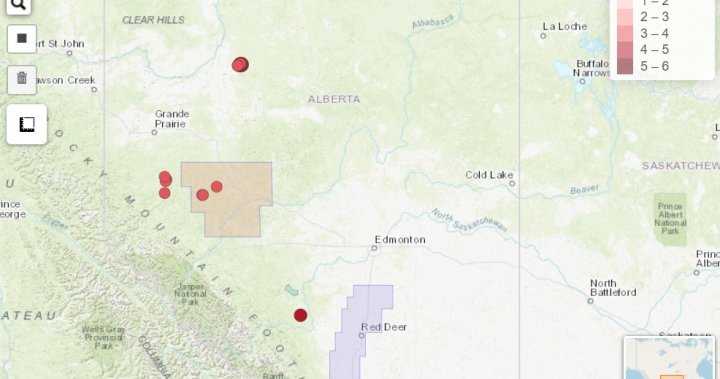
In November, parts of Alberta near the northwestern town of Peace River were rocked by a series of quakes culminating in one that reached a 5.6 magnitude.
Residents reported being knocked to their knees. The earth was pushed upward by more than three centimetres — enough to register on satellites.
Oilpatch techniques, such as deep disposal wells that inject wastewater kilometres underground, can induce earthquakes. One such well located near the earthquake site, used to dispose of water used in oilsands operations, has injected more thanone millioncubic metres of wastewater down about two kilometres.
After the record-breaking quake occurred, the Alberta Geological Survey, a branch of the province’s energy regulator, attributed it to natural causes. The centre of the quake, then estimated to be six kilometres underground, was thought too deep and too far away from oilpatch activity in time and space to have been generated by industry.
Not so, said Schultz.
A closer and more thorough look at the data brought the centre of the quake up to about four kilometres beneath the surface. That figure is now reflected in the regulator’s catalogue of Alberta quakes.


Kinew now says the province is taking a step back from this approach and ensuring that different health-care interventions are built within the site before opening.

In Thailand, an order for civil servants to work from home for the foreseeable future came with another – use the stairs while the energy squeeze continues.

The police agency in a news release on Monday said it was continuing a trend of 'persistently high levels' of both types of interpersonal violence.

Ontario Premier Doug Ford saw his attempts to stop his cellphone records being partially released blocked by a panel of judges. Critics say he's changing the law as a result.

It is believed to have been left by local troublemakers, though RCMP said in an email there was no criminality involved in the situation.

Hypothermia contributed to the deaths of 62 people in 2023, with nine of them considered homeless, and 57 deaths in 2024 with 11 people listed as homeless.

According to Transport Canada, 'the seatback recliners for the second-row seats may not have been manufactured properly' on certain vehicles.

The teen originally pleaded not guilty in February 2025, before changing her plea in December. The Crown and defence jointly submitted a maximum youth sentence of three years.

The government in 2024 banned supervised consumption sites within 200 metres of a school or daycare, targeting 10 sites across the province for closure by the end of March 2025.

A few weeks ago, Eric Sauvageau received a call from someone he believed was his son. He withdrew thousands from the bank and paid it before realizing he'd been scammed.

The federal weather agency says most of southern and central New Brunswick and western and eastern Nova Scotia will be impacted.

Consumer inflation cooled to 1.8 per cent in February compared to a year earlier, when the federal GST/HST tax holiday meant lower prices for many consumer goods and services.

Ottawa Fire Services said they received multiple calls around 9:30 p.m. Saturday about a fire with people trapped in a high-rise building in the 300 block of Somerset Street West.