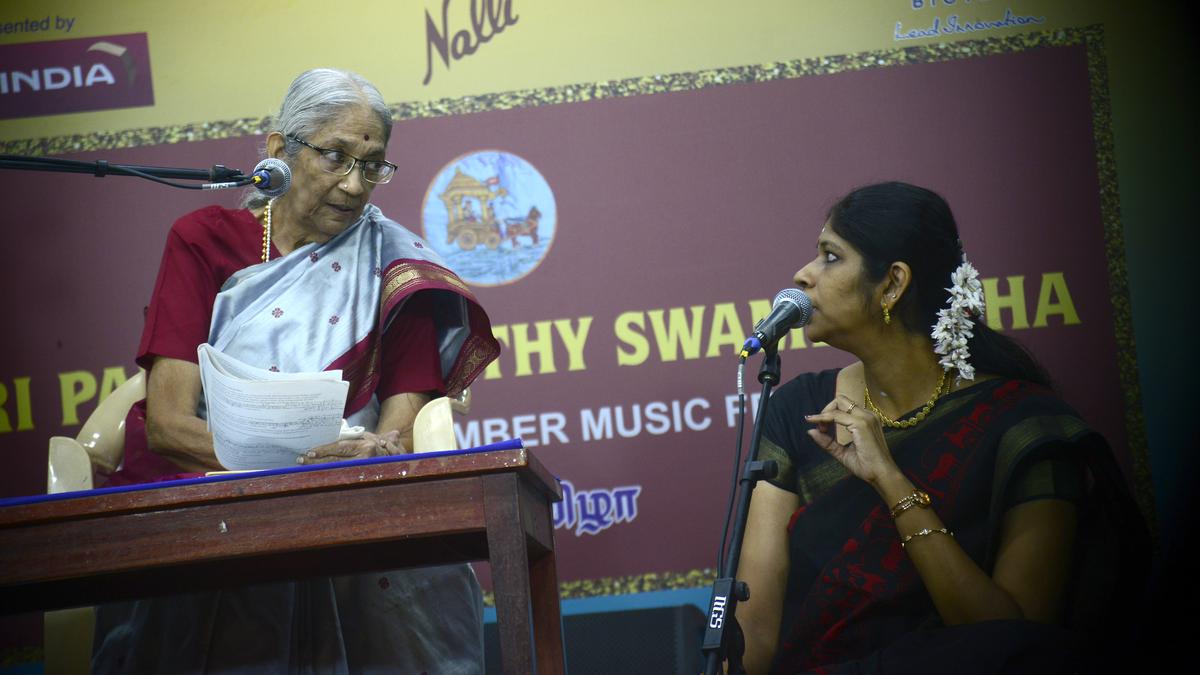
Spotlight on Mysore Vasudevachar’s compositions
The Hindu
An ode to Mysore Vasudevachar
Among the post-Trinity composers, Mysore Vasudevachar holds a special place. In her lec-dem on the ‘Compositions of Mysore Vasudevacharya’, veteran Rama Ravi presented a wealth of information. She was vocally supported by Nandhitha Ravi, with R.K. Shriram Kumar on the violin and K. Arun Prakash on the mridangam.
Rama said she was happy to be a student of Kalakshetra when Vasudevachar was one of the faculties. Born in Coimbatore, he moved to Mysore at a young age when his father migrated there. He was inducted into the study of vedas and shastras by his father. Soon he got the patronage of the Mysore royal family to pursue his passion for music. His initial music training with Patnam Subramania Iyer in Madras was daunting as he learned the Begada varnam for six full months to understand the swaras, akaras, speeds and tala. His training continued for nearly six years.
Vasudevachar returned to Mysore and performed his first concert at the royal court and in front of experts such as Veena Seshanna. Vasudevachar composed kritis, varnams, javalis and darus. His Mandari varnam ‘Vanajaksha’, was presented by Nandhitha. His compositions were mostly in Telugu and Sanskrit.
His notable kritis include ‘Brocheva’ in Khamas, ‘Pranathartha’ in Abheri and ‘Raghavendra’ in Darbar. He also composed kritis in Melakarta ragas such as ‘Bhajana seya’ in Dharmavati and ‘Neelakantane’ in Bhavapriya.
Rama Ravi presented an interesting nugget about how Swadesamitran, the weekly, used to publish Vasudevachar’s compositions every week with clear notations. His penchant for chittaswaram is well-known. Rama and Nandhitha presented some chittaswaras of his compositions set in the western style.
A kind and accessible teacher, he ensured students understood the nuances of the ragas and kritis he taught. Interestingly, Vasudevachar tuned many Sanskrit shlokas too. He was among the composers of Rukmini Devi’s Ramayana ballet.


Written and directed by Kunal, the film also stars Sparsh Shrivastava and Vanshika Dhir

This year, Bharatnatyam artistes will present the Tyagaraja Aradhane as a dance performance

This year, Bharatnatyam artistes will present the Tyagaraja Aradhane as a dance performance

The actor, along with director Sushant Shah, speak about their upcoming series ‘Chiraiya’, Divya’s process of working on the dialect, Sushant’s approach to telling a story about women, and more

An independent video, ‘Feel the Spark’ by Raleigh Rajan with vocals by Ciera Dumas that celebrates Tamil literary giants, garnered 1.4 million views in less than 36 hours.

In ‘Jack Ryan: Ghost War’, John Krasinski is back as the savvy CIA analyst, diving headfirst into a high-stakes mission that unravels a deadly conspiracy and pits him against a rogue black-ops unit

Shriram Bharatiya Kala Kendra’s Shankarlal festival showcased rare ragas, radiant artistry, and inclusive performances, from Pt Madhup Mudgal’s serene morning ragas to Ramana Balachandran’s Saraswati veena.

Explore "Threads that Bind: The Kantha Project," an exhibition in Delhi reimagining kantha as a medium of repair and renewal.

Sean Penn skips the Oscars to meet Ukraine's Zelenskyy, who praises him as a "true friend" amid the war.

The teaser of Tamil star Suriya’s much-awaited film with director Venky Atluri, titled Vishwanath and Sons, was unveiled by the makers on Monday

A 'Golden' moment for a K-pop track at the Oscars.

Parvathi Nayar’s new exhibition, The Primordial, in Mumbai, traces oceans, pepper and climate change
Opened on March 12, the exhibition marks the artist’s first solo show in Mumbai in nearly two decades. Known for her intricate graphite drawings and multidisciplinary practice spanning installation, photography, video, and climate change, her artistic journey has long engaged with the themes of ecology, climate change and the natural world. In this ongoing exhibition, these strands converge through a series of works centred on water, salt, and pepper — materials that carry natural and historic weight across centuries.

Explore the highlights and key winners of the 98th Academy Awards, featuring memorable moments and historic achievements from Oscars 2026.