SPJIMR’s TaSIC 2026 catalyses dialogue on responsible growth
The Hindu
SPJIMR’s TaSIC 2026 catalyses dialogue on responsible growth
Global scholars and industry leaders co-create actionable pathways for India’s sustainable, aspiration-led growth
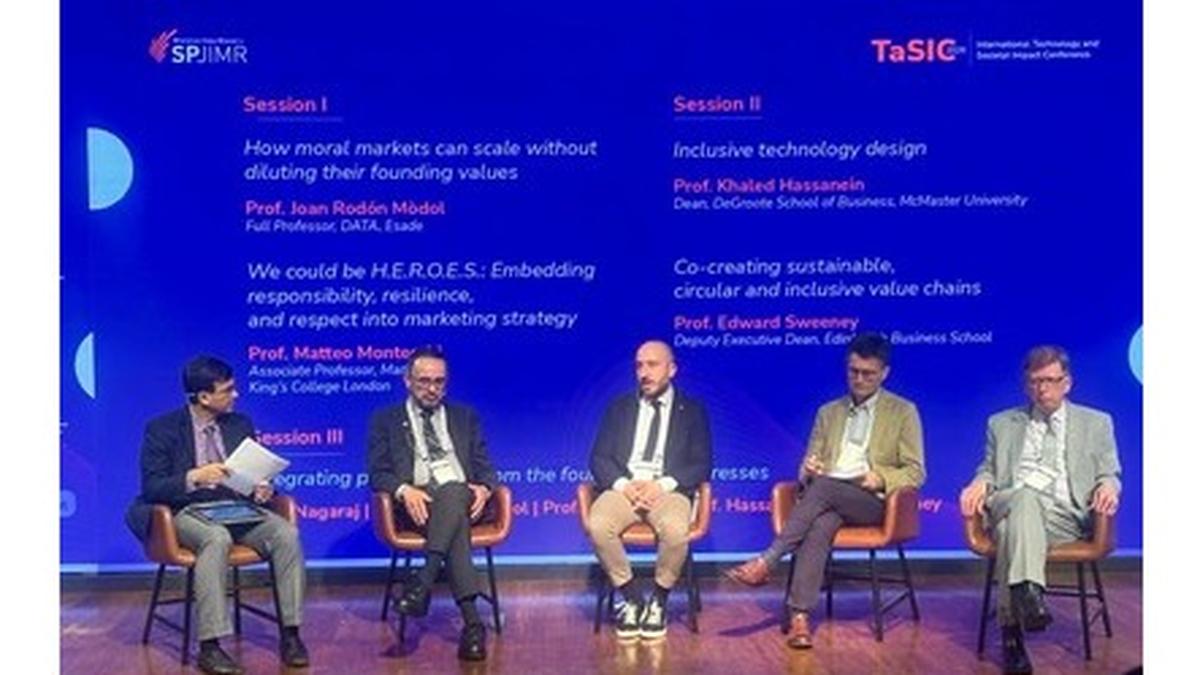
MUMBAI, India, Feb. 23, 2026 /PRNewswire/ -- ‘How can India meet rising consumer aspirations without compromising responsibility, resilience, and long-term societal well-being?’ This question anchored the two-day international Technology and Societal Impact Conference (TaSIC) 2026, hosted by Bharatiya Vidya Bhavan’s S.P. Jain Institute of Management & Research (SPJIMR) at its Mumbai campus on February 20 and 21. Designed as an Academic–Practice Sprint, the conference brought together global scholars, industry leaders, innovators, and policymakers to move beyond dialogue towards actionable solutions.
Research-led perspectives meet practice
The Academic Plenary on February 20 featured four internationally respected scholars who examined the intersection of technology, markets, and sustainability through complementary lenses. Prof. Joan Rodón Mòdol (Esade) explored how moral markets can scale without diluting founding values; Prof. Matteo Montecchi (King’s College London) presented the H.E.R.O.E.S. framework for embedding responsibility, resilience, and respect into marketing strategy; Prof. Khaled Hassanein (McMaster University) emphasised inclusive technology design and responsible AI; and Prof. Edward Sweeney (Heriot-Watt University) focused on the co-creation of sustainable, circular, and inclusive value chains.
In a synthesis roundtable, Prof. Varun Nagaraj, Dean, SPJIMR reframed these insights around a central provocation posed to both speakers and the audience: India’s aspiration–sustainability paradox: affordability versus sustainability, innovation versus regulation, and inclusion versus resource limits. SPJIMR’s second-year PGDM participants presented 12 pressing problem statements across five sectors, challenging the audience to respond not in theory, but in systems terms.
Their mapping revealed a single, uncomfortable insight: systemic interdependence. Environmental stress surfaced through single-use packaging, food loss, toxic e-waste, groundwater depletion, inefficient energy systems, and AI’s growing carbon footprint. Simultaneously, BNPL-driven debt, algorithm-led overconsumption, EV-linked job displacement, and rising non-communicable diseases exposed deepening socio-economic fragilities. Assumptions were challenged. Simplistic binaries were dismantled. The message was unequivocal: isolated interventions cannot solve interconnected failures.


Join the Bengaluru job fair for ex-servicemen on February 27 to connect with top employers and showcase your skills.

Tushar Gandhi opposes displacement of people for Telangana Government's Gandhi Sarovar project in Hyderabad, urging reconsideration due to potential displacement of residents in Hyderabad.

Mangaluru will debut its first private electric passenger bus on February 26, enhancing eco-friendly transport options in the city.

Karnataka High Court relief for Ranveer Singh from police action over controversial remarks on sacred traditions, pending cooperation with investigation.

Farooq Abdullah urges Jammu and Kashmir students to evacuate Iran immediately amid rising tensions and airspace concerns.

IISc researchers unveil a brain circuit that suppresses itch during stress, advancing understanding of its neural mechanisms and potential treatments.

Maharashtra BJP appoints Navnath Ban as chief spokesperson and announces new office-bearers in recent organizational reshuffle.

Kerala High Court criticizes "The Kerala Story 2" for misrepresenting the state’s people and seeks pre-release screening.

Telangana intensifies fire audits and inspections to prevent accidents as summer heightens fire risks in Hyderabad.

Kerala Assembly adjourns amid protests over Sabarimala gold theft, with officials criticizing the opposition's actions and competence.

Rahul Gandhi criticises Uday Bhanu Chib's arrest, calling it a sign of dictatorial tendencies and supporting Youth Congress protests.

Directed by Sujeeth and produced by Niharika Entertainment and Unanimous Productions, the Nani starrer ‘Bloody Romeo’ promises to be a good mix of fun and action

Amitabh Bachchan and Kamal Haasan reunite for 'Kalki 2,' nearly 40 years after their last collaboration in 'Geraftaar.'