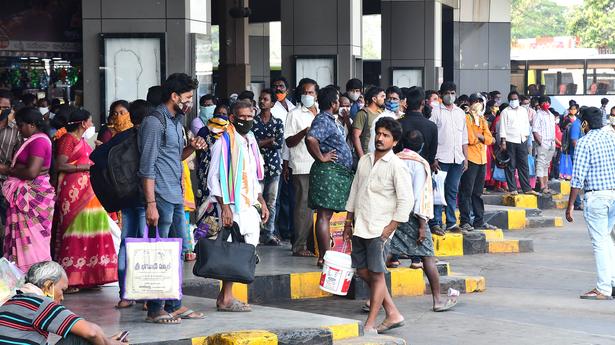
Sparing passengers a fare hike, APSRTC keeps festive spirit up
The Hindu
APSRTC takes populist route this festival season by doing away with the 50% extra charges collected in special buses operated every year as the move earned more disrepute than revenue for the State-run transport organisation
Anumolu Chandra Kumar is upbeat. He has just cancelled a ticket he had booked in advance in a private bus company to visit home for Dasara festivities and made a fresh booking in a bus belonging to the AP State Road Transport Corporation (APSRTC) for a lower price. “The decision of the State-run transport organisation to operate buses on regular fares this year will benefit many travellers like me,” says the techie from Hyderabad gleefully.
After a marathon round of talks with the State officials, the APSRTC management has announced its decision to do away with the 50% extra charges collected in the special buses that are pressed into service every year to clear the festival rush.
With the main festival days Durgashtami falling on October 3, Navami on October 4 and Dashami on October 5, the public transport giant will deploy 4,500 special buses, starting from September 26 up to October 9. “Dasara is a major festival for people of Andhra Pradesh, Telangana and Karnataka. We will deploy special buses to cater to the transport needs of people travelling through the States to be with their families and friends on this special occasion. Regular charges will be collected in the special buses also because we do not want to burden the public,” says Ch. Dwaraka Tirumala Rao, the Vice-Chairman and Managing Director of the corporation.
Sources in the department indicate that the decision is mainly to fend off criticism heaped against the management by the Opposition parties and also the public in general for increasing ticket rates on all important occasions. “More than the financial advantage, we have been targeted for the raise,” says an official, hinting that the talk of “excessive rates” is doing more harm than good. The officials also do not deny the existing stiff competition posed not just by private bus operators but also other State transport units.
The State RTC move to announce its decision early, giving ample time to people to revise their travel choice, has become a cause of worry for private bus operators who make a killing during festival seasons by jacking up the ticket fares manifold. “This may have an impact on the business of private bus operators,” admits M. Sambi Reddy, State president of AP Private Bus Operators’ Association. He goes on to add: “As it is we have enough reasons to worry about the ever-increasing burden of taxes and fuel price.”
Mr. Sambi Reddy says to keep a check on private operators from fleecing the passengers, the association has asked them to effect a minimum hike in bus fares during the festivities. But this is seldom followed in practice. As is evident, some of the private operators are charging as high as ₹3,000 per seat for a Vijayawada-Hyderabad trip.
Doing away with additional bus fares at a time when the corporation is jostling with its financial troubles may further add to the financial stress of the organisation. It may be noted here that the Corporation, as part of the revenue-sharing agreement reached at the time when the APSRTC employees were merged with the government, has been asked to part with 25% of its monthly revenue with the State government, which now pays salaries to the RTC employees taken into the fold of the newly-created Public Transport Department (PTD). Ever since the merger, the government has been paying salaries to the RTC employees, estimated to cost the exchequer ₹300 crore every month.


Karnataka government to consult legal experts on pursuing action against Adani Group's ACC Ltd. over ₹850 crore in disputed dues.

The FCRA amendment bill aims to create an authority for managing NGO assets after license loss, addressing misuse of foreign funds.

Telangana Minister assures adequate petroleum stocks for three months, warns against illegal fuel carrying amid panic buying rumors.

TMC calls for the removal of Bhabanipur returning officer, citing alleged ties to BJP and concerns over neutrality.

Kerala CM Pinarayi Vijayan condemns UDF's misogynistic attacks on CPI(M) legislator U. Prathibha, highlighting political degeneration.

Selected from 9,400 submissions across 37 countries, the 100 photographs on display traverse intimate and political terrains. In MRC Nagar, photographer Swastik Pal captures life in the Sundarbans, where severe climate change has brought humans and wildlife into closer contact. Shane Hynan’s Beneath Beofhod reflects on Ireland’s boglands as sites of memory and restoration, while Mateo Trevisan’s More than the Sun examines the impact of coal-driven industrialisation in the Western Balkans.

Hyderabad officials assure sufficient fuel supply for 60 days, warn against misinformation and illegal sales amid panic buying.

Telangana MP urges Centre to expedite ₹1,270 crore dues transfer from Andhra Pradesh for financial fairness and development.

A Karnataka man was detained with ₹62.5 lakh in cash during election checks on NH 544, claiming it was from a property sale.

Telangana Government issued 16 notifications to fill 31,798 vacancies, with 67,763 total recruitments since Congress took power.

Supreme Court directs Tarun Butolia's family to seek safety assessment from Delhi Police after fatal Uttam Nagar clash.

CM Stalin asserts unity in the DMK-led alliance, dismissing division attempts and emphasizing collaborative efforts for the upcoming elections.

Rahul Gandhi to skip Kerala rally due to Sonia Gandhi’s ill health; Kharge to attend Kozhikode event
Rahul Gandhi will miss the Kerala rally due to Sonia Gandhi's health; Congress president Kharge to attend instead.