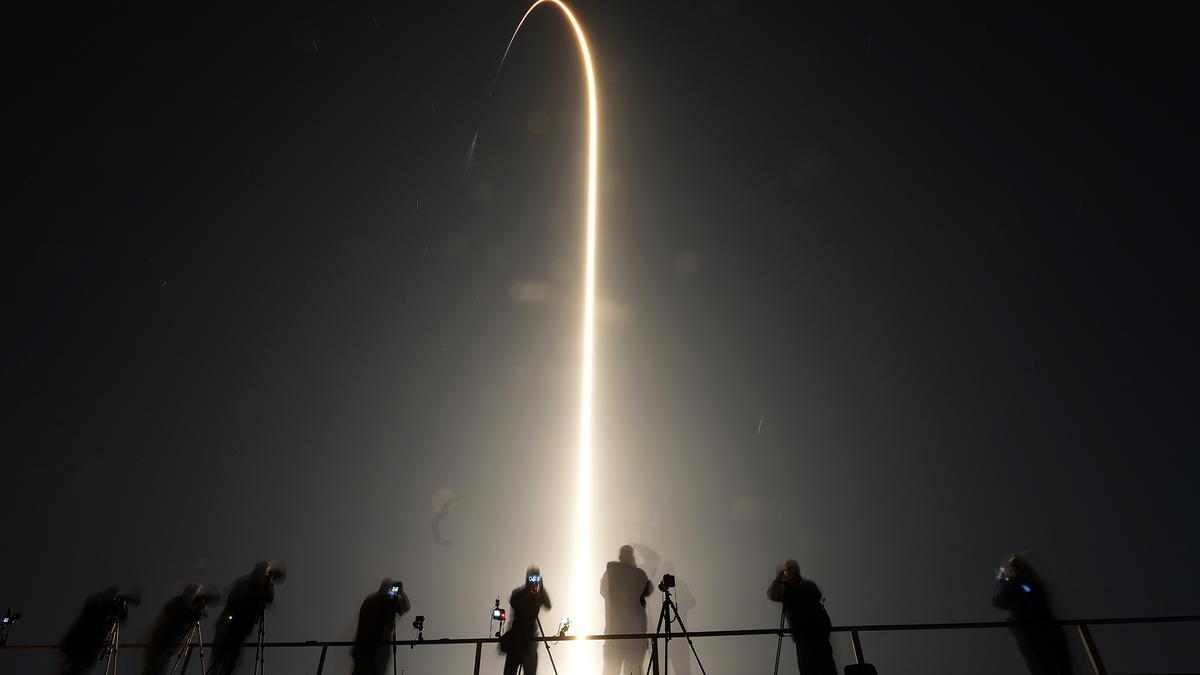
SpaceX launches eighth long-duration crew for International Space Station orbit
The Hindu
A SpaceX rocket safely lifted off from Florida on Sunday night carrying a crew of three U.S. astronauts and a Russian cosmonaut on their way to the ISS to begin a six-month science mission in Earth orbit.
A SpaceX rocket safely lifted off from Florida on Sunday night carrying a crew of three U.S. astronauts and a Russian cosmonaut on their way to the International Space Station (ISS) to begin a six-month science mission in Earth orbit.
The two-stage Falcon 9 rocket topped with an autonomously operated Crew Dragon capsule dubbed Endeavor was launched from NASA's Kennedy Space Center at Cape Canaveral, along Florida's Atlantic coast, at 10:53 p.m. EST (0353 GMT Monday).
A live NASA-SpaceX webcast showed the 25-story-tall rocketship ascending from the launch tower as its nine Merlin engines roared to life in billowing clouds of vapor and a reddish fireball that lit up the night sky. The rocket consumes 700,000 gallons of fuel per second during launch, according to SpaceX.
The Falcon's upper stage delivered Endeavor to its initial orbit nine minutes after liftoff, with live video from the cabin showing the four crew members strapped in side by side garbed in their helmeted white-and-black flight suits.
"What an incredible ride to orbit," astronaut Matthew Dominick, 42, the flight commander and one of three spaceflight rookies aboard the capsule, radioed to control outside of Los Angeles. "A big thank-you to SpaceX."
"Really honored to fly this new-generation spaceship with this new-generation crew," NASA veteran Dr. Michael Barratt, 64, chimed in from his seat beside Dominick.
The four crew members were scheduled to reach the space station early on Tuesday after a 16-hour flight, docking with the orbital laboratory some 250 miles (420 km) above Earth.


Explore 2026's wallpaper trends in India, highlighting botanicals and handmade designs that enhance modern homes with nature-inspired aesthetics.

Mercedes-Benz CLA 250+ with EQ Technology review: design, performance, range and features explained. Discover how the new electric CLA combines advanced AI, long range, fast charging and futuristic styling for the next generation of luxury EVs.

AI tool for sparrow conservation

BTS’s comeback with ‘Arirang’ marks a major global music event. When does the album release, and where can you watch their concert live stream? We have all the details

The 2026 U.S. cholesterol guidelines urge starting screening and treatment at 30 to prevent cardiovascular disease effectively.

Olam Festival 2026 in Thiruvananthapuram returns March 27-29 with 120+ vendors, music, art, and cultural zones.

A few storytellers in Thiruvananthapuram share their journeys, challenges, and evolving methods on World Storytelling Day, inspiring young minds.

76-year-old Kurian Jacob from Kerala triumphs with seven medals, including five golds, at the Open Masters Games in Abu Dhabi.

Explore the nature of the human mind as an emergent property of brain activity and complex neural interactions.

CERN's Large Hadron Collider discovers the Xi-cc-plus particle, enhancing understanding of quantum mechanics and baryon behavior.

Vibha Batra’s latest book, Spotless (Hachette India) is a novel in verse for young adults

In its first edition, the Madras Art Salon spotlights the works of journalist and artist Narayan Lakshman at The Botanical Club, a social space in the British Deputy High Commission, Chennai

Cholesterol enhances melanoma cell invasion by making nuclei squishier, revealing a potential treatment target in cancer progression.