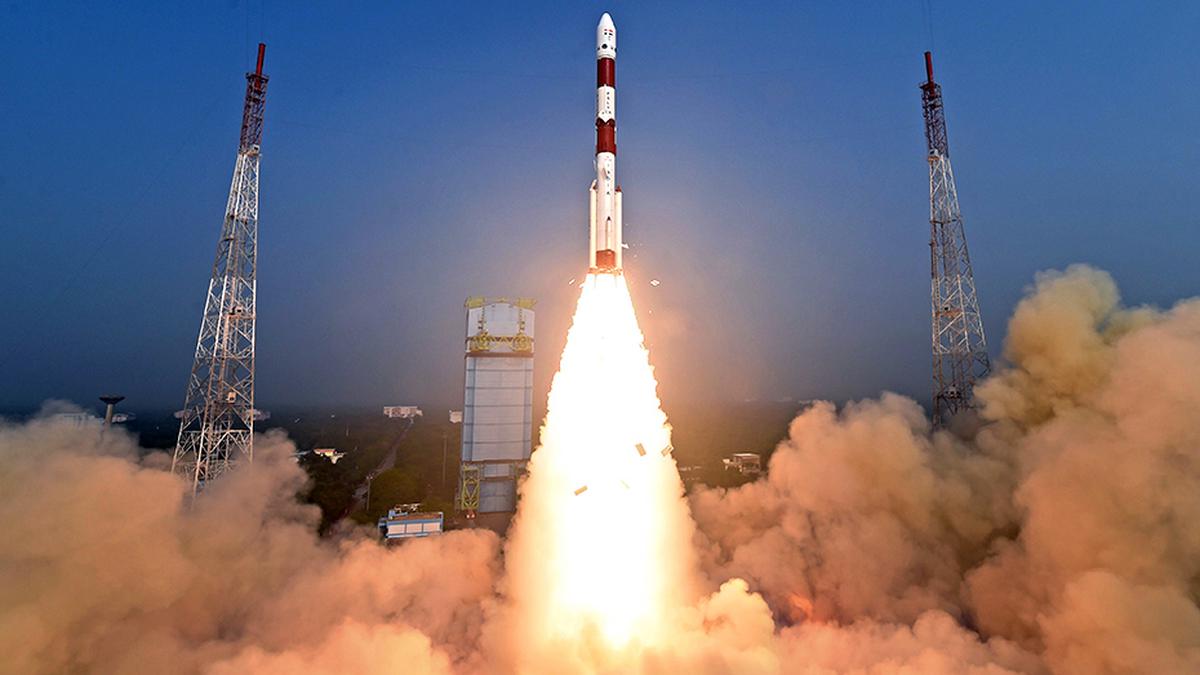
Space gets nominal hike, but boost for spaceflight start-ups in Interim Budget 2024
The Hindu
Budget 2024: The Union Finance Ministry increased allocation for the Department of Space by only 4%, but the nascent private sector received a boost.
With no major space missions slated for 2024, the Department of Space has recieved only a nominal hike of 4% in its allocation in the Interim Union Budget for 2024-25, from ₹12,545 crore to ₹13,043 crore. The Indian space programme will spend much of the year on pre-launch testing milestones for the lunar exploration (Chandrayaan) and human spaceflight (Gaganyaan) missions, and some other projects.
In 2023, the Indian Space Research Organisation (ISRO) launched and successfully executed its long-awaited Chandrayaan-3 mission, to soft-land a robotic instrument on the moon. ISRO also launched the Aditya-L1 mission to study the sun and the XPoSat — short for ‘X-ray Polarimetry Satellite’ — mission to track and study neutron stars and black holes from space. India also signed the Artemis Accords to participate in the United States’ multilateral programme to return humans to the moon by 2025.
Also read: Budget 2024 live updates
The major launches slated for 2024 include an uncrewed Gaganyaan test flight, the third developmental flight of the Small Satellite Launch Vehicle, and the NASA-ISRO Synthetic Aperture Radar mission. ISRO scientists and engineers have also been working on propellants, satellite propulsion systems, new launch vehicles, and technology transfer to the industry.
In her Budget speech, Finance Minister Nirmala Sitharaman announced a corpus of ₹1 lakh crore, with five-decade interest-free loans, to boost private sector investment in research and development. While the details are not clear, India’s nascent private spaceflight sector and its 200 or so startups are expected to benefit from this infusion. The revenue expenditure of IN-SPACe, the nodal agency setup by the Union Cabinet in 2020 to oversee the activities of this sector, also increased 24%.
Similarly, revenue for space technologies — which includes work on Gaganyaan and the development of systems for new launch vehicles and spaceflight missions — increased 27%.
Also read: Where does the money come from and where is it allocated?


Explore 2026's wallpaper trends in India, highlighting botanicals and handmade designs that enhance modern homes with nature-inspired aesthetics.

Mercedes-Benz CLA 250+ with EQ Technology review: design, performance, range and features explained. Discover how the new electric CLA combines advanced AI, long range, fast charging and futuristic styling for the next generation of luxury EVs.

AI tool for sparrow conservation

BTS’s comeback with ‘Arirang’ marks a major global music event. When does the album release, and where can you watch their concert live stream? We have all the details

The 2026 U.S. cholesterol guidelines urge starting screening and treatment at 30 to prevent cardiovascular disease effectively.

Olam Festival 2026 in Thiruvananthapuram returns March 27-29 with 120+ vendors, music, art, and cultural zones.

A few storytellers in Thiruvananthapuram share their journeys, challenges, and evolving methods on World Storytelling Day, inspiring young minds.

76-year-old Kurian Jacob from Kerala triumphs with seven medals, including five golds, at the Open Masters Games in Abu Dhabi.

Explore the nature of the human mind as an emergent property of brain activity and complex neural interactions.

CERN's Large Hadron Collider discovers the Xi-cc-plus particle, enhancing understanding of quantum mechanics and baryon behavior.

Vibha Batra’s latest book, Spotless (Hachette India) is a novel in verse for young adults

In its first edition, the Madras Art Salon spotlights the works of journalist and artist Narayan Lakshman at The Botanical Club, a social space in the British Deputy High Commission, Chennai

Cholesterol enhances melanoma cell invasion by making nuclei squishier, revealing a potential treatment target in cancer progression.