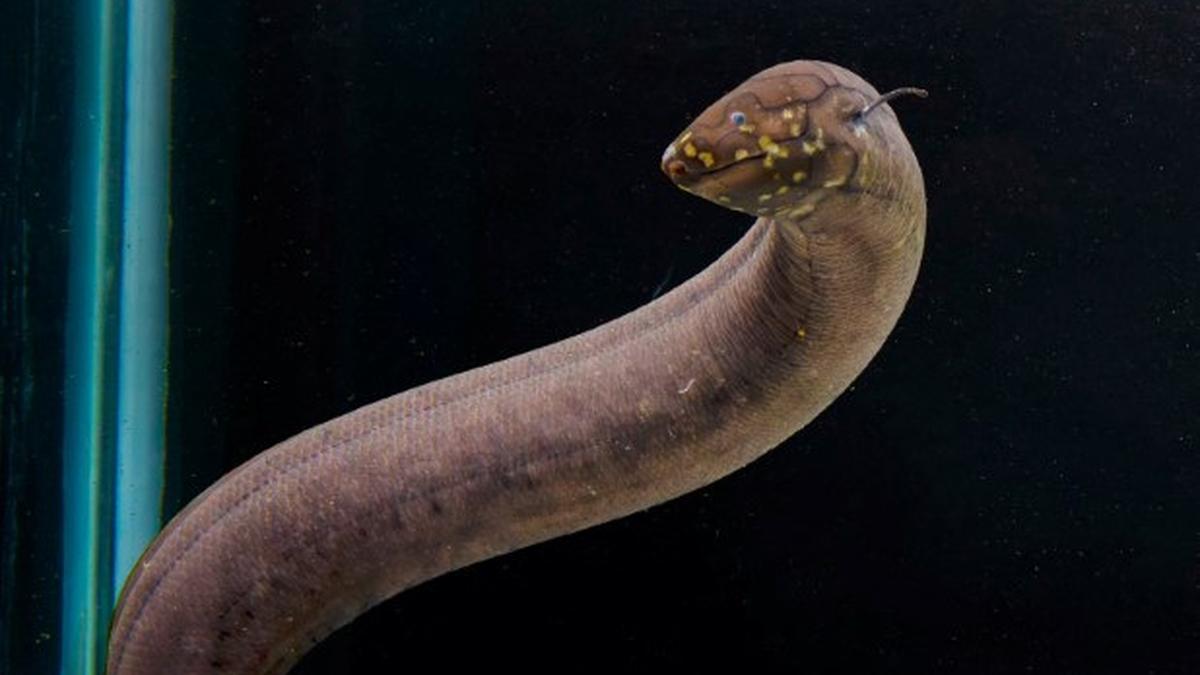
South American lungfish has largest genome of any animal
The Hindu
The South American lungfish, a living fossil with the largest genome, offers insights into vertebrate evolution and land colonization.
The South American lungfish is an extraordinary creature - in some sense, a living fossil. Inhabiting slow-moving and stagnant waters in Brazil, Argentina, Peru, Colombia, Venezuela, French Guiana and Paraguay, it is the nearest living relative to the first land vertebrates and closely resembles its primordial ancestors dating back more than 400 million years.
This freshwater species (Lepidosiren paradoxa) also has another distinction: the largest genome – all the genetic information of an organism – of any animal on the earth. Scientists have now sequenced its genome, finding it to be about 30-times the size of the human genetic blueprint.
The metric for genome size was the number of base pairs, the fundamental units of DNA, in an organism’s cellular nuclei. If stretched out like from a ball of yarn, the length of the DNA in each cell of this lungfish would extend almost 60 metres. The human genome would extend a mere 2 metres.
“Our analyses revealed that the South American lungfish genome grew massively during the past 100 million years, adding the equivalent of one human genome every 10 million years,” said evolutionary biologist Igor Schneider of Louisiana State University, one of the authors of the study published this week in the journal Nature.
In fact, 18 of the 19 South American lungfish chromosomes - the threadlike structures that carry an organism’s genomic information - are each individually larger than the entire human genome, Schneider said.
While huge, there are plants whose genome is larger. The current record holder is a fork fern species, called Tmesipteris oblanceolata, in the French overseas territory of New Caledonia in the Pacific. Its genome is more than 50 times the human genome’s size.
Until now, the largest-known animal genome was that of another lungfish, the Australian lungfish (Neoceratodus forsteri). The South American lungfish’s genome was more than twice as big. The world’s four other lungfish species live in Africa, also with large genomes.


Explore 2026's wallpaper trends in India, highlighting botanicals and handmade designs that enhance modern homes with nature-inspired aesthetics.

Mercedes-Benz CLA 250+ with EQ Technology review: design, performance, range and features explained. Discover how the new electric CLA combines advanced AI, long range, fast charging and futuristic styling for the next generation of luxury EVs.

AI tool for sparrow conservation

BTS’s comeback with ‘Arirang’ marks a major global music event. When does the album release, and where can you watch their concert live stream? We have all the details

The 2026 U.S. cholesterol guidelines urge starting screening and treatment at 30 to prevent cardiovascular disease effectively.

Olam Festival 2026 in Thiruvananthapuram returns March 27-29 with 120+ vendors, music, art, and cultural zones.

A few storytellers in Thiruvananthapuram share their journeys, challenges, and evolving methods on World Storytelling Day, inspiring young minds.

76-year-old Kurian Jacob from Kerala triumphs with seven medals, including five golds, at the Open Masters Games in Abu Dhabi.

Explore the nature of the human mind as an emergent property of brain activity and complex neural interactions.

CERN's Large Hadron Collider discovers the Xi-cc-plus particle, enhancing understanding of quantum mechanics and baryon behavior.

Vibha Batra’s latest book, Spotless (Hachette India) is a novel in verse for young adults

In its first edition, the Madras Art Salon spotlights the works of journalist and artist Narayan Lakshman at The Botanical Club, a social space in the British Deputy High Commission, Chennai

Cholesterol enhances melanoma cell invasion by making nuclei squishier, revealing a potential treatment target in cancer progression.