Solace in fits and starts
The Hindu
Kerala has a social security triumph, by ensuring the economically challenged get a pension, but it also has a payment tribulation, with amounts this year delayed by four months.
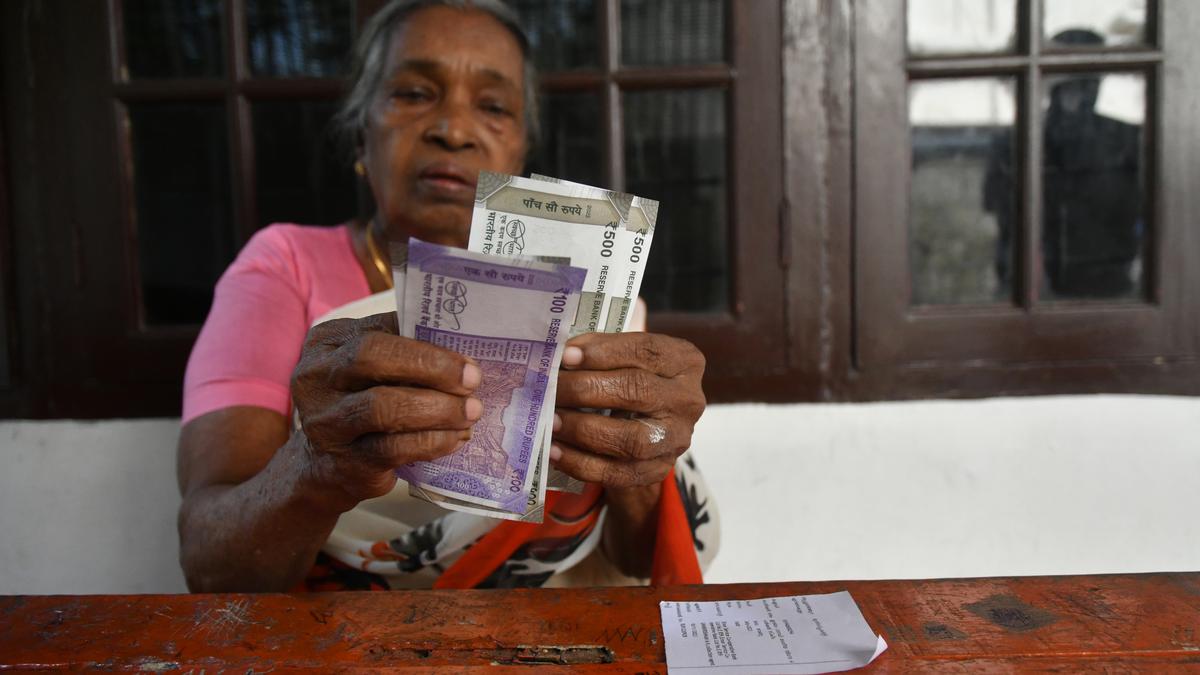
For the last few months, Mary Jayashree has been waiting patiently for the arrival of her social security pension. The ₹1,600 a month cannot fully meet the educational expenses of her two daughters, says the homemaker from Nediyamcode, a panchayat ward in south Kerala, but it is still an amount due to her. The delay that has hit welfare pension payments in the State in recent months has affected thousands, and Jayashree, who is eligible for a widow pension, is no exception. She says resignedly, “We can only wait for it to arrive. You can’t simply go there [the pension office] and demand it.”
From August 2023 onwards social security pensions have been in the news for the wrong reasons: they have not been paid. Though orders have been issued in November to release the July payment immediately, there is no clarity on arrears. The government spends about ₹900 crore a month on pension disbursed to close to 60 lakh beneficiaries.
The issue has quickly become part of an impassioned debate on the troubled Centre-State relationship, in particular on the fiscal front that has been raging for some time now. The CPI(M)-led Left Democratic Front (LDF) government has blamed hostile Union government policies for Kerala’s wider financial crisis. The delay also acquired a political and social dimension with the Opposition Congress-led United Democratic Front (UDF) attacking the government for ignoring the disadvantaged sections while splurging crores on the November 1-7 Keraleeyam 2023 celebrations, which — in the government’s words — was meant to show “Kerala’s progress, achievements, and cultural heritage to the world”.
For many, the monthly pension of ₹1,600 is indispensable. K.V. Sarasan, 77, from Edavanakkad, Ernakulam district, illustrates the predicament of elderly beneficiaries. He and his wife Remani, who is 75, require close to ₹5,000 to pay their monthly medical bills. Sarasan is also a heart patient. “Perhaps it is not enough to meet all our needs, but we have no other income. People like us, in fact, cannot do without these monthly payments. When there is a delay, we are forced to borrow money, and run up a debt,” he says.
In early November, two women in their 80s, Mariyakutty and Annamma Ouseph, as a way of protest, took to seeking alms at Adimali town in Idukki district, on failing to receive their monthly pensions. They received wide media coverage and this contributed to keeping alive the heated debate on the pension arrears. A smear campaign, allegedly intended to discredit Mariyakutty, misfired. Meanwhile, senior Congress leader Ramesh Chennithala and actor and BJP leader Suresh Gopi said they would personally pay the pensions of ₹1,600 each to the two elderly women until the government disbursed the amount. Subsequently, on November 16, the Finance department issued orders sanctioning funds for distributing the social security pensions and welfare fund board pensions for July.
“There are many elderly people who depend on these pensions so that they don’t have to approach their children for their meagre needs, including buying medicines,” notes L.N. Selvaraj, 67, a pensioner and former daily wage earner, from Thiruvananthapuram district. But Selvaraj also views the issue in a larger context. “The UDF too had run up arrears in their time, so it is not something you blame the Left government alone. Besides, you cannot ignore the fact that it is the LDF government which increased the pensions to ₹1,600 a month, in 2021-22,” he says. Through the 2016-17 Budget, the Oommen Chandy-led UDF government had increased the old age pension to ₹1,500 and extended the benefit of the widow pension to women who were deserted by their husbands for “more than five years.”
The social security pensions consist of the Indira Gandhi National Old Age Pension, the Indira Gandhi National Widow Pension, the Agriculture Labour Pension, the Indira Gandhi National Disability Pension, and the Pension for Unmarried Women above 50 Years. Kerala’s emphasis on social protection through welfare pensions has also evolved into a Kerala Model.


MP M. Sribharat urges collective efforts to revive Visakhapatnam Steel Plant, highlighting key reforms for crucial recovery and growth.

141 candidates have filed nominations for Kozhikode's Assembly elections, with scrutiny on March 24 and campaigning intensifying.

BJP's Vijayendra accuses Congress of using money to influence Bagalkot bypolls, urging voters to reject their tactics.

First randomization of electronic voting machines completed in Tirunelveli and Tenkasi districts for upcoming Assembly elections.

RPF seizes 10.12 kg of unclaimed cannabis worth ₹5.06 lakh from a train in Mangaluru.

Kolar's groundwater levels rise to 50-100 ft due to the K.C. Valley project, ensuring clean water and improved health outcomes.

Three smugglers arrested in Sangareddy with 574 kg of ganja valued at ₹2.87 crore during a police operation.

Mysuru MP urges a 'flex-free Mysuru' by discouraging birthday banners, promoting responsible celebrations to preserve the city's heritage.

Farmers of Kalakudi demand payment for paddy bags procured at DPC

BJP's seal on a 2019 Election Commission letter ignites controversy in Kerala, prompting claims of careless handling by CPI(M).

Transgenders go on rally condemning Transgenders Amendment Bill 2026

Supreme Court dismisses plea challenging Sonam Wangchuk's detention, noting the Centre revoked it on March 14, 2026.

Private medical shops in Telangana government hospitals face eviction due to expired leases and ongoing legal challenges, says Health Minister.