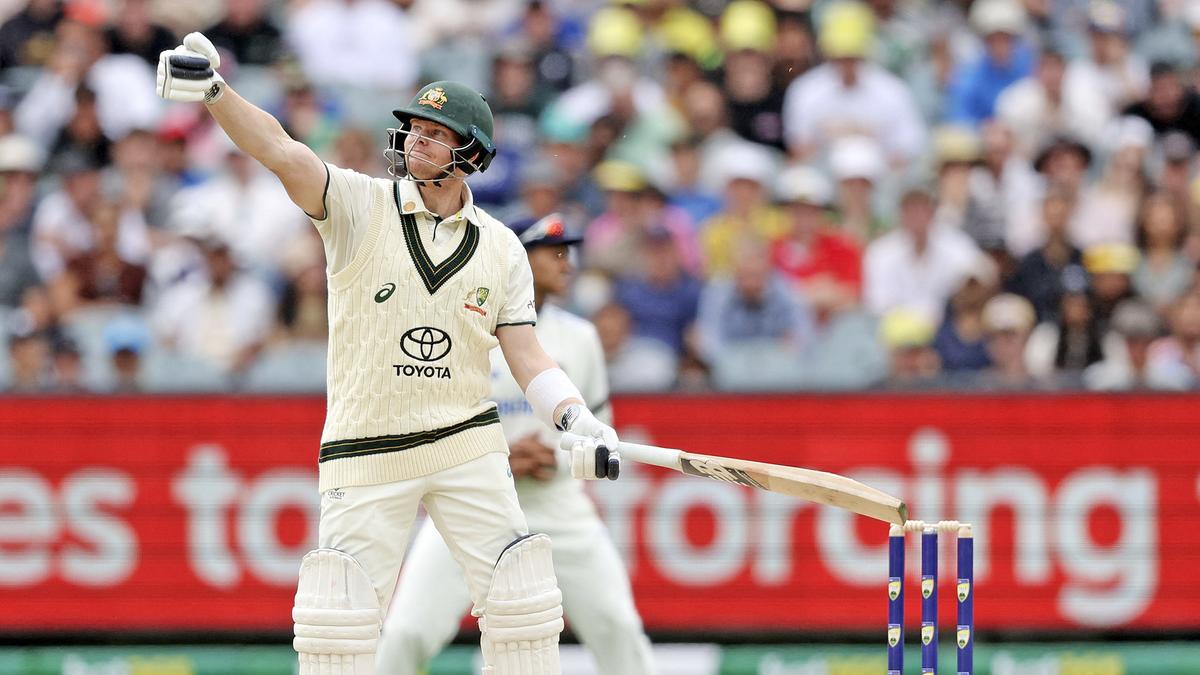
Smith still shows the hunger to remodel his beloved art
The Hindu
Steve Smith's unique batting style, hand movements, and resilience make him a cricketing legend of his generation.
Even those with only a cursory interest in Steve Smith’s international career will be aware that he started his days in Test cricket as a leg-spinner, more than 14 and a half years ago against Pakistan at Lord’s. That he batted at No. 8 and No. 9 respectively on his Test debut, and didn’t move up into the top half of the batting order until March 2013, by which time he had played for Australia for close to three years.
The right-hander’s first foray in the top six netted him 92, against India in Mohali. That cemented his position as a specialist batter who occasionally bowled leg-spin. So occasionally, that in the last five years since he returned from a long ban following his involvement in Sandpapergate in South Africa in early 2018, he’s bowled only 20.5 overs for two wickets in the five-day game.
Smith’s status as among the three or four most pre-eminent batters of his generation is well established. Full of quirks and unique mannerisms that coaches across the world urge their wards to steer clear of copying, he has found his own happy medium through which he makes runs. Not attractive runs – seldom attractive runs, actually – but effective, match-saving, match-turning runs. He is a mere 38 short of completing 10,000 runs in Test cricket, boasts 34 centuries, including two in the last fortnight against India, and averages a smashing 56.28, the mark of an all-time great, no matter in which era he plies his wares.
Of all things quintessential Smith, eccentric movements and elaborate leaves included, the most crucial element to his batting are his hands. That might sound silly, considering that without ‘hands’, batters can’t bat. But Smith’s hands are the stuff of folklore. When he says he has found his hands, oppositions beware. It loosely translates to, ‘I am feeling good about the feel of the bat in my hands, here I come’.
When Smith has claimed to have found his hands, the runs come automatically. And in a torrent. Before the 2017-18 Ashes when he spoke about re-finding his hands, his average was an astonishing 137.40. Prior to that, in 2015-16, he boasted averages of 214 and 131 in successive series on rediscovering his hands. So, when Pat Cummins pronounced in Perth, ahead of the first Test against India, that Smith’s hands too had come with him to the Western Australian capital, there was good reason for the Indians to start wondering what carnage lay in store.
To their good fortune, while the hands came to Perth, the runs did not. Not to Perth, nor to the Adelaide Oval, the venue of the pink-ball Test. His scores in the first three innings were 0 (trapped leg before, first ball, by Jasprit Bumrah), 17 and 2. The famous hands, eh? Where were they?
Very much with Smith, as it turned out. Even when the runs weren’t coming – and one of those dismissals was caught down leg, one of the unluckiest ways for a batter to be dismissed – Smith didn’t fret or fume. He wasn’t anxious, he wasn’t seized of the need to lay bat on ball, to spend long hours wondering when the big one was coming. After all, at the end of the Adelaide Test, he had gone 18 months and 24 innings without a hundred. For a serial century-maker, that wasn’t just unusual, it was unprecedented.


Sam Curran to miss IPL 2026 for Rajasthan Royals due to injury, prompting search for replacement options.

IPL 2026 Countdown: Lucknow Super Giants should strike a balance between aggression and recklessness
Lucknow Super Giants should strike a balance between aggression and recklessness

Novak Djokovic withdraws from the Miami Open due to a shoulder injury, missing his chance for a seventh title.

Stojanovic's late goal secures a 1-1 draw for Jamshedpur against SC Delhi in the ISL opener.

Tamil Nadu’s Balamurugan and Pande secure a doubles medal by defeating top seeds at the 87th National Table Tennis Championship.

CSK faces a major setback as Nathan Ellis's hamstring injury rules him out of IPL 2026, prompting replacement plans.

Lionel Messi scores his 900th career goal, joining Ronaldo in an elite club despite Inter Miami's CONCACAF exit.

Men in Blue — a T20 behemoth

Delhi Capitals aim for IPL 2026 success, relying on key players to finally achieve their elusive championship dream.

Delhi Capitals aim for IPL 2026 success, relying on key players to finally achieve their elusive championship dream.

Abhay aims to break into top 20 by the end of the season

76-year-old Kurian Jacob from Kerala triumphs with seven medals, including five golds, at the Open Masters Games in Abu Dhabi.

Virat Kohli leads RCB's training session ahead of IPL 2026, marking a significant return to M. Chinnaswamy Stadium.