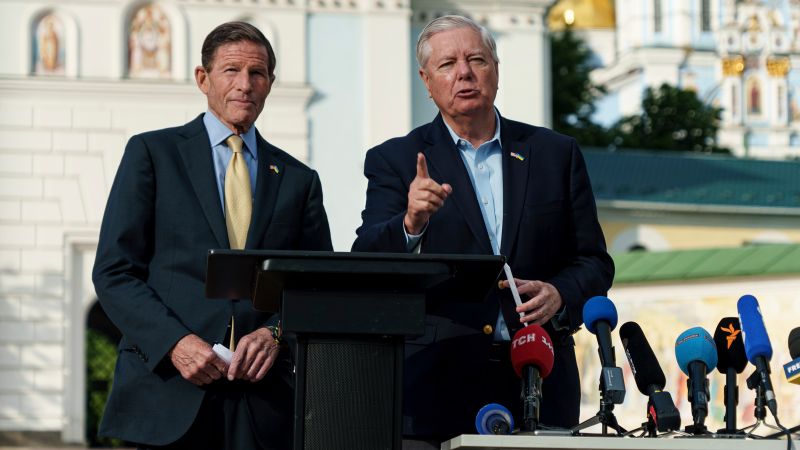
Senators tout Russia sanctions bill as ‘sledgehammer’ for Trump to end war in Ukraine
CNN
The legislation, which would allow the president to levy a 500% tariff on imports from countries that purchase Russian uranium, gas and oil, has gained momentum in the Senate as Trump has signaled he will escalate US action against Russia.
Republican Sen. Lindsey Graham and Democratic Sen. Richard Blumenthal are urging quick action by the US as Russia escalates its war in Ukraine, including the passage of a bipartisan bill they’ve introduced implementing sanctions on Moscow that they say could be the “sledgehammer” President Donald Trump needs to end the conflict. The legislation, which would allow the president to levy a 500% tariff on imports from countries that purchase Russian uranium, gas and oil, has gained momentum in the Senate as Trump has signaled he will escalate US action against Russia. “(Blumenthal) and I have got 85 co-sponsors in the United States Senate for congressional sanctions with a sledgehammer available to President Trump to go after Putin’s economy and all those countries who prop up the Putin war machine,” Graham said on CBS’ “Face the Nation” on Sunday, referring to Russian President Vladimir Putin. The two lawmakers just returned from Rome, where they attended a conference focused on Ukraine’s recovery and met with Ukrainian President Volodymyr Zelensky and other European leaders. Blumenthal said European allies expressed to the lawmakers that any potential US sanctions would “have to be tough and rigorous to change behavior.” Russia conducted its largest drone assault on Ukraine since the start of its full-scale invasion last week, launching 728 drones and 13 missiles in strikes that killed at least one person, according to Ukrainian officials. Senate Majority Leader John Thune told reporters last week that he could bring the bill to the floor by the end of the month, something he had indicated he would not do without the Trump’s approval.


The Justice Department on Thursday seized several websites it says were used by Iran as part of “psychological operations” targeting perceived advisories and spreading terrorist propaganda.

Sen. Thom Tillis on Thursday blasted talk of ending the Senate filibuster to pass the “SAVE America Act” as a “foolish and lazy idea” and warned his party that pushing the president’s priority through the so-called talking filibuster would hand control to Democrats.

On two major occasions, the Trump administration has gestured at Israel being mostly responsible for major inflection points in the Iran war — even though the evidence on both counts isn’t totally clear.

Conservative hardliners who supported subpoenaing Attorney General Pam Bondi in the House Oversight Committee’s Jeffrey Epstein probe are now indicating that they are open to changing their position after Bondi met with the panel for a briefing that turned contentious with Democrats.

Cracks emerge in GOP over Iran war cost as administration floats more than $200B request to Congress
Cracks are emerging among congressional Republicans over the Iran war with key lawmakers skeptical about spending hundreds of billions of dollars to prolong the conflict and several refusing to support any money without a clear White House strategy.

Jeffrey Epstein’s longtime employee and attorney Darren Indyke testified on Thursday that he “had no knowledge whatsoever” of the convicted sex offender’s wrongdoing and rejected “any suggestion” he assisted or facilitated his former boss’ crimes.

Democratic Sen. John Fetterman cast the deciding vote Thursday to advance Markwayne Mullin’s nomination to serve as US Department of Homeland Security secretary, crossing party lines to send President Donald Trump’s nominee to the full Senate for consideration.

A US F-35 fighter jet made an emergency landing at US air base in the Middle East after it was struck by what is believed to be Iranian fire, according to two sources familiar with the matter.

In 2025 a record number of more than 22,000 Cubans arrived in Uruguay, according to to the National Migration Agency. CNN’s Dario Klein reports.

For over a month, Transportation Security Administration employees have been showing up to work at US airports without getting paid.

CNN’s 5 Things AM brings you the news you need to know every morning.

Both President Donald Trump and first lady Melania Trump have encouraged Susie Wiles to take the time she needs away from the White House to deal with her treatment, but Wiles argued she does not plan to do so, people familiar said.

A transparency law passed by Congress has forced the release of more Epstein files than ever before, but some lawmakers and victims are exploring ways to push the Justice Department to disclose even more information from the voluminous trove that’s being withheld.