Seeped in sepia: Deep blacks, striking shadows define Jethalal’s photos of Bollywood’s yesteryear stars
The Hindu
Sitare Zameen Par, an ongoing exhibition at Noida’s Kiran Nadar Museum of Art, shows his quintessential photography techniques, like using cigarette smoke and lamp soot to create dreamy backgrounds
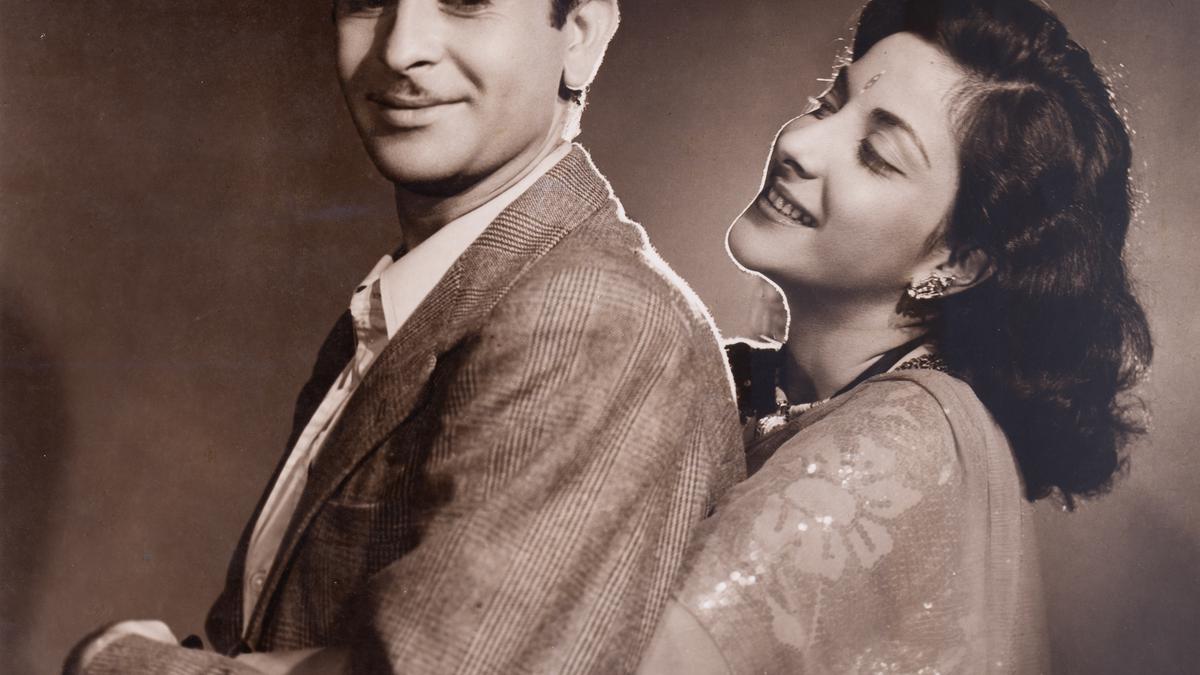
A striking portrait of Raj Kapoor and Nargis Dutt greets you at the entrance wall, two life-size photos of Madhuri Dixit smile at you from far end; a series of pictures with familiar faces draw you inside as soft melodies of yore playing on a radio set transport you to an era gone by.
Sitaare Zameen Par, the ongoing exhibition at the Kiran Nadar Museum of Art (KNMA) in Noida, brings to life the enigmatic Bollywood stars of the yesteryear through elegant black-and-white portraits shot by legendary photographer Jethalal H. Thakker. “Thakker, a partition refugee, set up India Photo Studio in 1948, in a spacious art-deco apartment in Dadar (Mumbai),” informs Roobina Karode, director and chief curator of KNMA. A master of compositions in black and white and sepia tones, Jethalal, adds Roobina, created magic with his silver gelatine prints, a technology that he had mastered. He created images with deep blacks, striking shadows, and organic textures which eventually became his style. About 120 of which are on display at the exhibition..
In a new light
The exhibition presents legendary actors of the 50s and 60s in avatars we may have never seen them in. A photograph of Meena Kumari, who was otherwise perceived as quiet, serious, and guarded, shows her as a young woman in a sensous costume with glistening eyes, and a playful expression. A picture of actor Raaj Kumar, known for his tough characters, presents him as a gentle lover in a warm embrace with co-star Nimmi (Nawab Bano); another one, of Mithun Chakraborty, known for his versatility and confidence, portrays an innocent young man who had just landed in Mumbai looking for work. “Mithun got his first portfolio shot by Thakker on the basis of which he got admitted to FTII, Pune. The rest, as we know, is history,” says Roobina. “In one sense,” she adds, “all these images showcase the faith the stars entrusted in the photographer — in portraying the essence of an emotion as embedded in a pose.”
The emotions are palpable in all pictures and one cannot but take one’s eyes off the wall that displays nine portraits of the most popular heroines of the time — Sadhana, Meena Kumari, Vyjayanthimala, and Rajashree to name a few — each telling her own story. Another wall, dedicated entirely to Nargis (Jethalal was especially close to the Dutts), portrays her versatility and vivaciousness. The blow-ups of Madhuri Dixit, the only contemporary face here, blend in seamlessly with those of her seniors — thanks to similar lighting, costumes, and make-up. The use of lighting, one of Jethalal’s trademark, is evident in every portrait with shadows standing out as much as the light.
Beyond the stars
Jethalal’s work, however, was not confined to superstars alone. We see impressive portraits of character artistes, directors, villains, music directors and singers. An entire section showcases stills from larger-than-life film sets, another replicates Jethalal’s studio in Mumbai (now run by his son Vimal Thakker), and a short documentary that plays on a headphone-enabled screen, gives a deep insight into the world of the artiste’s photography.


South African naturalist Steve Boyes speaks on ghost elephants, ancestral tracking, and Werner Herzog’s documentary exploring Angola’s elusive highland giants

Actor-director Amol Palekar will receive META's Lifetime Achievement award for 2026 on March 25 in New Delhi.

India's artists unite against rising censorship, advocating for creative freedom and support for marginalized voices in the arts.

Written and directed by Kunal, the film also stars Sparsh Shrivastava and Vanshika Dhir

This year, Bharatnatyam artistes will present the Tyagaraja Aradhane as a dance performance

This year, Bharatnatyam artistes will present the Tyagaraja Aradhane as a dance performance

The actor, along with director Sushant Shah, speak about their upcoming series ‘Chiraiya’, Divya’s process of working on the dialect, Sushant’s approach to telling a story about women, and more

An independent video, ‘Feel the Spark’ by Raleigh Rajan with vocals by Ciera Dumas that celebrates Tamil literary giants, garnered 1.4 million views in less than 36 hours.

In ‘Jack Ryan: Ghost War’, John Krasinski is back as the savvy CIA analyst, diving headfirst into a high-stakes mission that unravels a deadly conspiracy and pits him against a rogue black-ops unit

Shriram Bharatiya Kala Kendra’s Shankarlal festival showcased rare ragas, radiant artistry, and inclusive performances, from Pt Madhup Mudgal’s serene morning ragas to Ramana Balachandran’s Saraswati veena.

Explore "Threads that Bind: The Kantha Project," an exhibition in Delhi reimagining kantha as a medium of repair and renewal.

Sean Penn skips the Oscars to meet Ukraine's Zelenskyy, who praises him as a "true friend" amid the war.

The teaser of Tamil star Suriya’s much-awaited film with director Venky Atluri, titled Vishwanath and Sons, was unveiled by the makers on Monday