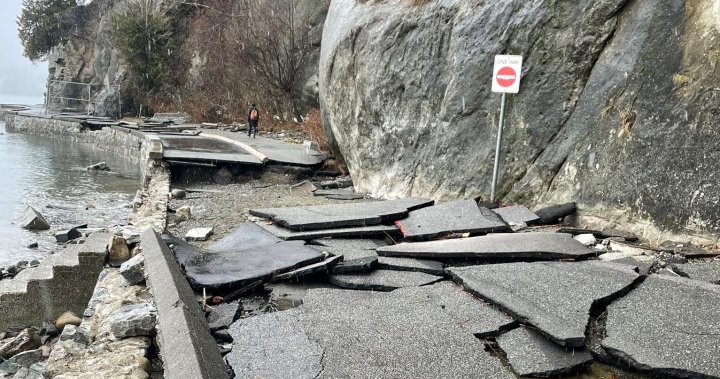
Seawall damage a sign of things to come amid sea level rise and climate change, experts warn
Global News
The damaging combination of winter storms and extra-high 'king tides' will pose a growing problem for coastal infrastructure amid rising sea levels, said one SFU earth scientist.
The extensive storm damage to parts of Vancouver and West Vancouver’s waterfront on Friday may be a sign of things to come amid climate change and rising sea levels, experts warn.
Parts of the Stanley Park and Ambleside Park seawalls were left looking like they’d been hit by an earthquake after strong winds helped produce a storm surge at the same time as a seasonal king tide.
SFU earth sciences professor, John Clague, said the combination of those two factors was exacerbated by sea level rise, and that similar damaging storms are expected to increase in frequency in the years to come.
“It’s a double whammy because you’ve got sea level higher, but you’ve also got the cyclic king tides stacked on top of that, which means that the types of event we saw on Friday are going to become more common and they’re going to be more damaging,” he said.
According to the U.S. Global Change Research Program, the global sea level has already risen by between 16 and 21 centimetres since 1900 — and the rate is increasing. About seven centimetres of that rise accrued in the last 29 years.
Estimates vary on how fast oceans will continue to rise, but the federal 2019 Changing Climate report projects the Vancouver area will likely see more than 50 centimetres in growth over 2000 levels by century’s end.
The B.C. government has advised municipalities to plan for a sea-level rise of 50 centimetres by 2050 and one metre by 2100.


Statistics Canada on Monday said the price of beef rose nearly 14 per cent year over year in February, but that rate is slower compared with the month before.

The decision halts an order to end broad recommendations for all children to be vaccinated against flu, rotavirus, hepatitis A, hepatitis B, some forms of meningitis and RSV.

It was both a big win and hopefully not too big of a loss for the Edmonton Oilers on Sunday.

Some experts say that a cyberwar through 'proxies' may be the next stage of the Iran war, with civilian infrastructure also coming under threat.

The study is being billed by the university as "the first to study a wide range of factors which link ADHD symptoms and mental ill health symptoms over time."

The group says MAGA Energy hasn't paid its lease for three years, and therefore the company is no longer allowed on their land in Edmonton.

The analysis by the Canadian Climate Institute says oilsands producers will pay an average of about 50 cents per oil barrel, if the minimum carbon price rises to $130 per tonne.

Between November 29 and February 27, authorities recorded 406 outbreaks of bird flu in domestic birds in 32 European countries and 2,108 outbreaks in wild birds, they said.

Dr. Michael Domeier, director of the Marine Conservation Science Institute, told Global News that they tag the adult females as they are the most interesting.

Regina’s recycling contamination is currently triple the limit and city is urging resident to change sorting habits now to avoid citywide fines and higher resident fees.

The study found that higher ultra-processed food intake at age three years was associated with adverse behavioural and emotional symptoms at age five years.

Edmonton's single-use waste rules were controversial and unpopular when introduced in 2023 — but new data shows the changes are having the intended effect of reducing garbage.

Carney's speech to Australia's parliament highlighted a soon-to-launch Canadian low earth orbit satellite network that experts say could soon compete with Elon Musk's Starlink.