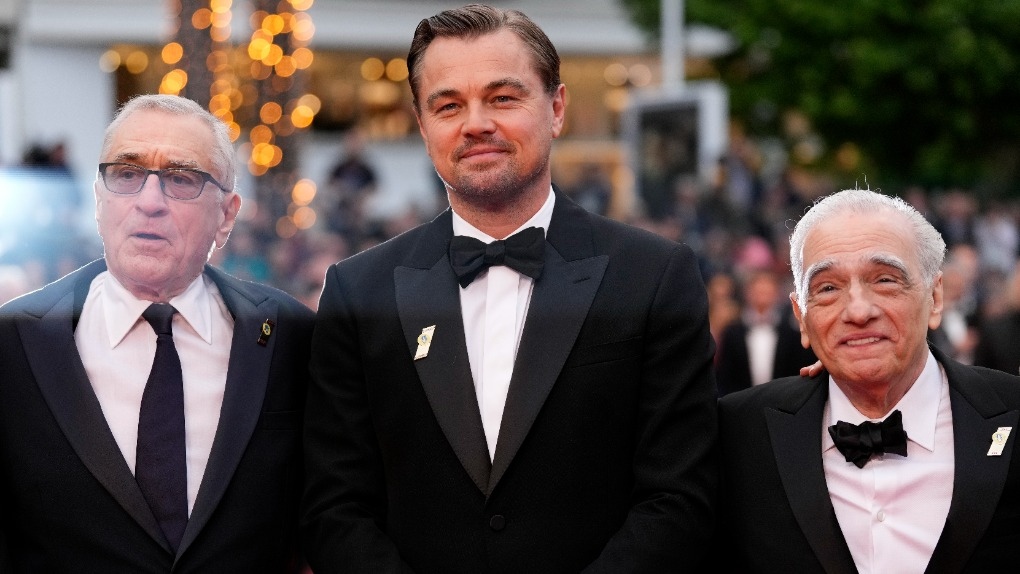
Scorsese debuts 'Killers of the Flower Moon' in Cannes to thunderous applause
CTV
Martin Scorsese unveiled "Killers of the Flower Moon" at Cannes on Saturday, debuting a sweeping American epic about greed and exploitation on the bloody plains of an Osage Nation reservation in 1920s Oklahoma.
Martin Scorsese unveiled "Killers of the Flower Moon" at Cannes on Saturday, debuting a sweeping American epic about greed and exploitation on the bloody plains of an Osage Nation reservation in 1920s Oklahoma.
Scorsese's latest -- starring Leonardo DiCaprio, Lily Gladstone and Robert De Niro -- is one of his most ambitious. Adapting David Grann's nonfiction bestseller, it stretches nearly three and a half hours and cost Apple US$200 million to make.
Nothing has been more anticipated at this year's Cannes Film Festival than "Killers of the Flower Moon" -- a historical epic, a bitter crime film and a Great Plains Western -- which appeared to meet those expectations. It drew a lengthy standing ovation and repeated cheers for Scorsese, 80, who premiered his first film at Cannes since 1985's "After Hours."
"We shot this a couple of years ago in Oklahoma. It's taken its time to come around but Apple did so great by us," Scorsese said, addressing the crowd after the screening. "There was lots of grass. I'm a New Yorker."
The red carpet drew a wide spectrum of stars. Along with the film's expansive cast, attendees included Apple CEO Tim Cook, as well as actors Cate Blanchett, Salma Hayek, Paul Dano and Isabelle Huppert.
Though Grann's book affords many possible inroads to the story, Scorsese and co-writer Eric Roth center their story on Ernest Burkhart (DiCaprio, in his seventh collaboration with Scorsese), a WWI veteran who falls for Mollie Brown (Gladstone), the member of a wealthy Osage family.
Since finding oil reserves on their land, the Osage were then the richest people per capita in the country. But that wealth is closely controlled by appointed white guardians. A series of murders prompts increased panic among the Osage, who are preyed on by a host of greedy killers.


Nicholas Brendon, who played the character of Xander in the hit ’90s TV series “Buffy the Vampire Slayer,” has died. He was 54.

ABC has scrubbed the upcoming season of “The Bachelorette,” starring Taylor Frankie Paul, citing a newly released video from 2023.

Still coming down from a marathon night of Oscars celebrations that stretched well past sunrise, Maggie Kang is already thinking about what her historic win could mean for filmmakers trying to break through.

Three men who alleged that actor Kevin Spacey sexually assaulted them have settled their civil claims before going to trial at the High Court in London, courts document show.

Neither Sofia Coppola nor Marc Jacobs were convinced a documentary was a good idea. Jacobs wasn’t sure he wanted to be the subject of one and Coppola wasn’t sure she wanted the pressure of being the person behind the camera. This was her friend of over 30 years, after all. What if the film wasn’t good?

Sean Penn finally got his hands on his third Oscar… sort of.

Len Deighton, a prolific writer whose tough, stylish spy thrillers featured on bestseller lists for decades, has died. He was 97.

A great deal of Ryan Gosling’s journey through the film “Project Hail Mary” unfolded in solitude. The “La La Land” actor spent long stretches filming alone on set, or acting opposite an alien creature his character, Dr. Ryland Grace, dubs Rocky.

Cardi B is dragging the Hammer for slow ticket sales.

A planned reboot “Buffy the Vampire Slayer,” that was set to be directed by Oscar-winning director Chloe Zhao, has been cancelled, star and producer Sarah Michelle Gellar said.

Sean Penn, who scored an Oscar for best supporting actor for “One Battle After Another” on Sunday, is in Ukraine to show support to the war-torn country, a senior Ukrainian official told AFP.

The 98th Academy Awards on Sunday saw “One Battle After Another” win big with six awards, including best picture, director, supporting actor and casting.

When Melanie Galeaz posted a fan edit of “Heated Rivalry,” she didn’t know it would lead to her dream job.