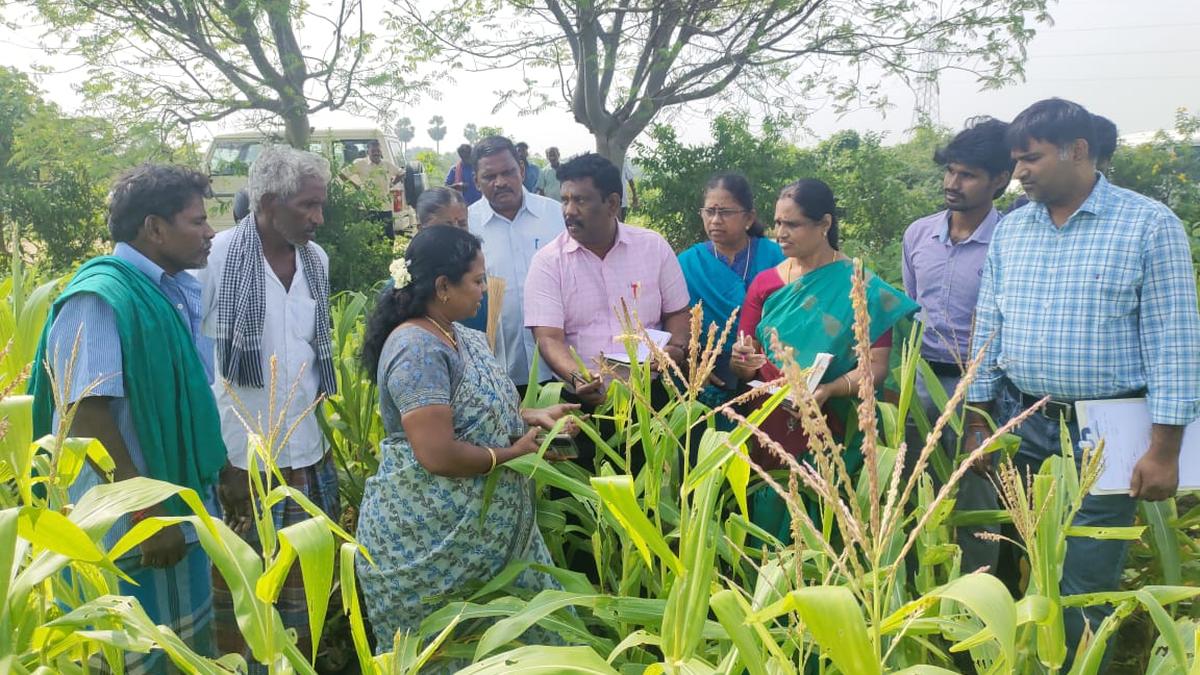
Scientists, officials inspect Fall Armyworm-hit maize fields in Tiruchi district
The Hindu
Scientists inspect maize fields in Tiruchi district for Fall Armyworm infestation, suggest integrated pest control measures.
A team of scientists from the Krishi Vigyan Kendra (KVK), Sirugamani, and officials of the Agriculture Department, inspected some of the maize fields affected by Fall Armyworm, an invasive pest, in Kariyamanickam and Thirupattoor areas in Tiruchi district on Tuesday.
Maize is raised in all 14 blocks in Tiruchi district and recently farmers from Kariyamanickam, Thirupattoor and neighbouring villages had complained of the pest attack. The issue was raised at the recent farmers’ grievances meeting and a section of farmers had made a representation to the Collector at the weekly grievances meet on Monday.
The crop has reached the maturity stage of 45-60 days, officials said.
A team led by P. Vasantha, Joint Director of Agriculture, C. Raja Babu, Programme Coordinator, K. V. K. Sirugamani, and scientists from Central Biological Control Centre conducted a field inspection in the two villages in Manachanallur block on Tuesday and suggested measures to control the pest. The team found sporadic attack of Fall Armyworm attack in some fields.
Later, in a statement, the KVK said that the Tamil Nadu Agricultural University (TNAU) has developed a ‘technology capsule’ to manage the pest. This included summer ploughing, basal application of neem cake of 100 kg an acre, seed treatment with a biopesticide, adopting proper spacing, growing border crops like cowpea, gingelly, sunflower and intercropping of blackgram or greengram.
Monitoring and mass trapping of adult male moths of Fall Armworm using pheromone traps and application of recommended pesticides were suggested.
The KVK scientists were visiting maize fields frequently to sensitise farmers on the need to adopt the integrated pest control mechanism consisting of a pheromone trap and bio-control methods to control the worm. The larvae start causing damage from 15 days after sowing and continue their ravage on tassels and cobs. While adult moths are covered with greyish white hairs on the upper surface of leaves, larva has an inverted Y mark. On the head and cluster of four dots in the abdomen region and can be seen on leaves. Farmers have been advised to apply 250kg of neem cake per hectare to reduce adult emergence from pupae, use light trap to monitor adult activity in the evening and avoid growing maize crop after crop, the release said.


Bengaluru police launch a special drive to curb reckless riding after doctors' alcohol-fueled road incident raises concerns.

Five queer activists discuss the repercussions of the Trans Amendment Bill 2026 on dignity and identity within the community.

Former Chief Minister Narayanasamy opts out of Puducherry Assembly elections to maintain alliance harmony amidst seat-sharing talks with DMK.

Dr Prarthana Venkatesh, the founder of nutraceutical brand Longevita, talks about the inspiration behind the brand, why the longevity discourse is now exploding and how modern medicine is tackling aging

Ponmudy seeks Madras High Court's intervention to dismiss BJP councillor's complaint over alleged derogatory speech against religious groups.

Congress leader K.C. Venugopal alleges corruption in Kerala's bar license renewals, accusing CPI(M) and BJP of unethical collusion ahead of 2026 polls.

Bengaluru police arrest three in a money-doubling fraud, recovering ₹40 lakh and uncovering additional victims.

AIADMK faces perception challenges and electoral setbacks in Tamil Nadu, struggling to maintain its traditional stronghold and voter base.

K. Ashok appointed Executive Director of BHEL Tiruchi, succeeding S. Prabhakar after 36 years of experience in the company.

Garbage collection resumes in Bengaluru amid contractor disputes over payment delays and new waste segregation rules by BSWML.

Delhi High Court rules universities cannot restrict peaceful expression of dissent, emphasizing the importance of independent thought and discourse.

Mettur Dam's water level is at 82.83 feet, with an inflow of 384 cusecs and discharge of 800 cusecs.

Lebanon expels Iran's ambassador, declaring him persona non grata, while maintaining a Charge d'Affaires at the embassy.