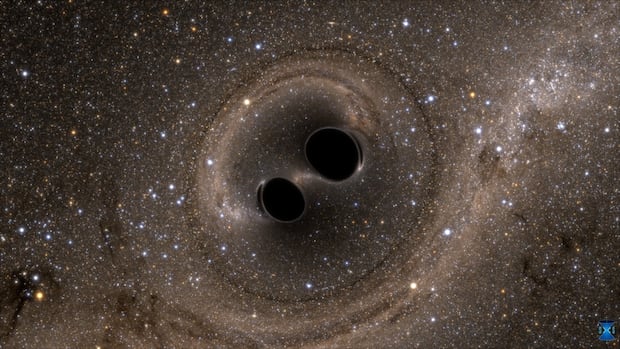
Scientists have detected the largest black hole merger yet. What it is and why it matters
CBC
It was a bump in the night. A big one.
On Nov. 23, 2023, waves from a colossal merger of two black holes reached Earth and were picked up by the LIGO-Virgo-KAGRA Collaboration, a group that detects these sort of mergers through gravitational waves.
And these black holes were chunky, coming in at 100 and 140 times the mass of the sun.
But the final merger produced something even more impressive: another black hole that is more than 225 times the mass of the sun, astronomers revealed today.
Astronomers are excited about this merger because it's unusual. Most of these kinds of mergers detected thus far through gravitational waves have been between 10 and 40 times the sun, said Sophie Bini, a postdoctoral researcher at Caltech who is part of the group.
"We detected the first gravitational wave 10 years ago, and since then, we have already found more than 300 events. So it's really an exciting [time]," Bini said. "But this event in particular is very interesting because it's the most massive one."
Gravitational waves are ripples in space-time that can only be detected by extremely sensitive instruments, like the ones from the collaboration, which are located across the United States, Japan and Italy.
The first gravitational wave was detected in 2015 and announced by astronomers in 2016.
The other interesting discovery of this detection — called GW231123 — is that the pair appear to have been spinning extremely quickly.
"The black holes appear to be spinning very rapidly — near the limit allowed by [Albert] Einstein's theory of general relativity," Charlie Hoy at the University of Portsmouth said in a statement. "That makes the signal difficult to model and interpret. It's an excellent case study for pushing forward the development of our theoretical tools."
Not all black holes are created equal.
There are supermassive black holes that can be tens of thousands to billions of times the sun's mass and lie at the centre of galaxies. The Milky Way, for example, has a black hole at its centre, called Sagittarius A* — or Sgr A* — that is roughly four million times the mass of the sun.
Then there are stellar-mass black holes, which can be from a few times the mass of the sun to tens of times the mass. Or, some argue, a hundred of times its mass. These form when a massive star runs out of fuel and explodes in a spectacular fashion, an event called a supernova.
But then there are those that lie somewhere in between the two, called intermediate black holes. Finding these in-betweens has proved difficult for astronomers. This new merger lies within what astronomers call the "mass gap" between stellar-mass and supermassive black holes.


The federal government is putting $200 million toward a Canadian-owned launch pad to send satellites into orbit.

Paige Eaton wanted to stay open-minded about the birth plan for her first baby, so when she ended up needing an emergency C-section, the Kitchener, Ont., resident felt somewhat prepared.

This story is part of CBC Health's Second Opinion, a weekly analysis of health and medical science news emailed to subscribers on Saturday mornings. If you haven't subscribed yet, you can do that by clicking here.

Lac La Ronge Indian Band's Woodland Wellness Centre has received funding to start a mobile addictions outreach program to address the opioid and mental health crisis.

Adriana Avelina Ruíz Márquez uses fake eyelash glue to attach a tiny transmitter to the thorax, just behind the head, of the monarch butterfly.

After several delays to the mission that will take four astronauts around the moon, NASA held a press conference today announcing that Artemis II is on track to launch as early as April 1.

Snuneymuxw First Nation is calling for a temporary closure and environmental investigation of a hazardous waste services company following a January oil spill on Duke Point near Nanaimo, B.C.

In February, five people were killed in separate avalanches across B.C. and Alberta. That same month, more than a dozen people were killed in California and Utah, including a particularly deadly avalanche that claimed the lives of nine. In Europe, from Andorra to Slovakia, the season has recorded 125 deaths from avalanches so far.

Getting a proper vehicle to transport people for urgent medical care is an ongoing challenge in fly-in First Nations in northwestern Ontario.

A new supergroup of musicians from Six Nations of the Grand River and Mississaugas of the Credit First Nation have collaborated on a Robbie Robertson-inspired song they will perform at the Junos Honouring Ceremony later this month in Hamilton.

People as young as 45 should be invited to provincial and territorial programs to screen for colorectal cancer, the Canadian Cancer Society urged on Wednesday.

The Métis Nation-Saskatchewan (MN-S) has opened an office and retail space in Ottawa to create a stronger presence in the capital since removing itself from the Métis National Council in 2024.

Toronto resident Winhan Wong's lung cancer journey began in 2016, with a nagging cough that just wouldn't go away.