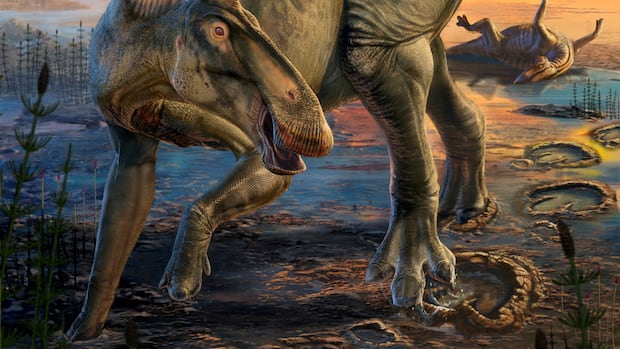
Scientists discover dinosaur 'mummies' with hoofs like a horse
CBC
It’s been more than 60 million years since duck-billed dinosaurs roamed around what is now known as western North America.
Or, more accurately, since they clomped around. On their hoofs.
This, according to a new study of “dinosaur mummies” — fossils in which the external anatomies of dinosaurs are rendered in incredible detail onto thin layers of ancient clay.
It marks the first time hoofs have been found on a dinosaur or, in fact, any reptile. But the researchers behind the discovery expect more will turn up, now that people know to look for them.
“I think people's antennae will be up now to try and make sure there's nothing there when they're excavating,” University of Chicago paleontologist Paul Sereno, the study’s lead author, told As It Happens host Nil Köksal.
The findings, published in the journal Science, paint the most complete picture to date of what duck-billed dinosaurs actually looked like.
What’s more, the study unravels the long-standing mystery of how these so-called dinosaur mummies formed in the first place.
Duck-billed dinosaurs were far more common than their more famous contemporaries of the Cretaceous Period, like the apex predator Tyrannosaurus, or horned dinosaur Triceratops.
In fact, these nearly three-metre long plant eaters were a favourite meal of the T. Rex.
Also known as Edmontosaurus — because the first fossils were discovered in southern Alberta — they roamed together in giant herds, grazing on plants, much like modern-day cows, sheep and goats.
Also like today’s grazing mammals, these dinos developed hoofs, structures that protected their toes, supported their weight, offered traction and absorbed shock from the impact of all that walking — and running for their lives.
"It's remarkably like a later equine or horse hoof, or something that you might see on a relative, a tapir or a rhino,” Sereno said.
“There's a shield around the outside, and then sort of a soft core on the bottom side that really resembles the mammalian hoofs that evolved so much later.”
It’s an example of a phenomenon known as convergent evolution, in which different organisms independently evolve similar features — like the wings of birds, bats and the extinct flying reptiles called pterosaurs — while adapting to similar environments or ecological niches.


After several delays to the mission that will take four astronauts around the moon, NASA held a press conference today announcing that Artemis II is on track to launch as early as April 1.

Snuneymuxw First Nation is calling for a temporary closure and environmental investigation of a hazardous waste services company following a January oil spill on Duke Point near Nanaimo, B.C.

In February, five people were killed in separate avalanches across B.C. and Alberta. That same month, more than a dozen people were killed in California and Utah, including a particularly deadly avalanche that claimed the lives of nine. In Europe, from Andorra to Slovakia, the season has recorded 125 deaths from avalanches so far.

Getting a proper vehicle to transport people for urgent medical care is an ongoing challenge in fly-in First Nations in northwestern Ontario.

A new supergroup of musicians from Six Nations of the Grand River and Mississaugas of the Credit First Nation have collaborated on a Robbie Robertson-inspired song they will perform at the Junos Honouring Ceremony later this month in Hamilton.

People as young as 45 should be invited to provincial and territorial programs to screen for colorectal cancer, the Canadian Cancer Society urged on Wednesday.

The Métis Nation-Saskatchewan (MN-S) has opened an office and retail space in Ottawa to create a stronger presence in the capital since removing itself from the Métis National Council in 2024.

Toronto resident Winhan Wong's lung cancer journey began in 2016, with a nagging cough that just wouldn't go away.

Last month, Assembly of First Nations National Chief Cindy Woodhouse Nepinak pointed out on social media that history was made this year because there are a record 164 female chiefs serving across the country.

Most of humanity has a great propensity to think in the short-term, but generally, long-term considerations — air pollution, deforestation and emissions, for example — just aren't our thing.

As the COVID-19 pandemic began to unfold in early April 2020, Kolter Bouchard was just weeks into fatherhood when he noticed a lump on his neck.

Advocates and health care providers say they remain concerned about First Nations kids seeking services under Jordan's Principle even after the Canadian government’s recent promise of $1.55 billion in funding.

Contrary to science fiction, black holes are not portals to other dimensions or cosmic vacuum cleaners that swallow up everything around them.