Science This Week | India becomes the first country to land on Moon’s south pole and more Premium
The Hindu
Check out The Hindu’s science wrap featuring top 7 stories on new discoveries, findings, and studies in the scientific world from this week.
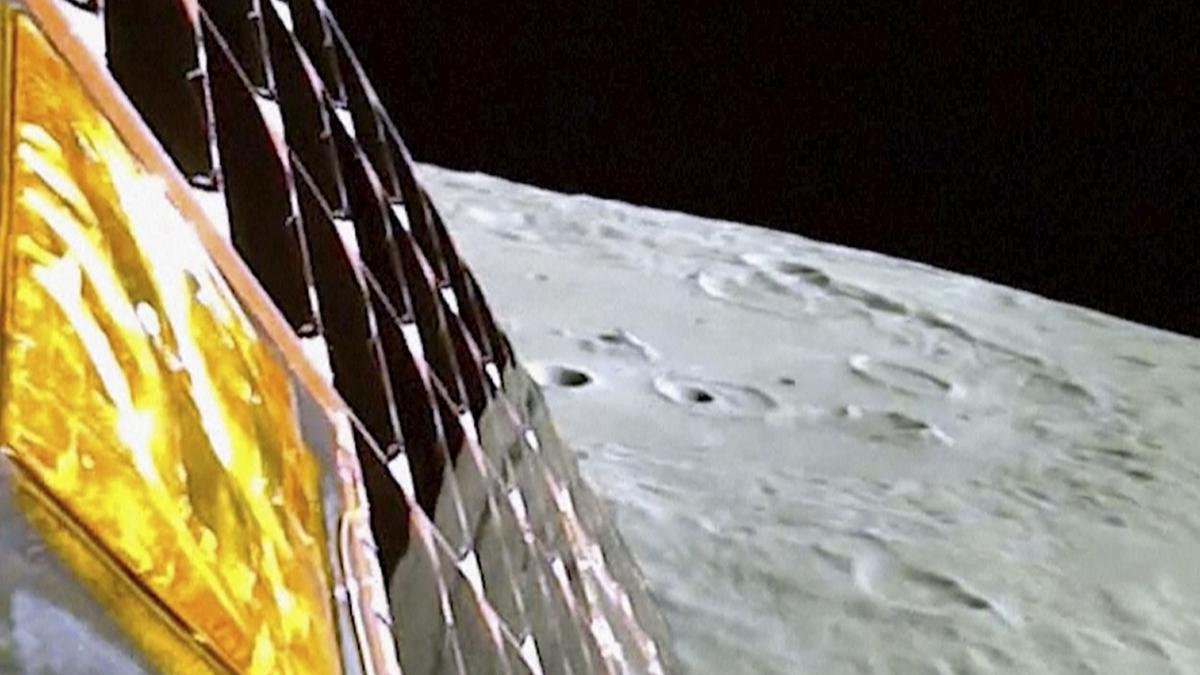
Indian Space Research Organisation charted history this week as Chandrayaan-3 successfully landed on the moon’s surface, making it the fourth country to do so and the only country to do so at the south pole. Find this week’s latest findings and discoveries from the field of science.
At 6.03 pm IST on August 23, the Chandrayaan-3 lander touched down on the moon’s surface, in the south polar region. The landing followed a 19-minute sequence in which the spacecraft used its engines, thrusters, and a suite of sensors to guide itself from an altitude of around 30 km and a speed of 1.7 km/s down to the ground. The success made India the fourth country to have soft-landed a robotic instrument on the moon and the first to have done so in the moon’s south polar region. This elite stature also boosts other countries’ confidence in the Indian Space Research Organisation (ISRO), which built, launched, and now operates the Chandrayaan-3 instruments.
New observations by the Solar Orbiter spacecraft may provide an answer to the origin of solar winds. Researchers have said that the spacecraft has detected numerous relatively small jets of charged particles expelled intermittently from the corona - the sun's outer atmosphere - at supersonic speeds for 20 to 100 seconds. The jets emanate from structures on the corona called coronal holes where the sun's magnetic field stretches into space rather than back into the star. They are called "picoflare jets" due to their relatively small size. Scientists think that these jets could actually be a major source of mass and energy to sustain the solar wind.
In July 2023, a group of scientists in South Korea uploaded two preprint papers claiming that a lead apatite material called LK-99 was an ambient condition superconductor. The group’s two papers elicited a mixture of surprise and scepticism in the scientific community – surprise because of the apatite, and scepticism because of the history of superconductivity. A group from India from the CSIR-National Physical Laboratory, New Delhi, was one of the first to report that it didn’t find any signs of superconductivity in LK-99. As far as current evidence suggests, LK-99 is not a superconductor.
With childhood TB continuing to remain a “staggering problem” in India, “eliminating” TB by 2025 might be extremely challenging. Nearly 0.34 million children
Scientists have finally been able to sequence the Y chromosome in its entirety. The findings provide a solid base to explore how genes for sex and sperm work, how the Y chromosome evolved, and whether – as predicted – it will disappear in a few million years. The Y chromosome is male-determining because it bears a gene called SRY, which directs the development of a ridge of cells into a testis in the embryo. The embryonic testes make male hormones, and these hormones direct the development of male features in a baby boy. Without a Y chromosome and a SRY gene, the same ridge of cells develops into an ovary in XX embryos.
A small percentage of leaves on trees in tropical forests may be approaching the maximum temperature threshold for photosynthesis to work, suggests a study published in Nature. An estimated 0.01% of all leaves currently surpass this critical temperature but there are uncertainties in the range of potentially critical temperatures in tropical trees. Modelling suggests that tropical forests can withstand up to a 3.9 degree C increase over current air temperatures before a potential tipping point, therefore action is needed to protect the fate of tropical forests under future climate change.


Trainee veterinary officer dies from hippopotamus attack at Shivamogga safari during health check, prompting investigation into safety protocols.

The Voice of Hind Rajab, a film about a Gaza war tragedy, faces an oral ban in India by CBFC.

K. Sudhakaran returns to Kannur to ensure Congress victory, while T.O. Mohanan prepares to launch his campaign.

Qaffeine Bistro in Hyderabad has Baaghini, a six-coffee blend

Stock markets rebound as Sensex and Nifty recover early losses, driven by cooling crude oil prices and positive geopolitical signals.

A cooking gas crisis in Telangana is disrupting restaurants, households, and industries amid rising prices and panic bookings.

Taiwan warns of China's military threat, emphasizing the need for strong deterrence to prevent potential invasion plans.

A folktale from Australia tells how the crane and kangaroo rat discovered fire.

Lockie Ferguson will miss the start of IPL 2026 with Punjab Kings, prioritizing family after the birth of his son.

BJP fields seven Christian candidates in Kerala 2026 elections, aiming to win Christian votes through focused outreach and issue advocacy.

FIFA mandates female coaches in women's tournaments, aiming to enhance opportunities and visibility for women in soccer.

Follow The Hindu's live updates on the Telangana state budget for 2026-27, presented on March 20, 2026

Iran's women's soccer team celebrated a warm welcome in Tehran after returning home, despite some players seeking asylum in Australia.