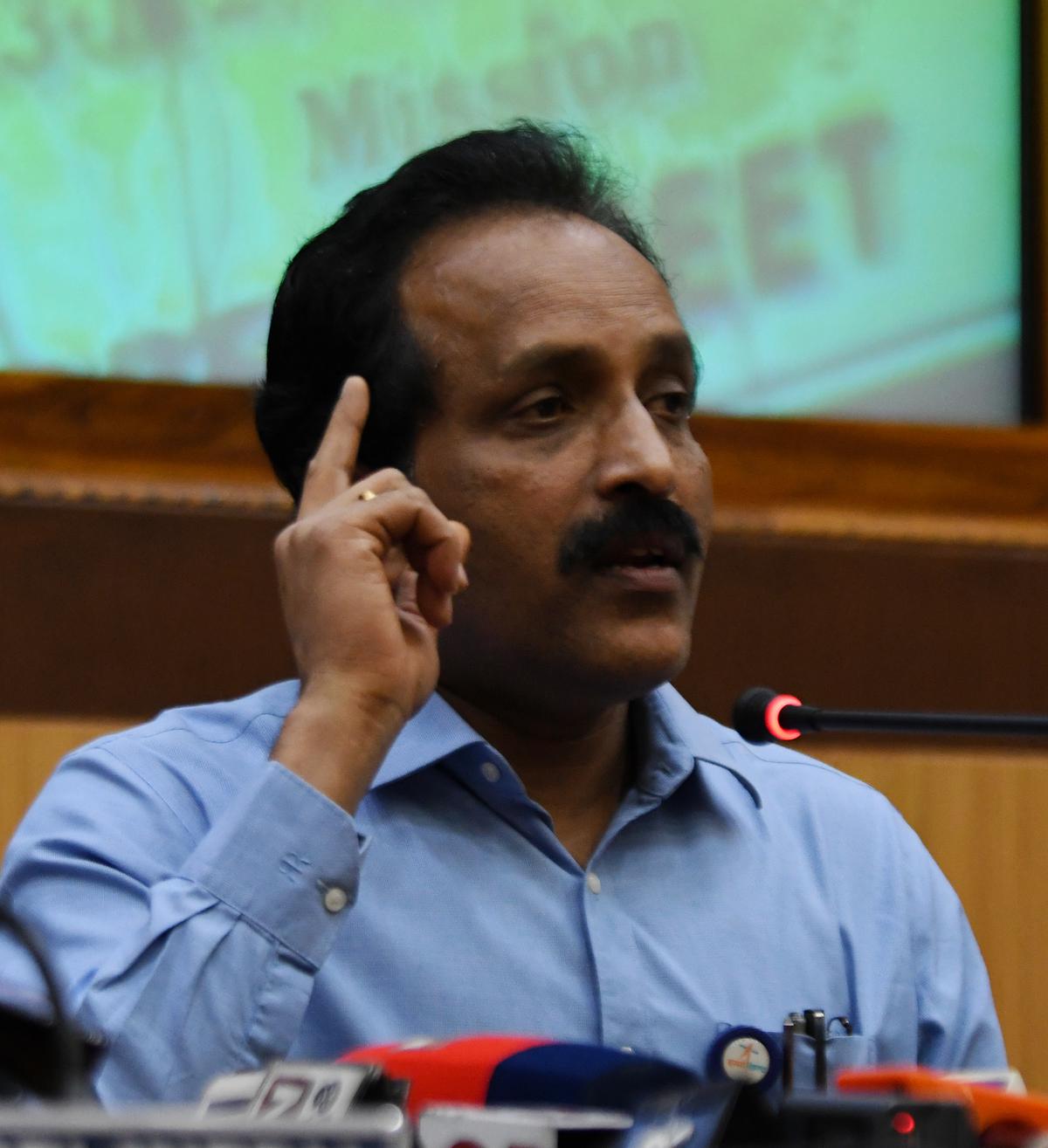
Science must become priority of space missions, we need more money for it: ISRO chief Somanath
The Hindu
ISRO chief says the agency’s role is to mentor and develop the industry ecosystem in India, and the new space policy will aid private companies
S. Somanath, Chairman of the Indian Space Research Organisation (ISRO), told The Hindu that scientific missions ought to be more important in the future. Excerpts:
The entire space sector is based on demand. When there is demand, I have to fulfil it. We have had only four science missions but have 53 satellites in orbit. The science component has always been very, very small. Science was never a priority but it must become the priority in the future. We’ve always had a very limited budget for science but we need more money so that we can do science missions. We are not doing enough in science but if we prioritise science, we will not get money.
The policy doesn’t talk about the structure of the organisation. Policy only spells out the intent and that is to have more non-governmental entities enter the space sector. The elements of this and how we can achieve this ‘intent’ is what the policy will spell out.
NASA is the national space agency of the United States and decides that country’s space activities. ISRO is the national space agency of India but the way both operate could be different because the U.S. ecosystem already has a developed industry. In India, there is no industry capable of doing anything (space launches, satellite manufacturing) independently. Thus, ISRO’s role is to mentor and develop the industry ecosystem here. Once we get to that point, we could discuss the role of ISRO. Right now, I’m not interested in a comparison with another country. We have our own model.


Explore 2026's wallpaper trends in India, highlighting botanicals and handmade designs that enhance modern homes with nature-inspired aesthetics.

Mercedes-Benz CLA 250+ with EQ Technology review: design, performance, range and features explained. Discover how the new electric CLA combines advanced AI, long range, fast charging and futuristic styling for the next generation of luxury EVs.

AI tool for sparrow conservation

BTS’s comeback with ‘Arirang’ marks a major global music event. When does the album release, and where can you watch their concert live stream? We have all the details

The 2026 U.S. cholesterol guidelines urge starting screening and treatment at 30 to prevent cardiovascular disease effectively.

Olam Festival 2026 in Thiruvananthapuram returns March 27-29 with 120+ vendors, music, art, and cultural zones.

A few storytellers in Thiruvananthapuram share their journeys, challenges, and evolving methods on World Storytelling Day, inspiring young minds.

76-year-old Kurian Jacob from Kerala triumphs with seven medals, including five golds, at the Open Masters Games in Abu Dhabi.

Explore the nature of the human mind as an emergent property of brain activity and complex neural interactions.

CERN's Large Hadron Collider discovers the Xi-cc-plus particle, enhancing understanding of quantum mechanics and baryon behavior.

Vibha Batra’s latest book, Spotless (Hachette India) is a novel in verse for young adults

In its first edition, the Madras Art Salon spotlights the works of journalist and artist Narayan Lakshman at The Botanical Club, a social space in the British Deputy High Commission, Chennai

Cholesterol enhances melanoma cell invasion by making nuclei squishier, revealing a potential treatment target in cancer progression.