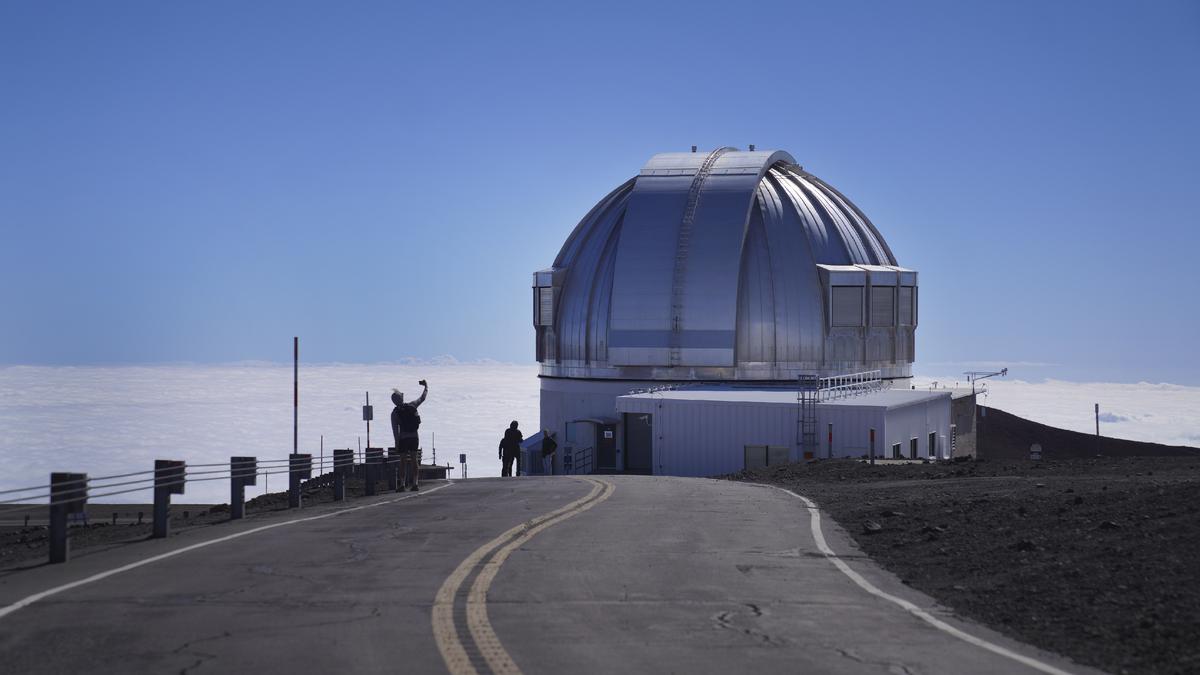
Science Ministry team visits Hawaii to take stock of international telescope project
The Hindu
In a signal of renewed enthusiasm for a global scientific project, an official delegation from the Department of Science and Technology visited Mauna Kea, an inactive volcano on the island of Hawai’i in the United States, to discuss “challenges” to the Thirty Meter Telescope (TMT) project.
In a signal of renewed enthusiasm for a global scientific project, an official delegation from the Department of Science and Technology visited Mauna Kea, an inactive volcano on the island of Hawai’i in the United States, to discuss “challenges” to the Thirty Meter Telescope (TMT) project, a press release said.
The TMT has been conceived as a 30-metre diameter primary-mirror optical and infrared telescope that will enable observations into deep space. It is proposed as a joint collaboration involving institutions in the U.S., Japan, China, Canada, and India. Indian participation in the project was approved by the Union Cabinet in 2014.
The project has faced considerable challenges. Mauna Kea, an inactive volcano, and by some measures the tallest mountain in the world, hosts multiple telescopes. However, upcoming projects have invited local opposition on the grounds that building telescopes violates religious and cultural customs, with many of these projects having been imposed upon the region without addressing the concerns of local inhabitants.
Though permits for constructing the TMT were availed, the Supreme Court of Hawaii invalidated them in 2015. Permissions were restored in 2018, though construction is yet to begin because of continued local opposition.
There are plans to construct the TMT at an alternate site, with the Observatorio del Roque de los Muchachos (ORM) on La Palma in Spain’s Canary Islands seen as the next best choice.
In 2020, Ashutosh Sharma, the then-Secretary of the DST told The Hindu: “India’s position has been clear. We would like the project to move to an alternate site if all the procedures and permits there are in place. The difficulty is that even if construction [in Mauna Kea] were to go ahead, there could be future agitations.”
Also Read: India, co-builder of Hawaii telescope, wants it shifted out of proposed site


76-year-old Kurian Jacob from Kerala triumphs with seven medals, including five golds, at the Open Masters Games in Abu Dhabi.

Explore the nature of the human mind as an emergent property of brain activity and complex neural interactions.

CERN's Large Hadron Collider discovers the Xi-cc-plus particle, enhancing understanding of quantum mechanics and baryon behavior.

Vibha Batra’s latest book, Spotless (Hachette India) is a novel in verse for young adults

In its first edition, the Madras Art Salon spotlights the works of journalist and artist Narayan Lakshman at The Botanical Club, a social space in the British Deputy High Commission, Chennai

Cholesterol enhances melanoma cell invasion by making nuclei squishier, revealing a potential treatment target in cancer progression.

The designers reinterpret the Swedish artist’s symbolic forms and colour energy through contemporary resortwear silhouettes

Discover the inspiring legacy of Bibha Chowdhuri, a pioneering woman in physics and a trailblazer in STEM history.

Discover the inspiring legacy of Bibha Chowdhuri, a pioneering woman in physics and a trailblazer in STEM history.

Ashdeen’s Spring 2026 collection features saris inspired by the designer’s Parsi gara archive

Red ochre burials, ritual markings and myths across cultures show that red repeatedly marks liminal thresholds such as puberty, sacrifice and death; anthropologists argue that the colour functions as a technology of collective ritual and value, binding communities through shared symbolic acts

India approves 23 institutions for quantum labs under the National Quantum Mission, aiming to advance quantum technology and research.

India approves 23 institutions for quantum labs under the National Quantum Mission, aiming to advance quantum technology and research.