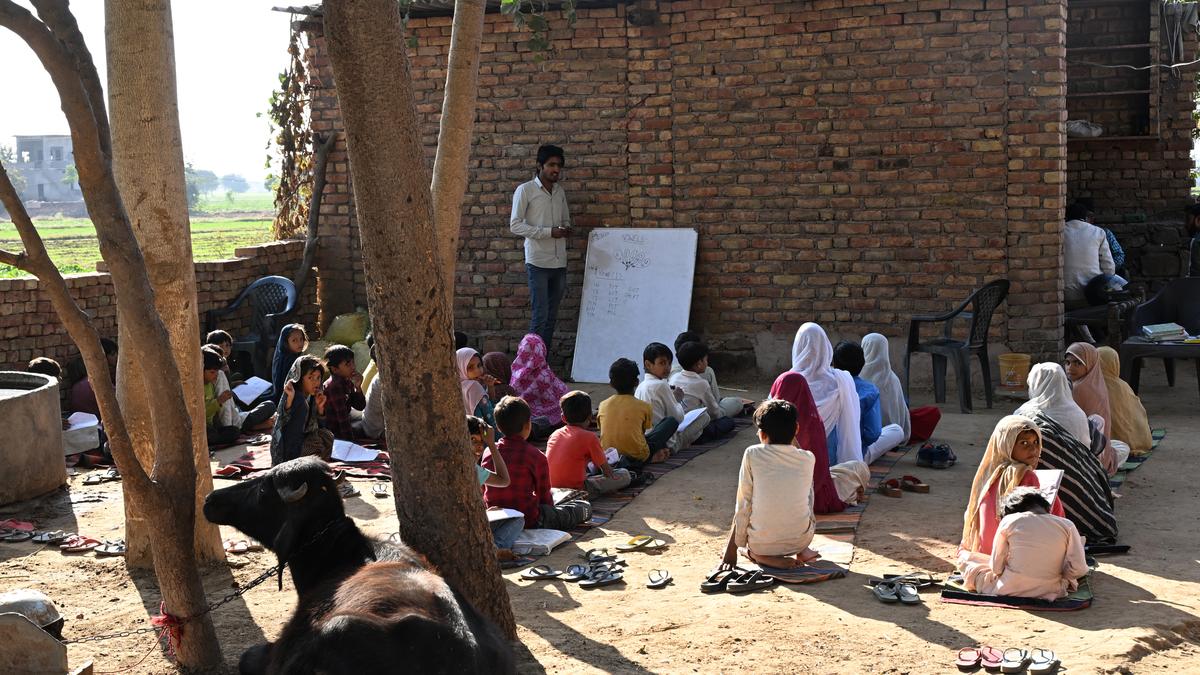
School’s out — out in the open
The Hindu
Children study in makeshift schools in Nuh district, lacking basic facilities, highlighting challenges in rural education in India.
Endless acres of land covered in yellow mustard glisten in the winter sun. In between are deep violet onion shoots springing out of vegetable patches. The scene paints a deceptive picture of abundance in the Nagina block of Nuh district in Haryana.
Closer to Padodiyabass village in Nagina block, children from Class 1 to 5 revise maths tables, their shrill chorus heard from a few meters away. The 30-odd children are seated under a shady neem tree with six cows to keep them company. The open space under the tree also doubles up as their classroom. The cows sip on cool water from a large concrete container, but there is no sight of a school building, toilets, or drinking water for the school children. All of these are prerequisites to run a school in India. As evening approaches, the eager children neatly form a line and tread back home through the fluorescent green fields. A herd of goats rush in through the gates to occupy the shed.
“Over the past four years, I have been scrambling for space in Padodiyabass after the school was made functional on paper by UDISE registration,” says Hari Ram, the school teacher who has been posted in at the Government Primary School in Padodiyabass. UDISE, the Unified District Information System for Education, is a database of schools in India run by the Department of School Education and Literacy, under the Ministry of Education.
Data from UDISE from the District Education Office show that the Government Primary School (GPS) in Padodiyabass features among 19 primary schools in Nuh district declared ‘buildingless’. The District Education Department has been unable to construct a building for them, despite allotting them a UDISE code in 2018-19.
Over the last six years, the schools have been running out makeshift spaces: under trees, in animal sheds, in homes, or at a village chaupal (community space). On paper, besides a building, a school should have an open playground with an impregnable boundary wall for the children’s safety.
Alladin, 58, who lent his shed to run the school says, “The school has been shifted thrice. Before this, it was running out of another villager’s shed, and for some time even out of someone’s house.”
Out of 500 government primary schools in Nuh district, 10 of these building-less schools function out of Firozepur Jhirka block, four are in Taoru block, three in Nagina, one each in Nuh and Punhana blocks. The Hindu visited four of these schools: GPS Kubdabass, GPS Ghatwasan, GPS Malibass in Firozepur Jhirka block; and GPS Padodiyabass in Nagina.


PM Modi emphasizes India's pursuit of diverse gas and crude oil sources amid the global energy crisis due to West Asia conflict.

Kerala BJP chief Rajeev Chandrasekhar challenges Congress to prove undisclosed assets allegations in court, dismissing them as distractions.

As per information by Minister of State for Civil Aviation Murlidhar Mohol to a question in the Rajya Sabha, ₹146.89 crore has been utilised under the UDAN scheme till October 31, 2025.

Supreme Court rules women officers in Armed Forces deserve equal opportunities, upholding their right to permanent commission and pension benefits.

Telangana government assures no fuel shortage; Hyderabad police commissioner urges citizens to avoid panic buying

Telangana government employees will receive 10-20% discounts on electric vehicles to promote eco-friendly transportation, announces Transport Minister.

Discover the engaging teaser of 'Pallichattambi,' a period drama starring Tovino Thomas, releasing on April 10.

SP P. Jagadeesh reviews night patrols in Anantapur to enhance security and public safety during Operation Night Safety.

DMK announces candidates for 13 seats in Puducherry elections, reserving one seat for ally VCK amid strategic alliances.

Delhi HC safeguards Sonakshi Sinha's personality rights, prohibiting unauthorised use of her image and attributes across platforms.

Mohanlal's 'Drishyam 3', directed by Jeethu Joseph, has been postponed to May 21, coinciding with his birthday. The film marks the franchise's final installment.

Family of custodial death victims demands harsh punishment for nine convicted policemen to prevent future abuses of power.

United Democratic Front's candidate list for the 2026 Kerala Assembly elections, aiming for a significant political comeback.