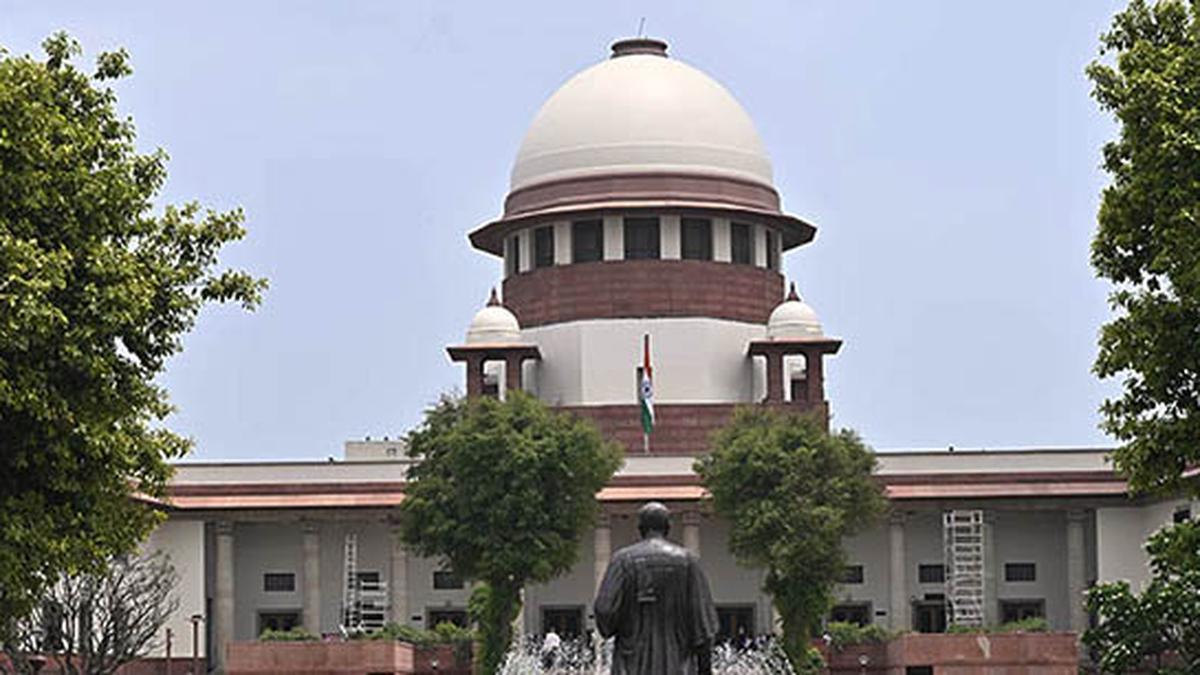
SC seeks Centre’s response on plea by woman who left Islam to be governed by secular law
The Hindu
Supreme Court seeks Centre's response on plea for non-believer to be governed by Indian Succession Act, not sharia law.
The Supreme Court on Monday asked the Centre to respond to a plea by a Kerala-based woman, born a Muslim but now a non-believer, to be governed by the secular statute of Indian Succession Act of 1925 rather than the sharia law.
Appearing before a Bench headed by Chief Justice of India D.Y. Chandrachud, Shafiya PM, represented by advocate Prashant Padmanabhan, said the fundamental right to religion under Article 25 of the Constitution includes both the right to believe and not to believe.
Chief Justice Chandrachud remarked that the 1925 specifically did not include Muslims within its ambit.
Additional Solicitor General Aishwarya Bhati, appearing for the Union government, said the prayer in the petition came within the legislative domain as it could be realised only with an amendment in the 1925 Act.
Nevertheless, the court asked the government to file a response to the petition.
The petition filed by Mr. Padmanabhan for Ms. Safiya said the apex court had emphasised on the “fundamental postulate of secularism which treats all religions on an even platform and allows to each individual the fullest liberty to believe or not to believe”.
Mr. Padmanabhan submitted that a person who leaves her faith should not incur any disability or a disqualification in matters of inheritance or other important civil rights. The petition said a person born a Muslim is governed by the Muslim Personal Law (Shariat) Application Act, 1937.


India pledges 60% non-fossil fuel power by 2035, targeting 47% emissions reduction per GDP unit and enhanced carbon sinks.

Supreme Court rules land acquisition compensation and interest must uphold constitutional guarantees, unaffected by financial burdens.

Election officials accept 23 nominations for Bagalkot bypolls, rejecting three, with polling scheduled for April 9.

Students and women’s self-help groups in Madurai engage in vibrant voter awareness campaigns promoting 100% voting participation.

Congress signals a "friendly fight" with allies in select Puducherry Assembly seats ahead of the April 9 elections.

Airstrike in western Anbar kills 7 Iraqi soldiers, injures 13, prompting condemnation for violating international laws on medical facilities.

Plaque unveiled in Bengaluru honors 11 victims of RCB stampede, emphasizing safety responsibility for future events.

India and the U.S. reaffirm commitment to enhance strategic defense cooperation at the 18th Defence Policy Group meeting in New Delhi.

Chhattisgarh's Deputy CM reports only 30-40 Maoists remain in Bastar, highlighting recent surrenders and future development plans.

Explore the historical and industrial significance of Ariyalur constituency, highlighting its challenges, agriculture, and political landscape.

Dindigul and Madurai Collectors conduct joint inspection

In this episode, Kalki Subramaniam speaks to us about why the Transgender Persons Amendment Bill has sparked protests, and how these amendments threaten to push a marginalised community back into the shadows.

India's EU FTA is poised to attract more German companies, boosting bilateral trade and investment opportunities.