Saudi Arabia is opening up its economy and its society. Why has Canada been so slow to capitalize on that?
CBC
There are many ways to measure just how much Saudi Arabia has changed in recent years. Bumping into Montreal businessman Sruli Richler at an ancient historic site is one of them.
Richler is an observant Jew, who has a beard and wears a yarmulke under his ball cap.
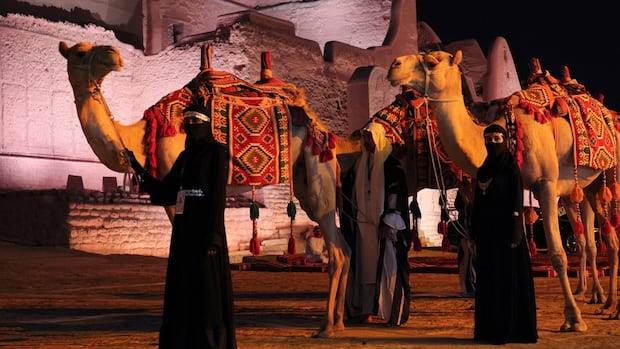
He stopped for a visit at the country's former capital Diriyah, just outside Riyadh, which is in the midst of an immense $63-billion US restoration project.
Just in case the presence of an overtly Jewish man in the staunchly conservative Islamic kingdom caused any friction, Richler jokingly pulls out a "Make America Great Again" cap from his bag — a precaution, he says, in case he wants to blend in quickly with the numerous U.S. visitors.
But by and large, he says he was welcomed graciously throughout Saudi's capital.
"I honestly thought it would be much more hostile," he told CBC News in Riyadh. "Everyone is very calm and very relaxed and it was pleasant to do business."
Richler — a distant cousin to the famous Canadian writer Mordecai and his journalist son Noah — is in what he calls the "reverse logistics" business. That is, his company finds money-making uses for items people return to stores that can't be resold.
"I'm looking to do business in Saudi. It's an up-and-coming country," he said, of his reconnaissance trip.
"When you land here, you are pleasantly surprised. I believe that when you bring businesses together, it brings people together. It's a road to the future."
But that's not how many other Canadians — including senior members of the current Liberal government — have always viewed the world's second-largest oil producer.
In 2018, Canada's Global Affairs Department, overseen by then-foreign minister Chrystia Freeland, sent out a series of tweets criticizing Saudi Arabia's human rights record and calling for the release of an activist with ties to Canada.
An enraged Saudi government accused Canada of meddling in its internal affairs. It expelled Canada's ambassador in Riyadh and took the unusual step of freezing trade links between the two countries and ordering thousands of Saudi university students studying in Canada to return home.
Later that same year, Canada imposed sanctions on 17 Saudis linked to the murder and dismemberment of Jamal Khashoggi, a prominent critic of Saudi leader Crown Prince Mohammed bin Salman. Khashoggi was killed inside the Saudi consulate in Istanbul.
As the deep freeze in relations set in, trade, cultural and political contacts between the two countries became casualties.


U.S. President Donald Trump is urging other countries to help secure the Strait of Hormuz as Iran targets ships in the vital oil route, but so far there are few firm commitments.

Arab Gulf states reported new missile and drone attacks on Sunday after Iran threatened to widen its campaign as the war in the Middle East entered its third week.


The former secretary general of NATO says he doesn't think allies will be pulled further into the conflict in the Middle East, but he's concerned the ongoing war with Iran will benefit Russia's economy and take the world's attention away from the invasion of Ukraine.

As American and Israeli strikes pound Iran — while it attacks shipping and energy infrastructure across the Persian Gulf — U.S. President Donald Trump made a new threat to Tehran's leaders.

The armed man who rammed his vehicle into one of the largest Reform synagogues in the U.S. Thursday has been identified as a 41-year-old naturalized citizen born in Lebanon, according to federal officials.

With jagged cliffs rising from the Arabian Sea, the Strait of Hormuz is striking in its scenery — and these days, its emptiness. This resource superhighway, which normally hosts more than a hundred of the world’s largest oil and liquid natural gas (LNG) tankers every day, has seen no more than a handful all week.

The Canadian government said Tuesday it is alarmed by the escalation of violence and attacks in Lebanon, as the war in the Middle East expands.

In a resounding victory that is guaranteed to reshape Nepal's politics, rapper-turned-politician Balendra Shah appeared headed for a landslide win in the South Asian country's first polls since youth-led protests toppled the previous government last fall.

China’s latest blueprint for driving growth in its economy was largely written before the U.S. and Israel instigated the most far-reaching war in the Middle East in decades.

U.S. President Donald Trump's firing of Homeland Security Secretary Kristi Noem on Thursday overshadowed the announcement of his plans to nominate Republican Sen. Markwayne Mullin as her successor.

The truck carrying Nepali prime ministerial candidate Balendra Shah was swarmed by cheering supporters in the capital, Kathmandu, on Saturday, unable to inch forward as the former rapper, wearing sunglasses and a sleek black suit, danced on top of the roof.

Israel sent troops into southern Lebanon on Tuesday and warned residents of more than 80 villages to evacuate as the Iran-backed militant Hezbollah group said it was ready for an "open war" with Israel in the wake of the U.S.-Israeli war with Iran.