Satan shoes, microscopic bags and big red boots: How MSCHF conquered the art world
CNN
The enigmatic artists took on “modern internet capitalism” and made millions. Now, a new book provides a behind-the-scenes look at how they did it.
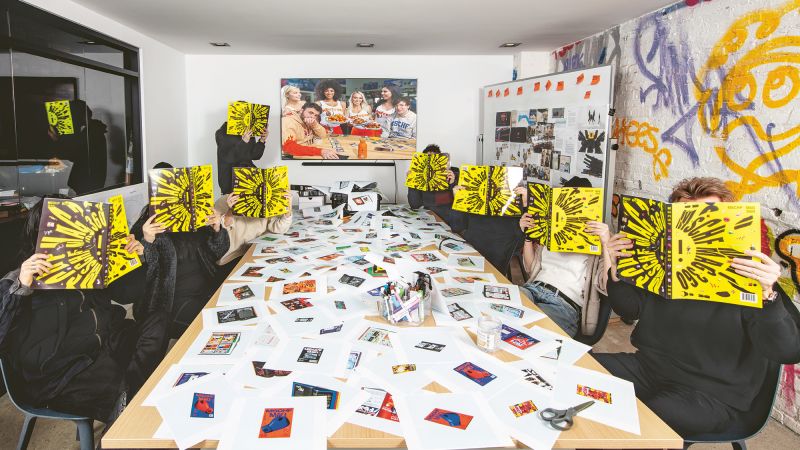
MSCHF has been called many things — performers, designers, even internet trolls — but for co-chief creative officer Kevin Wiesner, the title “artists” works just fine. It’s an ambiguous enough term to cover all the hats its members wear, he told CNN over a Zoom call. Besides, Wiesner added: “Nobody really knows what that means” — which aligns with the art collective’s typically elusive nature. Since its founding in 2016, the 25-member Brooklyn-based group has made headlines with provocative “drops,” like the cartoonish big red boots inspired by the Japanese manga character Astro Boy; the infamous “Satan Shoes,” containing a drop of human blood; and a microscopic Louis Vuitton-style bag, barely visible to the human eye, that sold for over $63,000. In the past, MSCHF would take a back seat after releasing its creations, preferring to watch the internet and media attempt to make sense of them with little or no information. “We were trying to maintain a black box as much as possible,” Wiesner explained. “We were really avoiding any kind of personal outward association with the group in a lot of ways, because we had this idea that we wanted these projects to show up from nothing — to seem like they just sprung, fully formed, from the head of Zeus.” Lukas Bentel, MSCHF’s other co-chief creative officer, agreed, telling CNN that “a lot of the projects are us setting up a scenario, and then we’re kind of watching (it) play out from everybody that’s interacting with it.” He added: “We really don’t give any behind-the-scenes look at any of the projects.” That’s about to change with the group’s first book “Made by MSCHF,” which offers a rare glimpse into some of the most successful drops of the past nine years. The book also addresses the highs and lows of being art-world outsiders and MSCHF’s approach to both leveraging and satirizing what it dubs “modern internet capitalism” — in other words, the internet’s role in consumerism.


With his maxi leopard print Chanel bag, the pop star issued a loud and proud proclamation that he got his hands on one of the most in-demand, status-bestowing styles of the moment.

Millions more adults should consider starting cholesterol-lowering medications earlier to reduce their risk of heart attack and stroke, according to new medical guidance.

At Paris Fashion Week, there were luxuriously plain black dresses and coats of the kind favored by Carolyn Bessette Kennedy, models strutting down runways with theatrical flourishes, and in some cases, no cellphones in sight.

Roughly one-third of respondents – equivalent to more than 82 million Americans – said they have had to cut back on at least one daily living expense to cover their health care bills, according to a new survey.

Before South African high school students complete their final exams, they first walk the red carpet, pulling out all the stops for their celebratory matriculation, or ‘matric,’ balls. The photographer Alice Mann documented the increasingly lavish dances for five years in her new book, “The Night is Young.”

The drug leucovorin was touted by the Trump administration in September as a potential treatment for thousands of children with autism. Now, some parents and guardians of children with autism say they feel abandoned by the US Food and Drug Administration’s new stance on leucovorin.

The prescription drug leucovorin is getting a label update, though it’s not what that the US Food and Drug Administration suggested might be coming during a White House briefing in September, when officials touted the drug as a potential treatment for thousands of children with autism.

With the release of “The Bride!” we asked scholars, film curators and experts in Mary Shelley’s work why so few women have tackled the Frankenstein story — and the impact that has on how we make sense of the 200-year-old tale.

In front of the Louvre Pyramid, Eileen Gu stepped out this week wearing a set of diaphanous wings — a fitting ensemble for an Olympic athlete whose sport sends her airborne.

Meagan Johnson recently spent four days calling dozens of pharmacies around Austin, Texas, trying to fill a prescription for her son, Jack.

Evidence is mounting that the wildly popular weight-loss medicines known as GLP-1s may also hold potential for treating addiction, and the field may be on the verge of obtaining desperately needed answers through more study.

Known for her blistering pace and powerful shots, the soccer player is having a Barbie made in her likeness as the toymaker names her as role model of the year.

The Screen Actors Guild Awards are back with a new name — and a thematic dress code.