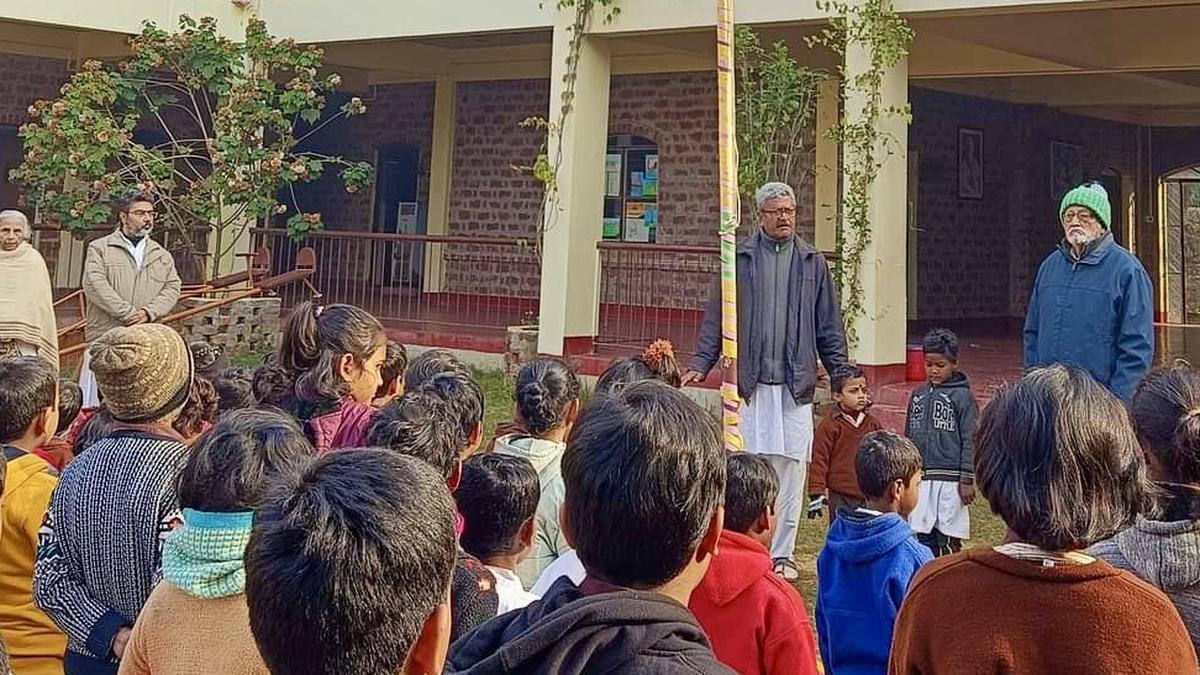
Santiniketan school run by Tagore family says it is empowering children through poet’s philosophy
The Hindu
Sishutirtha School in Santiniketan, founded by Sudripta Tagore, aims to educate children through Rabindranath Tagore's philosophy.
Sishutirtha, a school run in Santiniketan — the only institution in the place to be run by the Tagore family — is marking five years of its establishment, with its mentor Sudripta Tagore saying the idea is to educate and empower children through Rabindranath’s philosophy.
“We all talk about the relevance of Rabindranath Tagore’s educational thoughts in today’s world. Time is up for lip service. If we really believe in his ideals, let’s give them a chance to be relevant in the education for the Generation Next. Sishutirtha School is an attempt to try and preserve his practices by tweaking them into modernity to give them an eternal flavour,” Mr. Tagore, who is a descendant of Rabindranath’s elder brother Satyendranath and the principal of the school, told The Hindu.
Sishutirtha, which means Children’s Pilgrimage, was set up by Mr. Tagore, a seasoned educator himself, in April 2019, and at the moment has classes from LKG to the seventh standard, educating a total of 125 students. It is part of a 1989-formed society, Santiniketan Sishutirtha, which also has a children’s home under it, the home being set up back in 1999.
“Officially I am just the principal of the school, not even a board member. I want to keep it like this. I want to be seen merely as a worker of this society,” said Mr. Tagore, 59, himself a student of Visva-Bharati from 1972 to 1986 and who went on to make a career out of setting up and running corporate schools in India and abroad.
“Rabindranath did leave behind writings on education, yet they were more of ideas rather than practices through which these ideas could be realised. As a student (at Santiniketan) in the 1970s and 80s, I was fortunate enough to experience the remnants of educational practices probably initiated by Rabindranath himself. At the time though, they were mere rituals one went through. As I greyed, those rituals started taking on a meaning I could relate to the bigger picture,” the educator said.
It was in 2018 that he returned to Santiniketan as his parents were ageing, with the idea of making Sishutirtha Ashram self-sufficient, something he realised would be possible through setting up a school. “Though it is a private school, I refuse to call it corporate. We just want to have enough funds so that the children’s home can become self-sufficient and no more. This allows us to keep the numbers small, 30 students in each section with two sections each. We don’t want students to become roll numbers. We believe in ‘small is beautiful’,” Mr. Tagore said.
Rabindranath Tagore, the poet, is quite evident on the premises. Students regularly plant saplings (in fact the Madhabi creeper planted in 2019 has begun to bloom), classes are held outdoors in the winter, and people call one another ‘da’ or ‘di’ (“neutral yet respectful”) opposed to the “colonial” ‘sir’ or ‘madam’.


NITI Aayog allocates ₹1.55 crore to Guntupalli's RISE Centre, empowering women entrepreneurs through training and support initiatives.

Chief Minister Chandrababu Naidu to inaugurate ₹1.36 lakh crore AM/NS steel plant in Anakapalli, creating one lakh jobs.

Government increases commercial LPG allocation to 50% as domestic output stabilizes, supporting key sectors and migrant workers.

Thirumavalavan defends VCK's electoral strategy, emphasizing long-term goals as applications for Assembly election candidacy open March 21-24.

Officials review counting arrangements in Gobichettipalayam, ensuring facilities and infrastructure are ready for the election process.

DG Prisons inspects Siddipet jail ahead of inauguration

Reformative initiatives at Hubballi's sub-jail show positive outcomes, reducing habitual offender recidivism through various programs and activities.

Twenty-five police officers recognized for their swift actions in the arrest of a suspect in a teenage girl's murder case.

Indore's biogas plant converts urban wet waste into fuel for 400 buses, promoting sustainability and reducing fossil fuel dependence.

Thousand Lights faces parking chaos and traffic congestion despite its political significance and ongoing development efforts.

Bengaluru's BWSSB launches OTS scheme, waiving interest on water bill arrears to assist residents in clearing dues.

A lorry carrying firecrackers caught fire after hitting a high-tension wire in Hyderabad, but drivers escaped unharmed.

A Q and A career counselling column for students