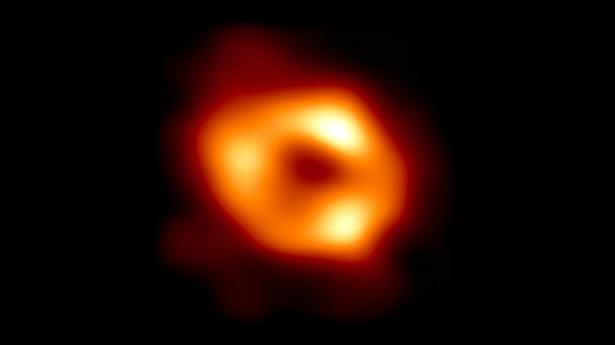
Sagittarius A* | The Milky Way’s dark centre
The Hindu
With an Earth-sized eye, researchers imaged the compact object in the galaxy
In 2020, Andrea Ghez and Reinhard Genzel were given the Nobel prize for showing that there existed, at the centre of the Milky Way, an extremely heavy, invisible object that pulls masses towards it and causes them to speed up enormously. They estimated that mass of around 4 million times the sun was concentrated in this region. Now, the Event Horizon Telescope, a collaboration of over 300 researchers from 80 countries, has published an image of this region. Known as Sagittarius A* (SgrA* for short), this region is believed to host a supermassive black hole of about 4 million times the solar mass. There have been other possibilities put forth by researchers in this context, but that of a supermassive black hole is the most likely one.
The Event Horizon Telescope is not just a single telescope. It consists of a consortium of eight powerful telescope arrays around the world, which together made up a giant eye, the size of the Earth and 3 million times sharper than the human eye. With this giant eye, the researchers gazed at this point which is about 27,000 light years away from the Earth. They observed SgrA* on multiple nights collecting data for hours at a stretch, just like a camera would use long exposure times. The technique was, however, very different as it uses a network of telescopes rather than a single one. This is called Very Long Baseline Interferometry.
Using this technique, the Event Horizon Telescope collaboration had, in 2019, imaged a region called M87*, the black hole at the centre of the galaxy Messier 87. Despite the fact that the two galaxies are so different and that the masses of the black holes were different, the images are strongly similar.
Although we cannot see the black hole itself, the gas moving around the black hole emits light, which takes a curved path around the black hole and this leaves a central dark portion, referred to as the “shadow” of the black hole. This effect happens because of the enormous gravity of the central region. Thus, this image is an attestation of Einstein’s General Relativity theory. The ring-shaped image of SgrA*, which looked a lot similar to the one of M87*, occupied 52 micro arcseconds in the field of view, which is as big a span of our view as a doughnut on the moon!
Despite the fact that M87* is much further away than SgrA*, the group was able to image the former earlier. This is because SgrA* is only one-thousandth the size of M87*; the line of sight to SgrA* is obscured by a lot of intervening matter; and, lastly, as SgrA* is much smaller than M87*, the gas swirling around it takes only minutes to complete an orbit around SgrA* as opposed to taking weeks to go around M87*. The last gives a variability that makes it difficult to image. A clear imaging requires long exposure of about 8-10 hours, during which, ideally, the object should not change much.
The telescopes making up the array are Atacama Large Millimetre/sub-millimetre Array, Atacama Pathfinder Experiment, IRAM 30-metre telescope, James Clerk Maxwell telescope, Large Millimetre Telescope Alfonso Serrano, Submillimetre Array, UArizona Submillimetre Telescope and South Pole Telescope. Since 2017, when observations were started on this, the group has added the Greenland Telescope, Northern Millimetre Extended Array and UArizona 12-metre Telescope on Kitt Peak to the set.
While there is overwhelming evidence that SgrA* contains a highly compact invisible object at its core, is the only possibility a black hole? This question has a non-trivial answer. According to Pankaj Joshi, founding director of the Cosmology Centre and Distinguished Professor of Physics at Ahmedabad University, who is an expert in this field and not part of the collaboration, “In their papers, the researchers consider various alternatives such as naked Singularities and wormholes. Their report in one of the papers — paper five of the series published in The Astrophysical Journal Letters — claims that the JMN (Joshi-Malafarina-Narayan) naked singularity with photon sphere could be the best black hole mimicker. The point is that the central object and its nature remains a question of great mystery. This is because just as a black hole event horizon would create a shadow, similarly the naked singularity also creates a similar shadow and therefore it is impossible to distinguish between the two.”


Discover the Minor Planet Centre, the key hub for tracking and verifying observations of small solar system bodies.

In this week's Science for All newsletter, XX explains

Test your knowledge with the quiz on Science films at the Oscars through history

Set between the Siwalik hills and the plains, Butwal offers travellers a mix of regional cuisine, pilgrimage trails to Lumbini and the comfort of Hyatt’s new hospitality landmark

Explore 2026's wallpaper trends in India, highlighting botanicals and handmade designs that enhance modern homes with nature-inspired aesthetics.

Mercedes-Benz CLA 250+ with EQ Technology review: design, performance, range and features explained. Discover how the new electric CLA combines advanced AI, long range, fast charging and futuristic styling for the next generation of luxury EVs.

AI tool for sparrow conservation

BTS’s comeback with ‘Arirang’ marks a major global music event. When does the album release, and where can you watch their concert live stream? We have all the details

The 2026 U.S. cholesterol guidelines urge starting screening and treatment at 30 to prevent cardiovascular disease effectively.

Olam Festival 2026 in Thiruvananthapuram returns March 27-29 with 120+ vendors, music, art, and cultural zones.

A few storytellers in Thiruvananthapuram share their journeys, challenges, and evolving methods on World Storytelling Day, inspiring young minds.

76-year-old Kurian Jacob from Kerala triumphs with seven medals, including five golds, at the Open Masters Games in Abu Dhabi.

Explore the nature of the human mind as an emergent property of brain activity and complex neural interactions.