S.M. Krishna will be remembered for his grace as External Affairs Minister
The Hindu
S.M. Krishna will be remembered for his grace as External Affairs Minister
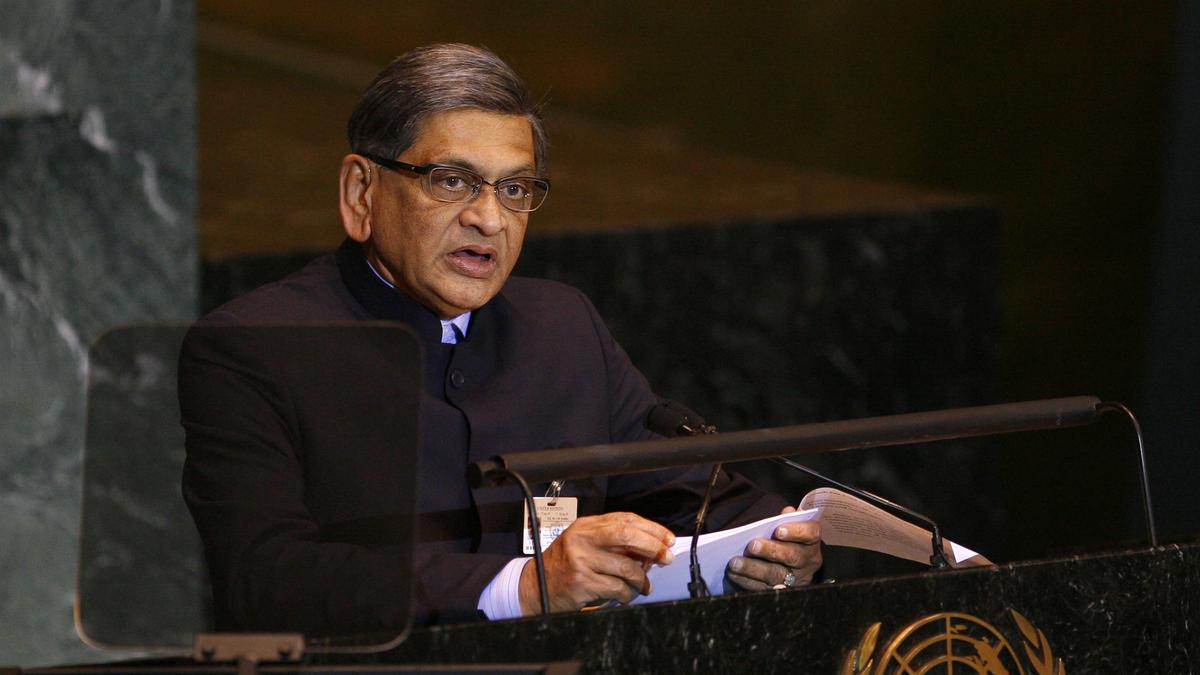
S.M. Krishna’s tenure as Minister of External Affairs (2009-2011) is often remembered for gaffes, like the time in 2011 when he accidentally began to read out the Portuguese Foreign Minister’s speech at the United Nations, but diplomats and journalists covering Indian Foreign Policy have lasting memories of Mr. Krishna’s grace and “old style of politics and diplomacy” in what was a particularly tense second term for the Manmohan Singh-led UPA government, and his ability to deal with crisis without showing the pressure.
Also read: S.M. Krishna, former External Affairs Minister and Karnataka CM, dies
His tenure in handling Indian diplomacy was particularly difficult as the government pressed Pakistan for accountability over the 26/11 Mumbai attacks, and Mr. Krishna was pilloried for a press conference in Islamabad in 2010 where the then Pakistan Foreign Minister Shah Mehmood Qureshi was publicly rude about the fact that Mr. Krishna had “taken calls from New Delhi” during their meetings.
Mr. Krishna, however, shrugged off the personal attacks, pursuing his line on the need for Lashkar-e-Toiba chief Hafiz Saeed to be brought to justice. The period also saw the U.S. come around to India’s view on terror emanating from Pakistan, and New Delhi was able to place Pakistan on the Financial Action Task Force’s ‘grey list’ for the first time in 2012.
A series of Wikileaks cables sent over India-U.S. talks at the time quoted Mr. Krishna’s persistent line on the need to address terrorism with U.S. officials, including the then Secretary of State Hillary Clinton. Officials at the time also remember that no matter the controversy or criticism, Mr. Krishna, who had a long career in politics by the time he took oath as Minister at the age of 77, never deflected the blame for problems to his juniors or colleagues.
“He was very good at cooling down tempers, adding moderation to any desire by others to respond in haste”, said an Indian Foreign Service Officer who worked with him at the time. As a globally well-travelled former Chief Minister of Karnataka, who had studied in the U.S. as a Fulbright scholar, the official found Mr. Krishna well-connected , “who did not need to be told how the world worked.” Mr. Krishna’s bigger challenge, however, was to carve out a space for himself where he did not step on toes in the Prime Minister’s Office, while fighting off attempts by other senior Ministers seeking to encroach on the Ministry of External Affairs (MEA)’s workings.
Mr. Krishna also faced some push back from within the Ministry, like when he hired a Bangalore-based tech MNC to modernise the working of the passport system in India. The launch of the Passport Sewa Project in 2010 revolutionised the distribution of passports by putting tech consultants in charge of gathering data and biometrics and cutting down the time and middlemen involved in the process. For a while, the All India Passport Employees Association even went on strike to protest the changes. However, officials recall Mr. Krishna’s refusal to reconsider his plans.


Niranjanaradhya highlights Gandhi's vision of life skills-based education and critiques the neglect of government schools in India.

Leader of Opposition R. Ashok on Tuesday alleged in the Legislative Assembly that the ruling Congress government is planning to shut down Bengaluru’s only Government Flying Training School (GFTS) at Jakkur to develop an exclusive club for MPs, legislators, and senior bureaucrats.

The highlight of every edition of the Whitefield Art Collective is the Kala Car, an exhibit that showcases the creative and artistic prowess of art students. Over the years, this clever play on words has titled vehicles that have either been rescued from the scrap yard or sponsored or auctioned or all of the above.

Devotees flock to Sri Kanaka Durga Temple for serene Pushparchana celebrations during Vasantha Navaratri, adorned with fragrant floral decorations.

CAG audit reveals Arvind Kejriwal's bungalow renovation exceeded budget by 342%, costing ₹33.66 crore instead of ₹7.91 crore.

Unexpected hailstorm and evening showers in Hyderabad catch commuters off guard on March 24, 2026 evening, providing relief from the intense afternoon heat.

EVMs and VVPAT units dispatched to Erode's eight Assembly constituencies ahead of polling on April 23, 2026.

Indigo Airlines may halt Bengaluru–Shivamogga flights; MP Raghavendra seeks to persuade the airline to continue services.

181 offenders held in month-long crackdown on harassment

39 enforcement officials in Hyderabad trained to enhance road safety measures in school zones for better child protection.

Hyderabad bucks congestion trend as traffic speeds improve despite a surge in vehicles on its roads.

‘Love Mocktail 3’, the latest installment of the hit Kannada franchise from Darling Krishna-Milana Nagaraj, is winning hearts in Karnataka, weathering the challenge of the action-packed juggernaut ‘Dhurandhar: The Revenge’

VSU professor R. Madhumathi awarded by Venus International Foundation for her exceptional contributions to education and social service.