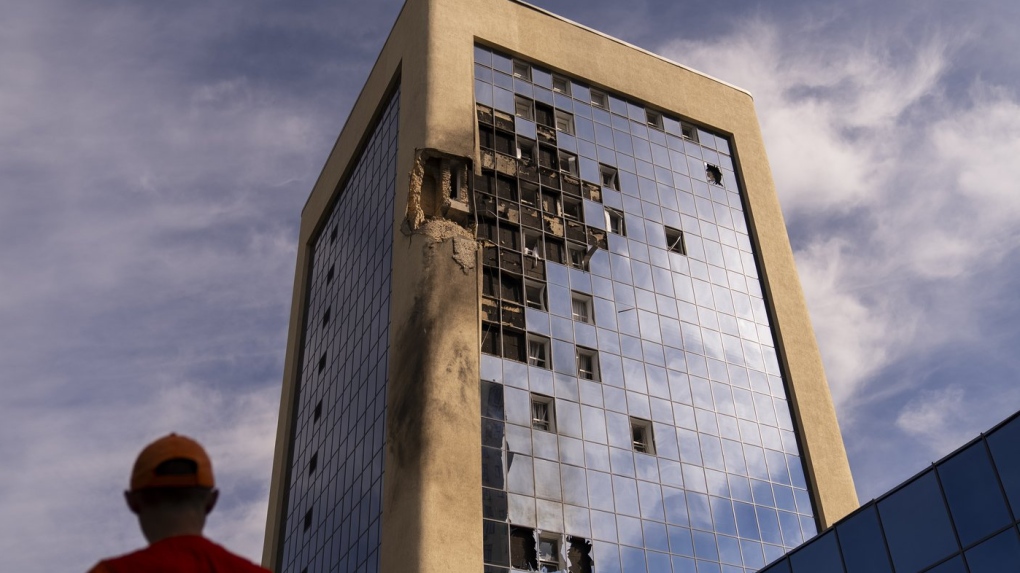
Russian drone strikes hit Ukrainian port on Romania border that is key to grain exports
CTV
Russian drones on Wednesday hit a Ukrainian port city along the border with Romania, causing significant damage and a huge fire at facilities that are key to Ukrainian grain exports.
Russian drones on Wednesday hit a Ukrainian port city along the border with Romania, causing significant damage and a huge fire at facilities that are key to Ukrainian grain exports.
The attacks followed the end of a deal with Russia that had allowed Ukrainian shipments to world markets from the Black Sea port of Odessa.
Since scrapping the deal, Russia has hammered the country's ports with strikes, compounding the blow to the key industry. In the past two weeks, dozens of drones and missile attacks have targeted the port of Odessa and the region's river ports, which are being used as alternative routes.
The head of the Ukrainian president's office, Andriy Yermak, said the city of Izmail was hit in the strikes. Izmail is on the Danube River that forms part of the Ukraine-Romania border.
Video obtained by The Associated Press showed explosions and a large fire in the distance on the Danube, captured by fishermen in Romania, a NATO member, on the other side of the river.
Three Ukrainian ports along the Danube are currently operating.
"The goal of the enemy was clearly the facilities of the ports and industrial infrastructure of the region," Ukraine's South operational command wrote in an update on Facebook. As a result of the attack, a fire broke out at industrial and port facilities, and a grain elevator was damaged.


China adopted a sweeping law Thursday to promote what it calls “ethnic unity,” a measure that critics say would further erode the rights of some minority groups as authorities cement a push toward assimilation.


Officials in Dresden evacuated 18,000 people Wednesday after the discovery of an unexploded World War II bomb, the largest such operation yet in the eastern German city, emergency services said.

At least six people have been killed and three others hospitalized with severe injures after a bus caught fire in a town west of the Swiss capital, police said Tuesday.

A U.S. judge has rejected a request for a new trial for a Venezuelan man convicted of killing Georgia nursing student Laken Riley, a case that became a flashpoint in the national debate over immigration.

Without warning, the sleepy Cuban farm town of San Antonio de los Baños burst into protest one morning nearly five years ago, triggering a series of copycat demonstrations across the country that shook the Communist government unlike any event in decades.

Three wealthy brothers, including two of New York’s top real estate brokers, were found guilty on Monday at a closely watched sex trafficking trial over allegations they lured women and girls to exclusive parties where they drugged and raped them.

Lawyers for a man accused of carrying out a deadly shooting on Sydney’s Bondi Beach sought a court order on Monday to stop media naming his family, saying their safety was at risk.

A fire at a building near Scotland’s Glasgow Central Station has caused major disruptions to train services.

A U.S. federal judge ruled Saturday that Kari Lake, U.S. President Donald Trump’s choice to lead the U.S. Agency for Global Media, did not have legal authority to take the actions she’s done to largely dismantle the Voice of America. The decision’s effect on VOA operations was not immediately clear.

Visitors to the Capitol will now have a visible reminder of the violent attack against the building on Jan. 6, 2021, and the officers who fought and were injured that day.

U.S. President Donald Trump is set to gather with Latin American leaders on Saturday at his Miami-area golf club as his administration looks to demonstrate it’s still committed to sharpening U.S. foreign policy focus on the Western Hemisphere even as it deals with five-alarm crises around the globe.

The calls to 911 poured in from staff at Camp East Montana in Texas, the nation’s largest U.S. Immigration and Customs Enforcement detention facility, at a rate of nearly one a day for five months, each its own tale of pain and despair.