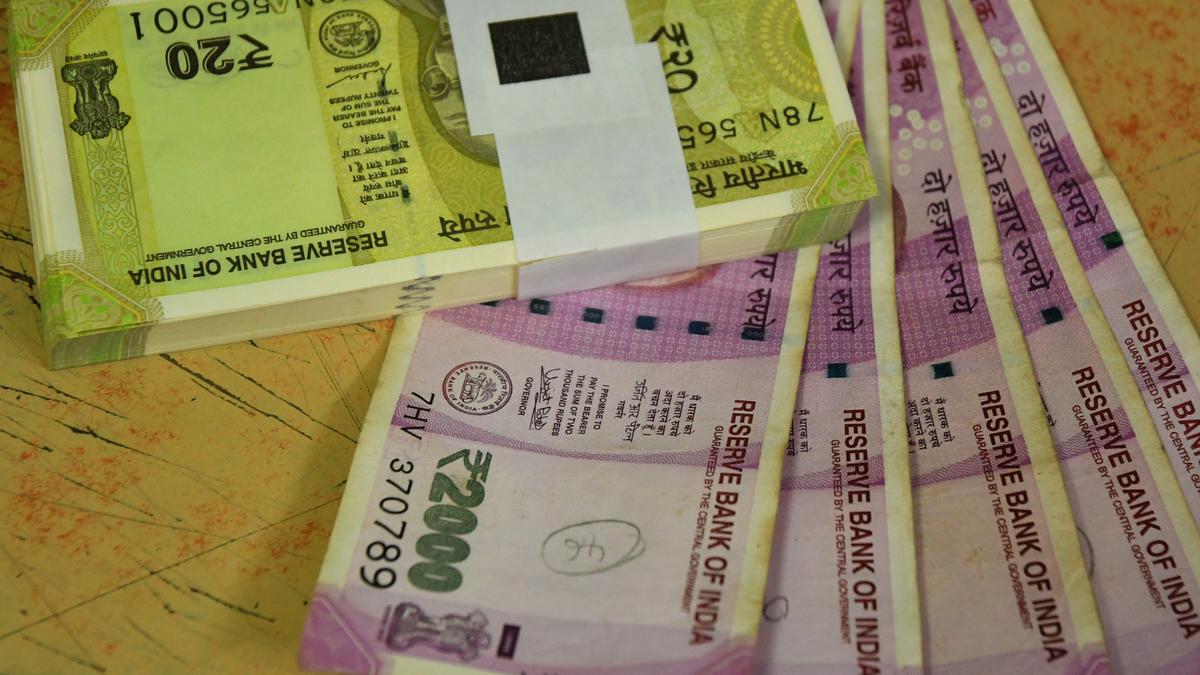
Rupee gains 10 paise to close at 82.08 against U.S. dollar
The Hindu
Rupee strengthens to 82.08 vs US$ on Thursday, marking 4th straight session of gain. Dollar index falls 0.20%, Brent crude rises 0.09%. BSE Sensex up 0.25%, NSE Nifty up 0.15%. Rupee supported by Dollar weakness, FIIs net sellers in capital markets.
The rupee strengthened further by 10 paise to close at 82.08 against the U.S. dollar on Thursday, marking its fourth straight session of gain following a firm trend in domestic equities and a weak greenback against major crosses overseas.
However, strengthening crude prices in the international market restricted the upside move in the local unit, forex traders said.
At the interbank foreign exchange market, the local unit opened sharply up at 81.98 against the U.S. dollar. It lost some ground later to settle at 82.08 (provisional), up by 10 paise over the previous close.
During the session, the domestic unit witnessed an intra-day high of 81.95 and a low of 82.14. This is the fourth straight day of rise for the rupee, during which it has gained 53 paise.
On Wednesday, the rupee had closed at 82.18 against the dollar.
"...at opening the rupee broke above 82 but witnessed some profit booking thereafter as secondary capital markets witnessed selling or profit booking from all time high in Nifty and closing near 19,413.
"The rupee found broad support from Dollar weakness, which now trades below $100 after CPI data in the U.S. came lower than expected at 3 per cent against 3.1 per cent, sending strong support to rupee buyers," Jateen Trivedi, VP Research Analyst at LKP Securities, said.


Arm Holdings announced a new artificial intelligence data centre chip on Tuesday which it said will add billions of dollars of revenue

Amazon said on Monday its Amazon Web Services region in Bahrain has been “disrupted” amid the current conflict in the Middle East

Petroleum Ministry directs reforms to enhance natural gas infrastructure, streamline approvals, and ease transition from LPG to PNG.

The Sora decision means the end of a blockbuster $1 billion deal between Disney and the ChatGPT maker that was announced a little more than three months ago.

Regulator mandates city gas distributors to provide piped gas to educational institutions within five days, supporting India's transition from LPG to PNG.

NHAI's Raajmarga InvIT listed on BSE, enhancing investor participation in highway infrastructure with strong demand and oversubscription.

HDFC Life Insurance faces ₹172 crore Income Tax order for alleged violations, plans to appeal the decision.

Air-conditioner makers in India are looking forward to FY27 with hope as the war in West Asia threatens to impact plastic component availability and consumer sentiment, adding to the challenges around raw material price and new energy label, a senior executive of a leading company has said.

Rupee falls 23 paise to an all-time low of 93.76 against the U.S. dollar amid foreign fund outflows and global uncertainties.

Stock markets surged nearly 2% as Trump paused strikes on Iran, boosting investor confidence amid easing geopolitical tensions.

Coal Minister urges State leaders to maintain stable coal prices amid rising global costs, assuring ample domestic supply.

Mahanagar Gas ensures reliable PNG and CNG supply in Maharashtra and Karnataka, offering customer benefits to encourage adoption.

OpenAI Chief Executive Sam Altman said on Monday he has stepped down from the board of directors of Helion Energy, the fusion startup he has backed since 2015