‘Run Rabbit Run’ movie review: Sarah Snook does too much for a movie that does too little for her
The Hindu
The Australian film does a neat job in creating an atmospheric horror but loses its command over the genre after a point
Australian filmmaker Diana Reid must either be a fan of Stephen King or The Shining, or both. Her latest feature, Run Rabbit Run, has the literary attributes of Stephen King as well as the genre characteristics of The Shining. Or at least, Run Rabbit Run does remind you of Stanley Kubrick’s masterpiece, particularly the way Reid playfully exploits the motif of the twin sisters from The Shining. Though Run Rabbit Run has nothing to do with twins, it has a subplot that involves two child actors who play two different characters; at one point, it takes a moment to recognise who plays what. For, the child actors look like mirror images. Reid gets the casting right, and Run Rabbit Run benefits largely from its actors.
All of which is not to say that Run Rabbit Run is a great work by any stretch. The screenplay comes across like the work of a horror movie fan who has seen all the great works of classical horror and yet, lacks clarity. Reid seems to have clarity only in the genre elements and a premise that benefits by stacking the odds against its protagonist. There is no emotional depth nor do the characters feel real.
Run Rabbit Run starts pretty well: Sarah (Sarah Snook), a fertility doctor, lives with her daughter Mia (Lily Latorre) who has just turned seven. Sarah recently lost her father with whom she was closest, and comes to know that her estranged husband Pete and his partner are trying for a baby. “Mia was going to be the only kid. I thought we agreed on it,” she shoots back at her ex-husband. Around this time, Sarah comes home to find an unusual gift for Mia at the doorstep — a rabbit with blood-red eyes waiting for them. At the same time, Mia begins to behave strangely and becomes increasingly not herself by the day.
There is a lot that goes against Sarah and understandably so. The unwritten rule in psychological horror is that the protagonist has to feel a sense of suffocation from her immediate reality. So, let’s dump everything in it.
When the genre elements kick in, the first half of Run Rabbit Run is quite enjoyable, giving us a false promise that there is something profound to come in the latter half. Sadly, it doesn’t come together as a whole. Even when the movie tries to create a mood, something doesn’t work or is wrong about the way Reid imagines horror and suspense.
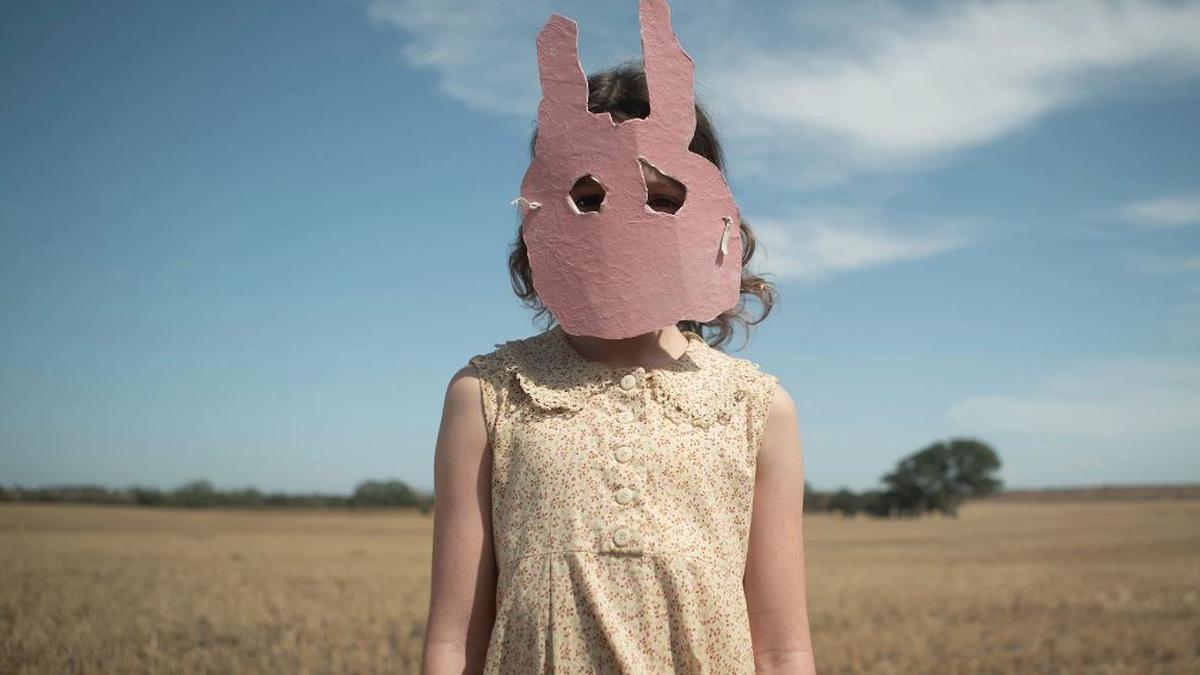
The winds are always rough in Run Rabbit Run; its aural cues almost never complement the visuals. So much so that when you watch the movie on mute, the audio description does a better job of telling us what kind of horror Reid is aiming at. The audio description always goes: ominous score, ominous music, unsettling score, disorienting sounds. Mia wears a paper mask shaped like a rabbit. These are all derivative, there is hardly any original. As the movie progresses, we are definitely hooked on; that is one thing Run Rabbit Run can be proud of. But over time, the narrative gets tedious and repetitive as if we are stuck in a time loop.
Written by Hannah Kent, Run Rabbit Run drops hints about Sarah, the equation she had with her father and the estranged relationship with her mother. We learn all this through Mia. There is a weighty piece of reveal about Sarah that is not difficult to guess, but one that the movie reserves till the end. The issue with Kent’s script is the narrative gaps and the lack of emotional clarity: when Mia exhibits strange behaviour at a later point — when she goes by a different name — it becomes a movie about two sisters when it would have actually made a decent watch if it were about Sarah and Mia. It still is. But Run Rabbit Run ultimately becomes Sarah’s story with a tad simple solutions.


An independent video, ‘Feel the Spark’ by Raleigh Rajan with vocals by Ciera Dumas that celebrates Tamil literary giants, garnered 1.4 million views in less than 36 hours.

In ‘Jack Ryan: Ghost War’, John Krasinski is back as the savvy CIA analyst, diving headfirst into a high-stakes mission that unravels a deadly conspiracy and pits him against a rogue black-ops unit

Shriram Bharatiya Kala Kendra’s Shankarlal festival showcased rare ragas, radiant artistry, and inclusive performances, from Pt Madhup Mudgal’s serene morning ragas to Ramana Balachandran’s Saraswati veena.

Explore "Threads that Bind: The Kantha Project," an exhibition in Delhi reimagining kantha as a medium of repair and renewal.

Sean Penn skips the Oscars to meet Ukraine's Zelenskyy, who praises him as a "true friend" amid the war.

The teaser of Tamil star Suriya’s much-awaited film with director Venky Atluri, titled Vishwanath and Sons, was unveiled by the makers on Monday

A 'Golden' moment for a K-pop track at the Oscars.

Parvathi Nayar’s new exhibition, The Primordial, in Mumbai, traces oceans, pepper and climate change
Opened on March 12, the exhibition marks the artist’s first solo show in Mumbai in nearly two decades. Known for her intricate graphite drawings and multidisciplinary practice spanning installation, photography, video, and climate change, her artistic journey has long engaged with the themes of ecology, climate change and the natural world. In this ongoing exhibition, these strands converge through a series of works centred on water, salt, and pepper — materials that carry natural and historic weight across centuries.

Explore the highlights and key winners of the 98th Academy Awards, featuring memorable moments and historic achievements from Oscars 2026.

Spring season celebrated at Ramakrishna Mission Institute, Kolkata, with ‘Evening of Basant’

The Spirit of the Land, a solo show by artist Shivakumar Sunagar, is a vista of Nature-inspired emotions

Tal Fry is all set for an exciting new performance season

Netflix is making a bold move by snagging InterPositive, the AI filmmaking company founded by Ben Affleck, in a deal that could hit $600 million