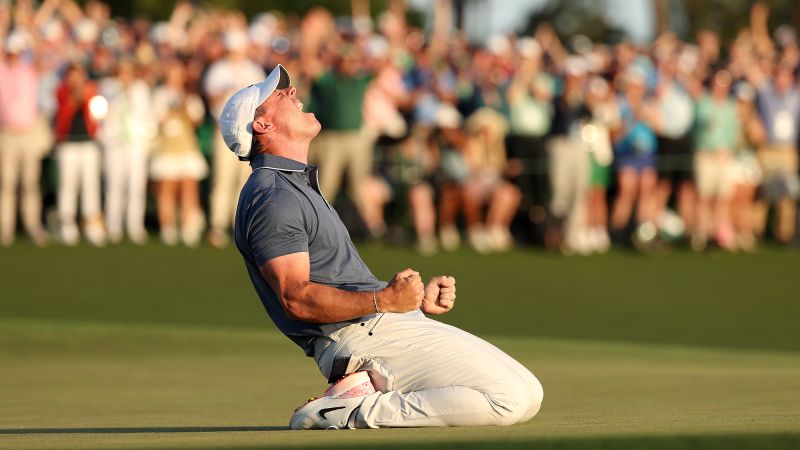
Rory McIlroy’s tearful Masters triumph was sport at its most moving. This week could be even more emotional
CNN
While Rory McIlroy’s Masters triumph earned him a long-awaited career grand slam, a home Open Championship win at Royal Portrush could be even more emotion for the Northern Irishman.
Hands clasped to his head, knees pinned to the emerald turf, chest convulsing in frenetic, ragged breaths, Rory McIlroy looked like a man subjugated by the weight of the world. Then, he propped himself upright, lifted his head skyward and unleashed a primal, fist-pumping roar that reverberated with the release of a seemingly indomitable burden. The images of McIlroy winning The Masters, finally capturing his white whale after a 17-year pursuit fraught with heartbreak, and the unbridled celebrations that followed will likely live long in the memory of anyone who followed that near-cinematic Sunday afternoon at Augusta National in April. Eyes welling up with tears as he discussed the prospect of celebrating with his parents back home in Northern Ireland, the raw intensity of McIlroy’s body language was a fitting reflection of the summit he had just scaled. Victory had stamped his ticket for entry into the sport’s most illustrious member’s club as just the sixth men’s golfer to complete the career grand slam of all four majors. Yet McIlroy isn’t done soul stirring. Far from it, the green jacket’s newest recipient believes that winning the Open Championship on home turf at Royal Portrush come Sunday could well top the realization of that “lifelong dream” three months ago. “I think it would be just as emotional, if not more emotional, to do that than what I did in Augusta … and everyone saw the mess I was after that,” the 36-year-old told BBC Sport on Monday. Born and raised some 60 miles (96 kilometers) away in Holywood, a small town of little over 10,000 people just a 15-minute drive from the hubbub of the capital Belfast, McIlroy was always guaranteed to receive a hero’s welcome at the 153rd edition of the major this week.


In a season of ticking off accomplishments, the Cornhuskers bull their way into March taking dead-eye aim at the elephant sitting square in the middle of their locker room: Their school is the only one power conference team that has failed to win an NCAA Tournament game.

Team USA avoided a World Baseball Classic disaster on Wednesday when Italy pulverized Mexico, ensuring the Americans advanced to the quarterfinals.

Cinderella is a funny girl when her glass slippers are Nike issued. We are amused by her as a lead-up to the ball, love her if earns a party-crashing admittance and then goes on to trash the place in the first weekend. But not everyone is so eager to hand her one of the coveted 37 extra tickets held in reserve.

New York Giants co-owner Steve Tisch is requesting his ownership stake in the team be transferred to his children, according to an internal NFL memo.

Team USA is on the verge of one of the most embarrassing exits in World Baseball Classic history and, at this point, there’s nothing they can do about it.

Rick Barnes has been a head coach for 48 years. Won 857 games, been to the NCAA Tournament 29 times. He is not a man who needs to explain or even create a culture around his team. It sort of just exudes from him at this point.

Seven members of the Iranian women’s soccer team have remained in Australia, while the rest of the squad has now left the country for Iran, a source has told CNN Sports.

After their final defeat in the AFC Women’s Asian Cup on Sunday, supporters of the Iranian women’s football team crowded around their bus shouting at police to “save our girls” as it pulled away.

The Iran women’s national soccer team was forced to salute and sing its anthem on Thursday ahead of its Women’s Asian Cup group stage match against host Australia, sources close to the team tell CNN Sports, just days after the squad refused to do so in its tournament opener.

Lou Holtz, the College Football Hall of Fame coach who led Notre Dame to the 1988 national championship and won 249 games over 33 seasons at six schools, has died. He was 89.

North Carolina runner Molly Born won the USA Track & Field (USATF) women’s half marathon championship by a slim margin of just over four seconds on Sunday in Atlanta – but the result is only half the story.

It’s now 100 days until the FIFA World Cup is set to begin in North America, and the intensifying war in the Middle East has raised further questions around what is already a controversial tournament.

When American golfer Brooks Koepka left the PGA Tour in 2022, he didn’t seem all that sorry about it.