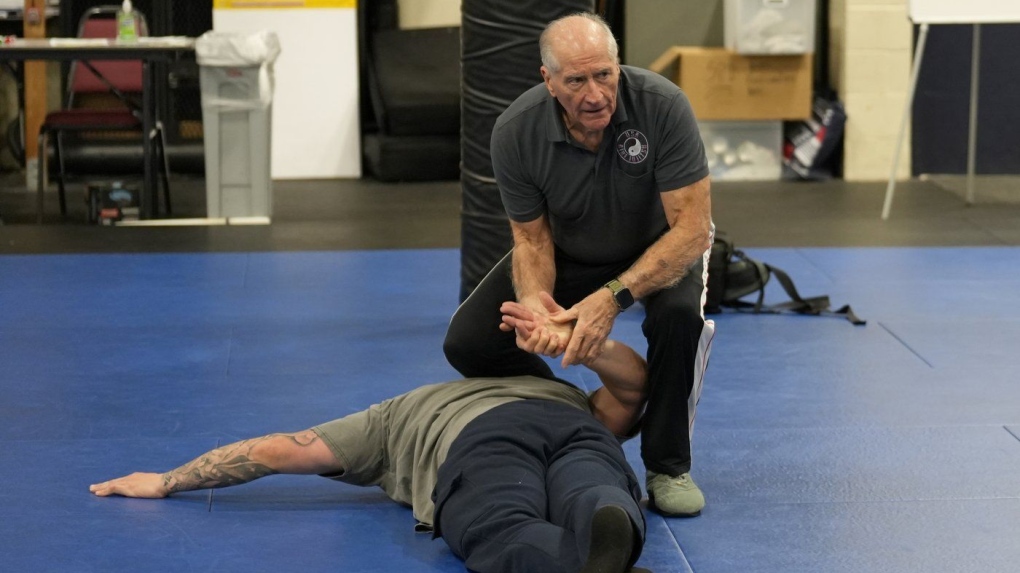
Risks of handcuffing someone facedown long known; people die when police training fails to keep up
CTV
For decades, police across the United States have been warned that the common tactic of handcuffing someone facedown could turn deadly if officers pin them on the ground with too much pressure or for too long.
For decades, police across the United States have been warned that the common tactic of handcuffing someone facedown could turn deadly if officers pin them on the ground with too much pressure or for too long.
Recommendations first made by major departments and police associations culminated in a 1995 federal safety bulletin that explained keeping someone on their chest in what’s known as prone restraint can dangerously restrict breathing. The solution: Once cuffed, turn them onto their side.
Yet today, what some officers are doing on the street conflicts with what has long been recognized as safe, a deadly disconnect that highlights ongoing failures in police training, an Associated Press investigation has found.
The cases involving prone restraint are among more than 1,000 AP documented over a decade of people who died not by gunshot but after officers used force that is not meant to kill. In all, at least 740 of these encounters involved prone restraint, making it the most prevalent tactic. It was also commonly misapplied.
In about half of the 740 cases, officers continued to pin someone down after handcuffing, often pressing with knees or hands when the person was controlled. That included people especially susceptible to the risks of prone restraint — those who were obese, impaired by drugs or had a medical condition.
Many people were held down longer than five minutes. In the extreme, at least 13 were down for 10 minutes or more — longer than George Floyd, whose 2020 death thrust policing back into the national conversation. Other cases involved police lying across, sitting or even standing on someone’s back.
Training that is ineffective, or that contradicts longstanding best practices, happens in part because policing in the U.S. lacks a national rulebook. The federal government’s 1995 guidance that warns against pressing someone down is just that — guidance, not the law.


In their latest joint public appearance, North Korean leader Kim Jong Un and his teenage daughter rode a tank together, state media photos showed Friday, days after they watched rocket launches and fired pistols.

Japanese Prime Minister Sanae Takaichi sought to reaffirm her alliance with U.S. President Donald Trump on Thursday after the president this week complained that Japan was among the nations that did not join his call to help protect the Strait of Hormuz.

Pope Leo XIV on Thursday summoned Catholic bishops to Rome for a special meeting on ministering to families that takes as its starting point Leo’s strong endorsement of one of Pope Francis’ most controversial policies on marriage and divorce.

Shaquille O’Neal is offering to pay for the funeral of a 12-year-old Georgia girl who died a few days after she collapsed following a fight after school.

Both parties on Capitol Hill remain unmoved in their fight over U.S. President Donald Trump’s immigration agenda, threatening to drag out the U.S. Department of Homeland Security shutdown for days – if not weeks – more.

Closing arguments are set to kick off Tuesday in a trial pitting Elon Musk against Twitter shareholders who say the world’s richest man engaged in a pattern of deceptive behavior that misled investors as he attempted to back out of his US$44-billion deal to buy the social media platform in 2022.

A Utah woman who wrote a children’s book about coping with grief after her husband’s death was convicted of aggravated murder in his death by poisoning him with fentanyl.

U.S. President Donald Trump has repeatedly taken aim at Democratic rival and possible 2028 presidential candidate Gavin Newsom. But lately, he’s become fixated on saying the California governor cannot be president due to his “learning disability.”

More than 10,000 U.S. flights were delayed or cancelled Monday amid a series of storms affecting several major airports along the East Coast and some other locales.

The man who attacked a Michigan synagogue was the brother of a Hezbollah commander killed earlier this month in an Israeli airstrike, Israel’s military claimed Sunday.

Taiwan saw a surge of Chinese military planes near the island, its defence ministry said Sunday, after a sharp drop in flights over the past two weeks had sparked discussions among observers.

North Korean leader Kim Jong Un, accompanied by his teenage daughter, observed a live-fire test of multiple rocket launch systems, state media reported Sunday, a likely response to ongoing U.S.-South Korean military training that North Korea views as an invasion rehearsal.

North Korea on Saturday fired about 10 ballistic missiles toward the eastern sea, South Korea’s military said, staging its own show of force as the rival South conducts a joint military exercise with the United States.