Rising tensions in the Korean peninsula | Explained
The Hindu
The escalating tensions between North and South Korea, along with their alliances with major powers, raise concerns about potential conflict.
The story so far: There has been a notable uptick in provocative moves by North Korea and the subsequent rebuttals by South Korea and its allies. North Korea has rescinded its national objective of Korean reunification and has formally categorised South Korea as an adversarial state. The country has also ramped up the frequency and diversity of its missile tests, expanding its strategic capabilities. These actions were responded to by South Korea through joint military drills with the U.S. and Japan. The ongoing developments in the Korean peninsula have raised serious concerns about the deterioration of the international security environment and a deepening of major power rivalry.
The Korean peninsula was divided into two by the end of World War II, after imperial Japan who occupied the territory was defeated. The North went under the ambit of the Soviet Union and the South under the U.S., resulting in the creation of two ideologically different regimes which mirrored either sides of the Cold War divide. The Korean war (1950-53) broke out as a result of the North’s attempt to take over the South — the first “hot war” of the Cold War. Decades after the cessation of active conflict and the end of the Cold War, the two countries are still divided over ideology and geopolitical leanings — the North being an authoritarian dynastic regime allied with China and Russia, and the South being a liberal democracy allied with the U.S. However, one of the biggest issues in the contemporary geopolitics of the Korean peninsula has been the question of North Korea’s de-nuclearisation. Various efforts were made by the international community to stop and reverse North Korea’s nuclear weapons programme.
North Korea’s nuclear ambitions were held up for a brief period during 1994-2002, when the U.S. signed an “Agreed Framework” with the country for halting its nuclear programme in return for nuclear energy. The deal unravelled and North Korea went ahead with its nuclear test in 2006 after exiting from the nuclear non-proliferation treaty in 2003. However, in 2003 itself, another initiative started for de-nuclearising the Korean Peninsula, called the six party talks involving the two Koreas, China, Japan, Russia and the U.S. In 2005, the talks resulted in North Korea pledging to forego its nuclear ambitions, only to conduct its nuclear test the very next year. By 2009, talks had broken down, and North Korea emerged out of it with a vow to never return. Ever since Kim Jong Un took over power as the leader of North Korea, missile tests have been conducted on a yearly basis, with a notable and consistent increase in such tests.
There was an effort by the Donald Trump administration to discuss peace with North Korea and veer it towards de-nuclearisation. During 2018-19, the two leaders met on three occasions to pursue peace talks. However, the talks failed to take off, and Kim returned to developing and testing delivery systems. Over the past couple of decades, North Korea has demonstrated its nuclear weapons capability by testing the same six times. It has developed, tested and deployed delivery vehicles, space launchers and satellites, and has conducted provocative actions ranging from military drills to shelling South Korean islands and even threatening nuclear attacks. North Korea supposedly has the ability to even target the U.S. mainland with its nuclear arsenal, and it has also become a major source of cyber-attacks across the world. South Korea, in turn has enhanced its military alliance with the U.S. and has become an integral part of the latter’s wider alliance system, hosting not just U.S. troops, but also advanced missile defence systems.
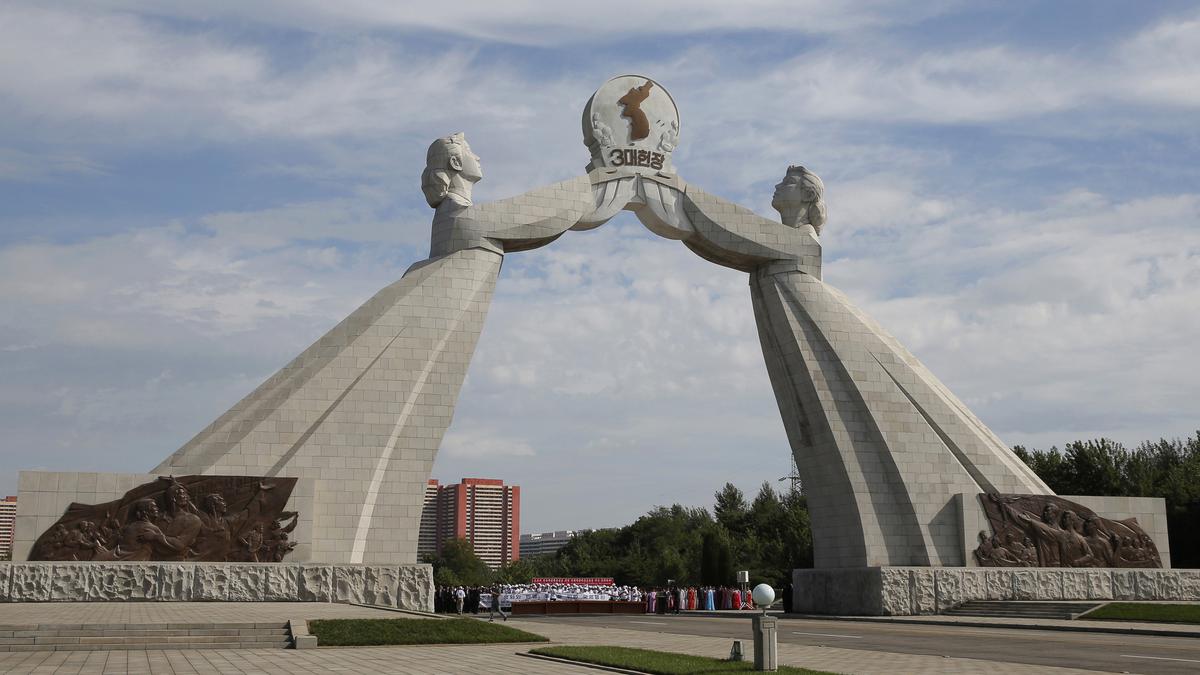
Mr. Kim, in his address to the Supreme People’s Assembly on January 15, proclaimed that he is scrapping the decades old North Korean goal of reunifying the South, and has rebranded the South as an enemy state. He ordered the rewriting of the North Korean constitution to reflect this new shift in the regime’s thinking. The offices related to reunification were closed, and a landmark monument in Pyongyang portraying the reunification ideal was brought down. In addition to these moves, North Korea has also flexed its military muscle by testing multiple types of missile systems during the first month of 2024 itself.
One such important test was that of a solid fuelled missile carrying a hypersonic warhead. This is significant because major military powers across the world are on a race for developing, testing and deploying hypersonic weapons. These weapons can theoretically provide countries the capability to evade and even target the missile defence systems of their adversaries. The U.S., Russia, China, India and Iran are working on such hypersonic weapons, and North Korea could now join the club. The U.S., South Korea and Japan have conducted joint naval drills in response to the provocations by North Korea, featuring nine warships. The exercises were meant to enhance their joint effectiveness against North Korea’s missile and underwater threats, as well as its illegal maritime shipment of arms. North Korea has alleged that these exercises are rehearsals of an offensive intent and not defensive drills. The nation subsequently tested its “Haeil-5-23” nuclear capable underwater drone in retaliation to these joint naval drills. Pyongyang also tested its strategic cruise missile “Pulhwasal-3-31”, which could allegedly threaten critical American bases in Japan.
The current government in South Korea is a newly elected one led by the conservative President Yoon Suk Yeol. He has a hawkish view of North Korea unlike his predecessor Moon Jae-in. The Yoon government’s strategy is to closely coordinate efforts with the U.S. and Japan to deter and counter North Korea’s aggressive moves. In fact, the three countries in August 2023 met together at Camp David in Washington D.C., in a historic meeting to initiate a new era of trilateral cooperation. This is a significant step as South Korea and Japan, even though close allies of the U.S., and strong economic partners, have bitter political relations among them due to the historical legacy of imperial Japan’s occupation of the Korean peninsula. In light of these developments, there is a high probability for tit-for-tat measures leading to unintended consequences. Hence, there is a growing concern among the international community that the tensions between North and South Korea maybe heading towards conflict.


U.S. official Elbridge Colby emphasizes India's vital role in the Indo-Pacific, highlighting mutual benefits despite existing differences.

Philippine President Marcos declares national energy emergency amid Middle East conflict, ensuring fuel and essential goods supply stability.

Mohammad Baqer Zolqadr appointed as Iran's new security chief, succeeding Ali Larijani after his assassination.

Israel plans to occupy southern Lebanon amid escalating violence, targeting Hezbollah and causing widespread destruction and civilian casualties.

Trump reveals Secretary Hegseth was pivotal in discussing military action against Iran amid escalating tensions in the Middle East.

Iran arrests 466 individuals for online activities threatening national security amid ongoing tensions with Israel and the U.S.

China protests to Japan over a break-in at its Tokyo embassy, demanding a thorough investigation and accountability.

After securing a historic mandate in Nepal’s polls, Balendra Shah and the RSP face the task of navigating the West Asia conflict and managing ties with India, China and the U.S.

A magnitude 7.6 earthquake struck near Tonga, prompting evacuations but no tsunami warnings or immediate damage reports.

Iran launches missile attacks on Israel, rejecting Trump's negotiation claims as 'fake news,' escalating regional tensions and market volatility.

A large explosion at Valero refinery in Port Arthur, Texas, prompts shelter-in-place order for nearby residents, no injuries reported.

Kim Jong Un vows to solidify North Korea's nuclear status and labels South Korea as its "most hostile" adversary.

U.S.-Israel war on Iran LIVE: Follow The Hindu for updates on the West Asia conflict on March 24, 2026