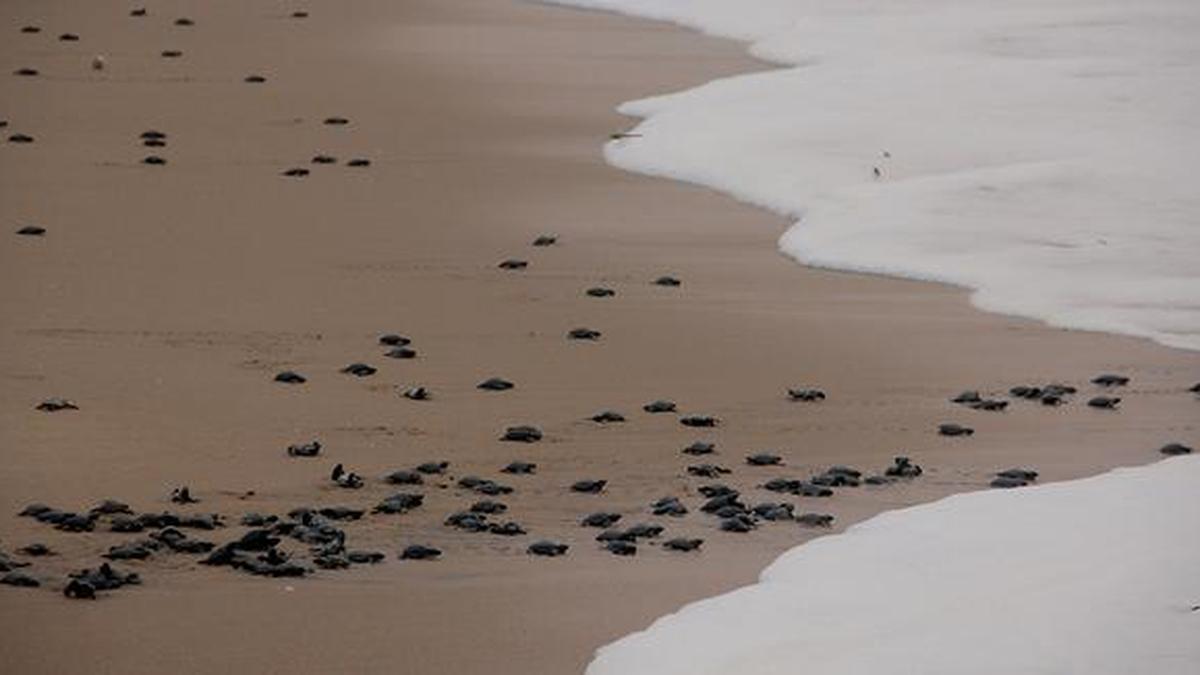
Rising seas could flood olive ridley nesting sites by 2050: study
The Hindu
A study based on digital elevation models has found that even in a moderate climate-change scenario, olive ridley turtle nesting sites on India’s east coast could be completely flooded by rising sea levels by 2050.
Should warming continue under moderate climate-change scenarios, leave alone drastic ones, some sea-turtle nesting habitats, including those of the olive ridleys that visit India every year, will be completely flooded by 2050. In more extreme emissions scenarios, they could completely vanish, a new study has found.
An international team of researchers, from Australia, Brazil, Costa Rica, Cuba, Dominican Republic, the U.K. and the U.S., combined freely available digital elevation models for continental and remote island beaches across different ocean basins, with projections of field data and sea-level rise, to examine the possible impact on five of the world’s seven living sea-turtle species. These are the leatherback turtles ( Dermochelys coriacea), loggerhead turtles ( Caretta caretta), hawksbill turtles ( Eretmochelys imbricata), olive ridley turtles ( Lepidochelys olivacea), and green turtles ( Chelonia mydas).
Of these, on the IUCN Red List, the leatherback, loggerhead, and olive ridley turtles are classified as ‘vulnerable’, the green turtles as ‘endangered’, and the hawksbill turtles as ‘critically endangered‘.
In a paper published in Scientific Reports on April 20, they reported that in a scenario in which the world’s carbon emissions are neither high nor low, “it is predicted that at some sea turtle nesting habitats 100% will be flooded, and under an extreme scenario many sea turtle rookeries could vanish” – either by 2050.
Overall, nesting beaches that had less steep slopes and those species nesting at open beaches – the leatherbacks and the loggerheads – could be the most vulnerable to future sea-level rise, they said.
According to the team, their method showcases the use of a low-cost approach to assess the impact of various sea-level rise scenarios on different sea turtle nesting rookeries worldwide. One of their objectives was to address the uncertainties in the magnitude and on the relevance of expected increases in sea levels for marine and terrestrial species that depend on coastal habitat for foraging, resting or breeding.
Previous studies attempted to address these problems but focused mainly on local regions and considered only one or two species at a time. Their techniques varied as well: regional field surveys often suffered from low accuracy, while the combination of ‘light detection and ranging’ (LiDAR) and biological data was more accurate but also more expensive, and thus not very repeatable.


The government plans to amend the FCRA, introducing new regulations for NGO asset management and accountability for key functionaries.

The draft policy for “Responsible Digital Use Among Students”, released on Monday by the Department of Health and Family Welfare, has recommended that parents set structured routines with clear screen-time rules and prioritise privacy, safety, and open conversation with children on digital well-being.

Police Observer Sushant Kumar Saxena conducts surprise inspection at Shencottai police station, reviewing warrants and security arrangements ahead of elections.

Andhra Pradesh government to launch key projects in April, focusing on industrial growth and infrastructure development, says Nara Lokesh.

Lok Sabha refers the Corporate Laws (Amendment) Bill to a JPC amid opposition concerns over CSR provisions dilution.

SHG members in Kanniyakumari use snakes and ladders to raise election awareness and boost voter turnout.

Government accelerates consultations for early implementation of the Women’s Reservation Act to ensure women’s representation in 2029 elections.

CM A. Revanth Reddy distributes ₹1 crore insurance cheques to families of deceased Electricity department employees, enhancing financial security for workers.

The Bengaluru Traffic Police (BTP) registered 634 cases of drunk driving during a week-long special enforcement drive conducted across the city between March 16 and March 22.

GHMC intensifies action against property tax defaulters, seizing properties and offering a One Time Settlement scheme for payments.

CCB arrests three drug peddlers in Mangaluru, seizing ₹2.5 lakh worth of MDMA and other valuables.

TVK's 28 candidates in Puducherry include former BJP MLAs, a sitting Independent, and a retired police IG.

BRS submits notice on private member bill to Speaker