Rigorous fitness routine awaits Sunita Williams, Barry Wilmore on earth Premium
The Hindu
Astronauts returning from space undergo rigorous post-flight rehabilitation, including medical tests and physical exercises to readjust to gravity.
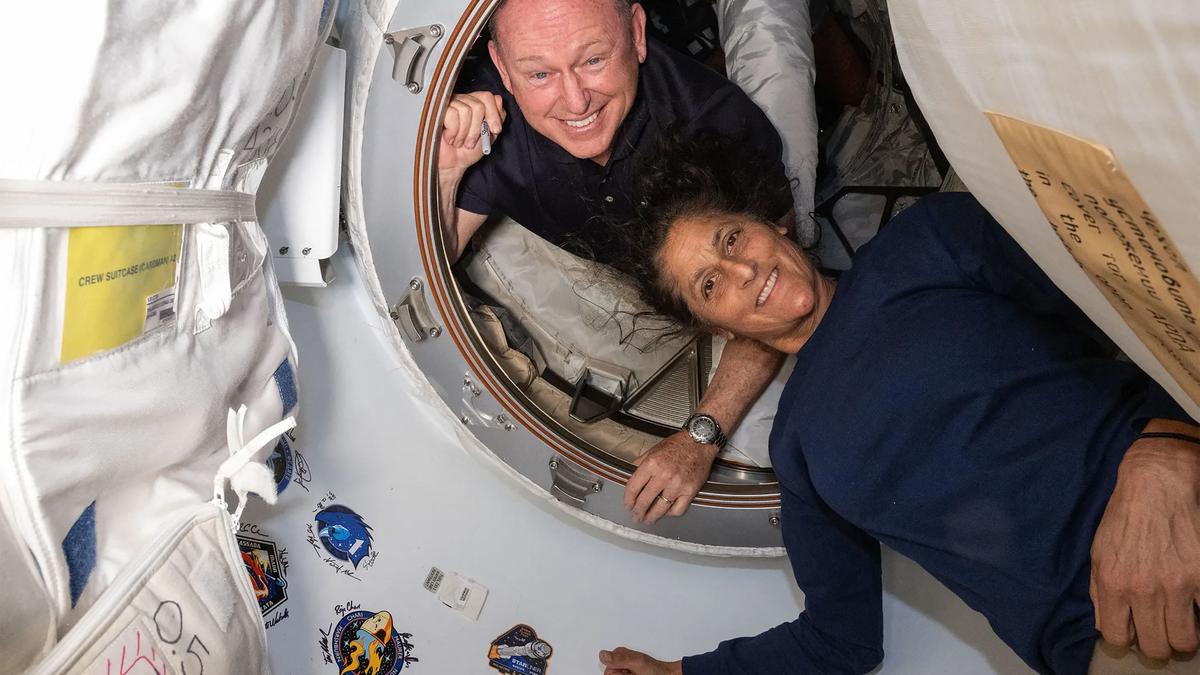
The story so far: At around 3 am IST on March 19, a capsule bearing the astronauts Sunita Williams, Barry Wilmore, Aleksandr Gorbunov, and Nick Hague splashed down off the coast of Florida, US. The four were returning from the International Space Station back to the earth; of them, Ms. Williams and Mr. Wilmore were wrapping up a roughly nine-month stay on the ISS, which they reached in June last year onboard Boeing’s Starliner capsule. Mr. Gorbunov and Mr. Hague were returning after a six-month stay onboard the ISS. NASA — which employs Mr. Hague, Ms. Williams, and Mr. Wilmore — has a regimen in place for the trio to follow now that they are back, to ensure they are in good health and are able to re-adapt to living with gravity after spending months in microgravity.
The ISS is in low-earth orbit and its occupants experience microgravity, i.e. a very small but non-zero gravitational force. This affects the body in many ways, including allowing fluids to flow more easily towards the brain, reducing the tension acting on muscles, and lowering bone density.
These consequences have cascading effects of their own. For example, the lower bone density causes more minerals to be deposited in the kidneys instead, leading to a higher risk of kidney stones.
Thus, astronauts like Ms. Williams and Mr. Wilmore maintain a strict routine of exercises and dieting onboard the ISS, tailored among other things to help increase the blood-cell regeneration rate, work the heart, and engage the brain.
NASA and other space agencies also have crafted specific programmes to make sure astronauts don’t become stressed or anxious by their workload or by the confined space they’re forced to occupy for months at a time.
While more and more people have gone to space with each new decade, the data about the effects of spaceflight on their bodies and minds is insufficient to make proper conclusions with. This is because the number of spacefaring individuals is still much smaller than in a clinical trial; human bodies can differ on a variety of parameters; and different missions have different spaceflight profiles.
Many agencies are currently pursuing programmes to systematically study astronauts’ health, including a standardised set of tests and benchmarks.


The ‘Swastha Mysuru’ initiative aims to promote healthy living and preventive healthcare in Mysuru through community engagement and awareness.

Farmers in Ongole protest against BJP's policies, citing dangers to their livelihoods and demanding support for local agriculture.

From March 24, paneer queserotta, prawn tostadas, beef birria and more feature on MadCo's special Mexican pop up menu by Chef Mathangi Kumar alongside experimental cocktails, including a marigold highball

Revenue Minister Krishna Byre Gowda defends subsidies as crucial for economic growth, emphasising their role in boosting consumer demand during recessions.

Three doctors were arrested by the Mico Layout traffic police on Monday (March 23) after a video allegedly showing them triple-riding without helmets with one of the pillion riders seen drinking from a bottle went viral on social media.

Assembly protest ends in arrests as BJP targets Government over guarantees

Andhra Pradesh accelerates city gas distribution with streamlined approvals, enhancing access to cleaner energy and supporting sustainable urban development.

Sattankulam father-son custodial deaths case: Trial court convicts all nine accused police personnel
Nine police personnel convicted in Sattankulam custodial deaths; sentencing to be announced on March 30.

Minister Laxmi Hebbalkar supports local protests against a solid waste management plant in Turmuri, addressing residents' concerns.

Sattankulam father-son custodial deaths case: Trial court convicts all nine accused police personnel
Nine police personnel convicted in Sattankulam custodial deaths; sentencing to be announced on March 30.

Erode district conducts first EVM randomisation for April 23 Assembly elections, ensuring transparency and fairness in allocation.

TNCC conducts public consultation in Erode to gather community input for its upcoming election manifesto.

CID to investigate sexual assault allegations against suspended Moodbidri Police Inspector P.G. Sandesh, reveals Home Minister Parameshwara.