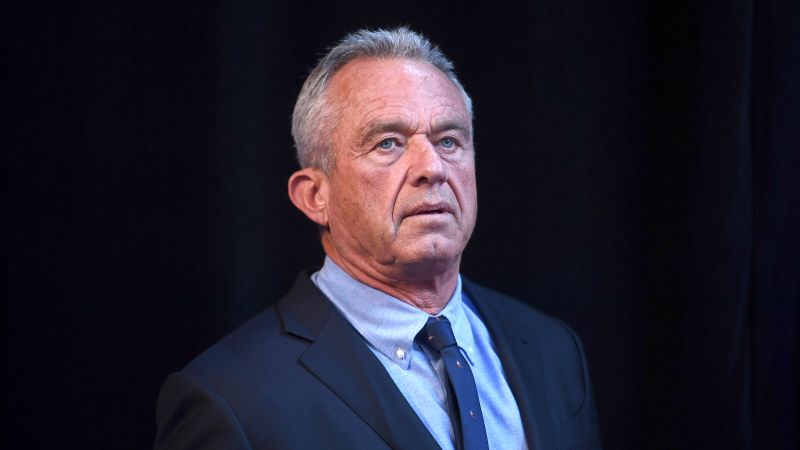
RFK Jr. details medical abnormality that he says was a parasitic worm in his brain
CNN
Independent presidential candidate Robert F. Kennedy Jr. on Wednesday detailed the medical abnormality he experienced in 2010 that he said was caused by a worm that entered his brain and then died, marking his first public explanation of the incident.
Independent presidential candidate Robert F. Kennedy Jr. on Wednesday detailed the medical abnormality he experienced in 2010 that he said was caused by a worm that entered his brain and then died, marking his first public explanation of the incident. Kennedy said he recalls experiencing “brain fog” and “having trouble with word retrieval and short-term memory,” during that period in a podcast interview on “Pushing the Limits with Brian Shapiro.” He was initially told by doctors that he had a tumor in his brain, and was planning to have it removed before he met with another doctor who looked at images of his brain and said it didn’t look like a tumor, Kennedy said. After the doctor measured the abnormality and determined that it hadn’t grown, Kennedy continued, “they said that this is almost certainly a parasite that got into your brain … it’s a parasite that’s very common in India where I had done a lot of environmental work.” According to the New York Times, which first reported the incident on Wednesday, Kennedy had said during a 2012 deposition, which concerned a divorce from his second wife, that a doctor had told him his health issues could be “caused by a worm that got into my brain and ate a portion of it and then died.” In a statement to CNN Wednesday, Stefanie Spear, a spokesperson for Kennedy’s campaign, said he had “traveled extensively in Africa, South America and Asia” as part of his work as an environmental advocate and said he contracted a parasite in one of those trips.


The House Oversight Committee released videos Tuesday of closed-door depositions with two men in Jeffrey Epstein’s inner circle as part of its probe into the late convicted sex offender.

The House Intelligence Committee voted Tuesday to give federal prosecutors classified records related to John Brennan, according to a committee spokesperson, signaling the Justice Department’s investigation into the former CIA director may be heading towards possible charges.

North Carolina State Senate leader Phil Berger on Tuesday conceded his primary race to Rockingham County Sheriff Sam Page, a political earthquake that took down arguably the most powerful politician in a pivotal swing state.

It’s looking like the Department of Homeland Security shutdown could soon be over. The two sides seem to have made serious progress, and President Donald Trump hasn’t rejected anything, even if he’s a little sour. But it’s likely the resolution will disappoint many Democrats.

California Gov. Gavin Newsom said that he regretted using the word “apartheid” to describe the Israeli government’s treatment of Palestinians, though he warned “that’s a word you may hear others use” if Prime Minister Benjamin Netanyahu pushes for territorial gains.

Haiti is about to get a new set of foreign boots on the ground. The goal sounds simple: fight the gangs that have brought life to a standstill.

Oklahoma’s governor picks energy executive Alan Armstrong to fill US Senate seat through end of year
Oklahoma’s governor on Tuesday appointed energy executive Alan Armstrong to serve in the US Senate through the end of the year and finish the term of Republican Markwayne Mullin, the new homeland security secretary.

Newly confirmed Homeland Security Secretary Markwayne Mullin told senators during his confirmation hearing that he wanted to keep the department out of the headlines. That won’t be easy.

A trader made nearly $1 million since 2024 from dozens of well-timed Polymarket bets that correctly predicted US and Israeli military actions against Iran, according to an analysis shared with CNN.

Travelers have been dealing with worsening airport wait times as ICE agents deploy to more than a dozen airports. Follow for live news updates.

President Donald Trump voted in Tuesday’s state House special election by mail even as he suggested on Monday that “mail-in voting means mail-in cheating.”

CNN’s 5 Things AM brings you the news you need to know every morning.

The Supreme Court on Tuesday will consider the legality of a policy championed by President Donald Trump during his first term that prevented scores of migrants arriving at the southern border from starting the process of applying for asylum.