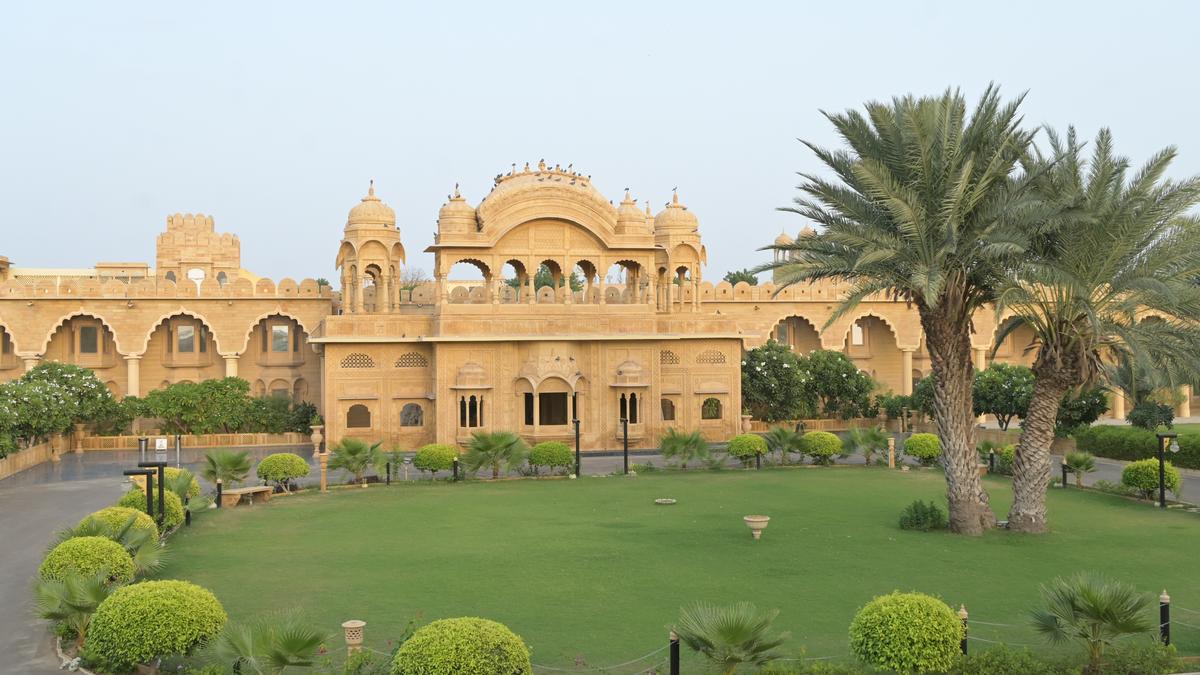
Retreat like the royals at Fort Rajwada in Jaisalmer
The Hindu
Amidst the Jaisalmer desert, Fort Rajwada exudes opulence, highlighting local craft and artisans with indigenous sandstone walls and hand painted ceilings
Jaisalmer is arid and parched. Desert brush dot the sands that seem to stretch endlessly. In the city, the barrenness is equally pronounced, which makes the first glance of Fort Rajwada even more impressive.
The gates loom large and majestic and the driveway curves past green lawns to stop at ornate double doors, intricately carved in sterling silver. Once you step through them you travel back in time to the land of maharajas, flying carpets and caparisoned elephants.
Except, this fort has only been around for two decades.
Vinay Khosla, managing director, Fort Rajwada, explains, “This is a built fort, one among the few hotels of this size constructed in 1999, with an intent to replicate the historic forts of the region.” He adds that it changed hands in 2017, and once it came into their possession, they began upgrading it as a hotel.
First, there is the traditional welcome, complete with aarti, tikka and a garland of marigolds. Next, a warm towel materialises on a salver and honestly, it is a little hard to pay attention to these ministrations when the foyer is so captivating.
Every visible surface exudes opulence — chandeliers, lush carpets, elaborate wallpaper, plush upholstery and carved stone pillars. The inner doors, again sterling silver, open out into a courtyard walled off with turrets at each corner. A huge marble fountain is flanked by walkways and nooks to the different wings of the fort that house the rooms.
Each wing sports a different motif (rosette, geometric, and the like), which is mirrored throughout — from the accents on the room’s furniture to the smaller fountain in the centre of that wing. The attention to detail is astounding. Four poster beds, wood and rattan panelling, burnished brass fittings and cut glass lights, add to the continued feeling of stateliness.


AI tool for sparrow conservation

BTS’s comeback with ‘Arirang’ marks a major global music event. When does the album release, and where can you watch their concert live stream? We have all the details

The 2026 U.S. cholesterol guidelines urge starting screening and treatment at 30 to prevent cardiovascular disease effectively.

Olam Festival 2026 in Thiruvananthapuram returns March 27-29 with 120+ vendors, music, art, and cultural zones.

A few storytellers in Thiruvananthapuram share their journeys, challenges, and evolving methods on World Storytelling Day, inspiring young minds.

76-year-old Kurian Jacob from Kerala triumphs with seven medals, including five golds, at the Open Masters Games in Abu Dhabi.

Explore the nature of the human mind as an emergent property of brain activity and complex neural interactions.

CERN's Large Hadron Collider discovers the Xi-cc-plus particle, enhancing understanding of quantum mechanics and baryon behavior.

Vibha Batra’s latest book, Spotless (Hachette India) is a novel in verse for young adults

In its first edition, the Madras Art Salon spotlights the works of journalist and artist Narayan Lakshman at The Botanical Club, a social space in the British Deputy High Commission, Chennai

Cholesterol enhances melanoma cell invasion by making nuclei squishier, revealing a potential treatment target in cancer progression.

The designers reinterpret the Swedish artist’s symbolic forms and colour energy through contemporary resortwear silhouettes

Discover the inspiring legacy of Bibha Chowdhuri, a pioneering woman in physics and a trailblazer in STEM history.