Retail inflation likely eased further in May
The Hindu
India’s consumer inflation could moderate further from April’s 18-month low of 4.7%, with food price rise likely to have cooled further in May even as prices of some items like milk, rise and pulses moved up on a month-on-month basis, economists reckoned.
India’s consumer inflation could moderate further from April’s 18-month low of 4.7%, with food price rise likely to have cooled further in May even as prices of some items like milk, rice and pulses moved up on a month-on-month basis, economists reckoned.
The National Statistical Office will release the Consumer Price Index (CPI) for May next Monday. Rice and Wheat prices increased 10% and 8% in May, compared with a year ago, as per a Crisil Market Intelligence report estimating costs of food plates (Thalis) which found expenses on both vegetarian and non-vegetarian Thalis increased sequentially for the first time in seven months.
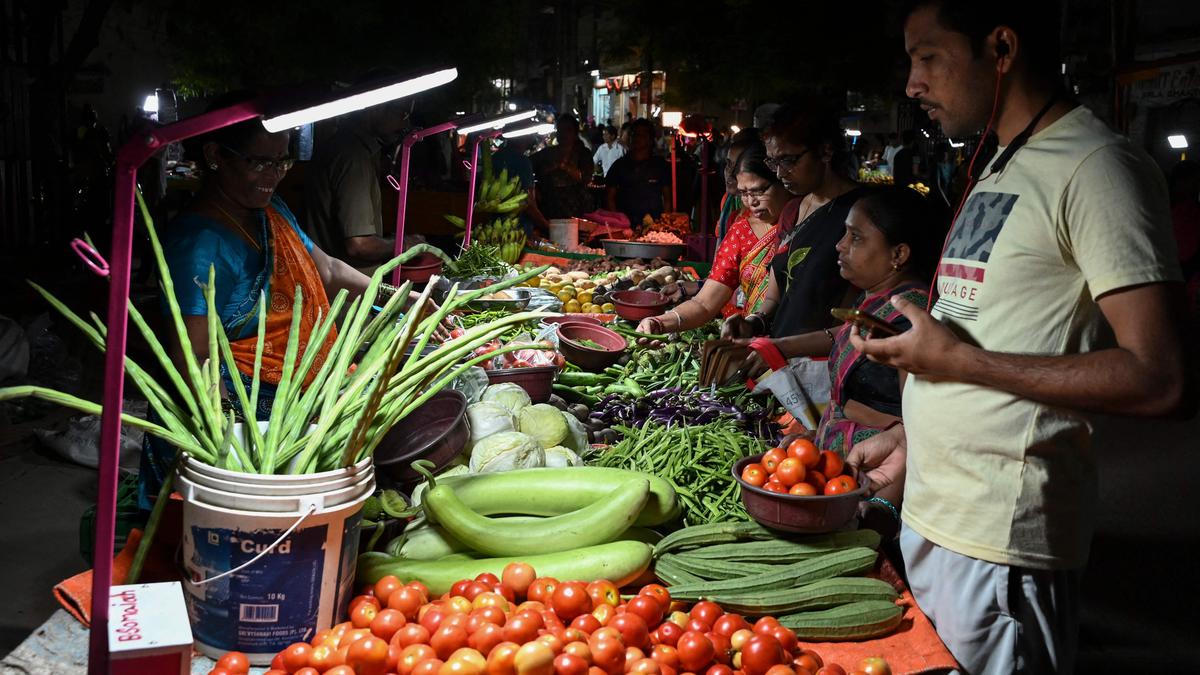
“The cost of veg and non-veg thalis declined 9% and 4% on-year, respectively, in May due to steep decline in prices of vegetables and cooking oil, which account for ~25% of the total cost of a veg thali, but increase in prices of cereals, pulses, chicken, and eggs capped the reduction,” the report said.
The Bank of Baroda Essential Commodity Index, which covers 23% of the CPI and 58% of the Consumer Food Price Index, slowed to 1.4% in May from 2.8% in April.
“We expect CPI to further edge down to 4.5% in May from 4.7% in April. Even the moderation in commodity, especially oil and gold prices, along with the 7% favourable base [the retail inflation rate in May 2022] supports our view,” the bank’s economist Dipanwita Mazumdar said in a note.
However, on a sequential basis, the index inched up to 0.4% in May compared to a 0.2% decline in the month before.
“Milk is still stubbornly high at 10.9% amidst reports of difficulty in procuring feed and also lumpy skin disease in cattle. Even sugar prices are inching up, with output declines reported in States such as Maharashtra and Karnataka. Even pulses could pose another round of spiral as Tur, Urad and Moong are noticing an upsurge,” she cautioned.


Four banks, Bank of Baroda, RBL Bank, Yes Bank, and State Bank of India, challenge RBI's decision to disclose NPAs and defaulters' list under RTI, citing potential harm to commercial interests.

Adani Group plans a ₹1.5 lakh crore investment in Kutch, focusing on renewable energy, ports, and logistics over five years.

Mukesh Ambani announces ₹7 lakh crore investment in Gujarat, emphasizing clean energy, AI, and support for Olympic ambitions.

India mandates selfies and 'penny drop' for crypto KYC, discouraging ICOs and ensuring strict anti-money laundering measures.

Mukesh Ambani announces ₹7 lakh crore investment in Gujarat, emphasizing clean energy, AI, and support for Olympic ambitions.

The All India Cashew Association calls for urgent action against illegal cashew imports threatening India's domestic processing industry.

Moody’s upgrades Shriram Finance’s outlook to positive, citing strategic benefits from MUFG Bank's upcoming investment and improved financial stability.

India's rice exports soar to near record levels in 2025, driven by lifted curbs and increased global demand.

Dr. Reddy's responds to U.S. FDA queries regarding its Hyderabad biologics facility following a recent inspection.

Techno Paints plans a ₹500 crore IPO in FY27, featuring Sachin Tendulkar as brand ambassador to boost growth.

India's shift from Russian oil imports will have limited fiscal impact due to low global prices and reduced discounts.

The latest Household Consumption Expenditure Survey (HCES) by MoS&PI reveals a transformative shift in India’s economic landscape. For the first time in over a decade, granular data on Monthly Per Capita Expenditure (MPCE) highlights a significant decline in the proportional share of food spending—a classic validation of Engel’s Law as real incomes rise. Between 1999 and 2024, both rural and urban consumption pivoted away from staple-heavy diets toward protein-rich foods, health, education, and conveyance. As Indian households move beyond subsistence, these shifting Indian household spending patterns offer vital insights for social sector policy, poverty estimation, and the lived realities of an expanding middle-income population.

Investors shifted to Gold ETFs in December 2025, with record inflows amid macro uncertainty and declining equity returns.