Researchers devise method to develop eco-friendly supercapacitors using activated carbon produced from coconut husks
The Hindu
Researchers devise method to develop eco-friendly supercapacitors using activated carbon produced from coconut husks
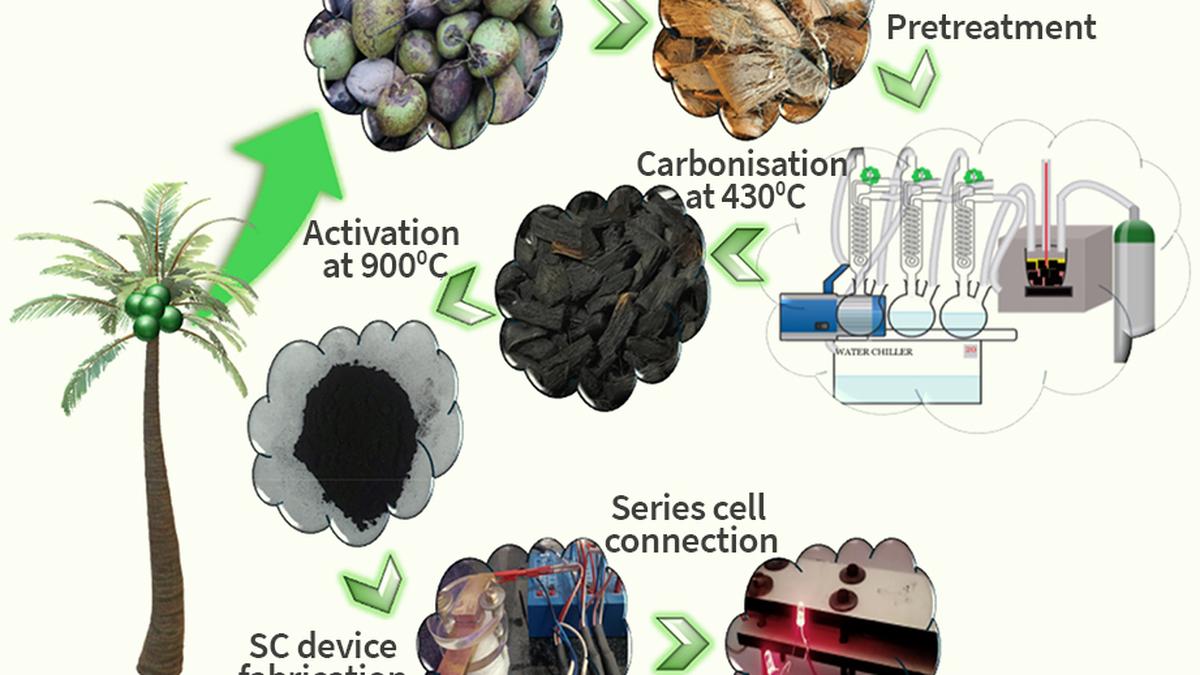
The researchers of the Government College for Women, Thiruvananthapuram, have devised a method to produce activated carbon, suitable for supercapacitor fabrication, from coconut husks, a major agricultural residue in Kerala.
The coconut husk biowaste-derived activated carbon holds immense promise for sustainable and efficient green solutions for high-performance supercapacitors due to its availability, low cost, and eco-friendly nature.
Supercapacitors, with significantly higher capacitance and energy storage capacity than conventional capacitors, have emerged as a vital component in the quest for sustainable energy storage solutions. But, the search for an ideal supercapacitor electrode material has been a significant challenge.
The research team, led by Xavier T.S., Assistant Professor, Department of Physics and including Merin Tomy, Ganesh S.G., Anu M.A., and Sreelakshmi S.R., found the prototype supercapacitors made of coconut husk-derived activated carbon to be four-times more efficient that the existing supercapacitors.
The findings have been published in American Chemical Society’s peer-reviewed Sustainable Resource Management Journal.
The team had leveraged the innovative microwave-assisted method designed at the Centralised Common Instrumentation Facility (CCIF) at the college.
According to Dr. Xavier, activated carbon produced in this manner, utilising microwave technology, is relatively inexpensive and exhibits exceptional supercapacitor capability. The innovative microwave-assisted method has also opened new avenues for the production of activated carbon, which is under consideration for an Indian patent.


Air Force employee arrested for espionage, allegedly sharing sensitive information with Pakistani handlers since 2023 for money.

Four killed and several injured in a Bengaluru–Mysuru Expressway crash; driver arrested for alleged negligence.

Four injured in SUV collision with a stranded goods carrier on Narsingi ORR, causing significant traffic congestion.

Parliament Budget Session LIVE: Follow The Hindu's latest updates on the Parliament Budget Session on March 23, 2026.

T. Nagar faces severe infrastructure challenges amid commercial growth, impacting emergency services and resident quality of life.

Five individuals detained after a man's death due to a lift malfunction at R.G. Kar Hospital in Kolkata.

In 2014, Amazon introduced its first smartphone, hoping to take on Apple and Samsung. Instead, the Fire Phone, overseen directly by founder Jeff Bezos, was scrapped in barely over a year, one of Amazon’s highest-profile flops.

A data jam on March 28 by OpenCity will have participants studying how the Assembly constituencies in and around Chennai are faring on a set of parameters

IUML files police complaint over a fake Facebook post targeting its leader, warning against misinformation and potential legal action.

Experience global flavors at Vizag's 'World Flavours' food festival, celebrating cultural unity through authentic international cuisines.

Three men were killed in a road mishap after their mini truck crashed into a stationary truck near Medahalli in east Bengaluru on Saturday night, police said.

Kerala's critical sectors face LPG shortages despite a 20% relief allocation, impacting restaurants and hotels significantly.

Explore the Sattankulam custodial torture deaths of P. Jayaraj and his son J. Benicks, revealing a shocking tale of police brutality.