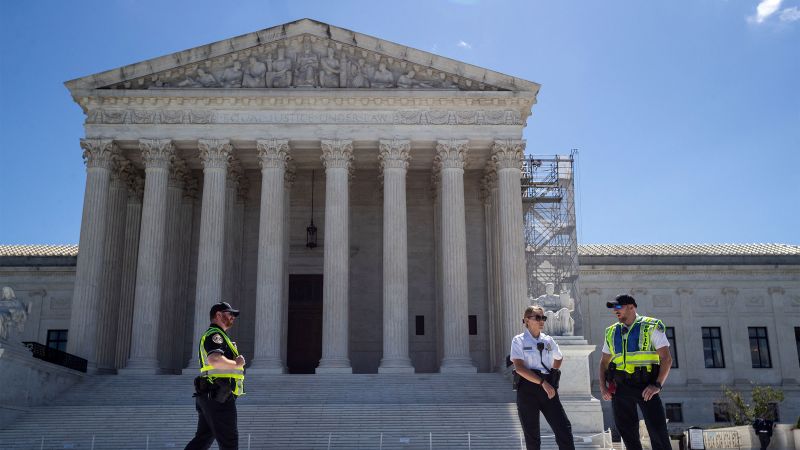
Republicans appeal Pennsylvania’s ‘naked ballot’ voting ruling to Supreme Court
CNN
Republicans asked the US Supreme Court on Monday to step into a fight over provisional ballots in the presidential battleground state of Pennsylvania, bringing a second potentially significant voting case to the high court within days of the election.
Republicans asked the US Supreme Court on Monday to step into a fight over provisional ballots in the presidential battleground state of Pennsylvania, bringing a second potentially significant voting case to the high court within days of the election. The Republican National Committee urged the justices to block a state court ruling that allows people to vote provisionally when election officials identify problems with their mail ballots – specifically, when they fail to put them into a “secrecy” envelope before sending them off in the mail. Those ballots, because they are missing the secrecy sleeve, are referred to as “naked ballots.” “This case is of paramount public importance, potentially affecting tens of thousands of votes in a state which many anticipate could be decisive in control of the U.S. Senate or even the 2024 presidential election,” the GOP said in its appeal. The case arrived hours after Virginia asked the Supreme Court to allow the state to continue a program to remove suspected noncitizens from the voter rolls. Both cases are likely to be handled with remarkable speed – by Supreme Court standards – and could yield orders within days. The RNC asked the Supreme Court to decide the Pennsylvania case by Friday.


The Department of Homeland Security is doubling down on the administration’s ongoing investigations into potential voter fraud — reviewing cases involving US citizens and whether they registered to vote, or voted, prior to being naturalized, according to an internal memo reviewed by CNN.

After six skiers were rescued from the “horrific” aftermath of an avalanche near California’s Lake Tahoe, the family members of nine remaining skiers received crushing news. The bodies of eight had been left on the icy mountainside, and a final member of the group was still missing, presumed dead among the blanket of snow.

The Department of Veterans Affairs is halting enforcement of a new rule for determining disability payments after veterans across the US expressed outrage for what they said would likely reduce benefits for many.

A large banner of Donald Trump was hung outside of the Justice Department headquarters in Washington, DC, Thursday, emphasizing the White House’s control over the nation’s top law enforcement branch that once pursued criminal prosecutions against the president.

A federal judge in Minnesota held a Trump administration attorney in civil contempt for “flagrant disobedience of court orders” in the case of a noncitizen swept up in the immigration crackdown there earlier this year.

A controversial pastor who supports repealing women’s right to vote and believes homosexuality should be a crime led a worship service at the Pentagon this week, saying he was invited by Defense Secretary Pete Hegseth.

The Commission of Fine Arts fast-tracked approval for President Trump’s East Wing renovation plans Thursday, bringing the president’s quest for his new ballroom one step closer to reality.

As the Trump administration continues its immigration crackdown in cities across the US, health care providers warn the impact of federal agents in health care settings – and the looming threat of immigration enforcement they’ve instilled nationwide – is presenting a barrier to care that could have a lasting impact on the health of communities.

CNN’s 5 Things AM brings you the news you need to know every morning.

Oklahoma Gov. Kevin Stitt arrived in Washington this week with invitations to two White House meetings and an angry President Donald Trump.

The Department of Homeland Security is broadening federal immigration authorities’ ability to detain legal refugees who have not yet obtained green cards, citing national security concerns and the need to ensure refugees undergo additional screening, according to a DHS memo obtained by CNN.

President Donald Trump is preparing to make health care a central focus of his midterm sales pitch, despite weak polling and misgivings among some of his own advisers.

The Commission of Fine Arts, an independent federal agency that advises the president and Congress on design plans for monuments, memorials, coins and federal buildings, is usually made up of experts in architecture, art and urban and landscape design.